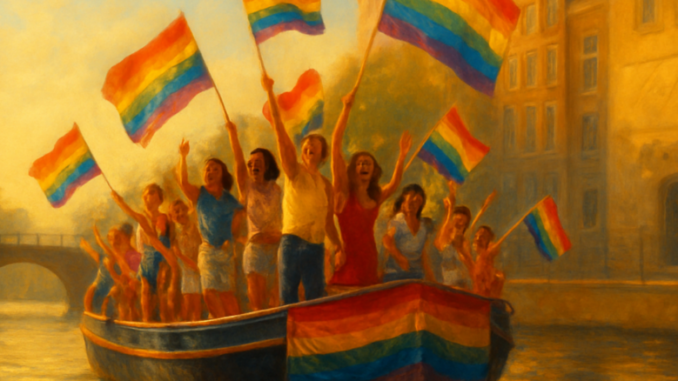
Perhaps you’ve already seen the call: if you’re heading to the Canal Parade and you’re between 16 and 30, you can join in — sail along, become part of something larger than yourself. It sounds like a festive invitation, and it is. But beneath the surface lies something far deeper: the power of brotherhood. That feeling of belonging, of doing something meaningful alongside others, even if you barely know each other. That principle is older than the canals of Amsterdam themselves.
The Call for Connection
There is something remarkable about an invitation that speaks directly to a specific group of people. It says: we see you, we want you here, your presence matters. In an era when so many young people struggle with loneliness and a nagging sense of not belonging, such an invitation is more than a practical matter. It is an outstretched hand.
Freemasons have understood this principle for centuries. The lodge has always been a place where men from vastly different backgrounds come together — not despite their differences, but precisely because that diversity enriches. The Canal Parade operates in a strikingly similar way. People who would never cross paths in everyday life suddenly find themselves standing side by side on a boat. They share music, they share laughter, they share the experience of being seen. This is not superficial entertainment. It is ritual in the broadest sense of the word: a collective act that imbues the moment with meaning.
What Brotherhood Really Means
Brotherhood is a word that can sound dusty, as if it belongs in old books or on yellowed documents. But its essence is timeless. It is about mutual respect, about the willingness to support one another, about the recognition that we are stronger together. Aristotle wrote about philia — the deep friendship that emerges when people strive together toward the good. He considered this the highest form of human connection, more important than utility or pleasure alone.
Brotherhood is not born of blood ties. It is forged through shared experience and the conscious choice to stand by one another.
In Freemasonry, this principle is ritually affirmed. Brothers address each other as such not out of habit, but as a reminder of a promise: we are equals, and we treat each other with dignity. That promise demands nothing supernatural. It simply asks that you recognize the other person as a fellow human being, of equal worth to yourself.
Sailing Together as Shared Ritual
Imagine stepping onto a boat full of strangers. You’re nervous, perhaps a little awkward. But then the music begins, the boat starts to move, and thousands of people along the canal banks are waving and cheering. Suddenly, you are part of something. You are no longer just an individual who happens to be standing on that boat. You are part of a collective experience, a shared statement.
This is exactly what rituals do. They elevate the ordinary to a higher plane. They create a space where the everyday becomes extraordinary. The philosopher Montaigne understood this well. He wrote about how rituals and customs help us find meaning in a world that often feels chaotic. Sailing through the canals of Amsterdam on that day becomes more than transport. It becomes an act of visibility, of pride, of togetherness.
Why Visibility Matters
It takes courage to be visible. To stand up and say: this is who I am, this is what I stand for. The Canal Parade offers that possibility to people who may struggle in daily life to show their true selves. For young people between 16 and 30, it can be a turning point — the moment you discover that you are not alone.
Freemasons traditionally work in relative privacy, yet they too understand the importance of visibility. Wearing certain symbols, speaking openly about values such as tolerance and love for humanity — these are ways of showing what you stand for. Not to boast, but to build bridges. To let others know they are welcome.
An Invitation That Extends Beyond One Day
The call to join the Canal Parade is aimed at young people, but its underlying message applies to everyone. Join in. Be part of something greater. Discover what happens when you do something meaningful alongside others. This is not an exclusive message for one community or one event. It is a universal invitation that returns in many forms throughout life.
Brotherhood demands presence — physical, mental, and emotional. Shared experiences forge stronger bonds than words alone. Visibility is an act of courage and connection. And rituals give meaning to moments that would otherwise slip by unnoticed.
Whether you sail in the Canal Parade, visit a Masonic lodge for the first time, or simply decide to say yes more often when life extends an invitation — the core remains the same. Connection is created through action, through showing up, through opening yourself to others.
The Canal Parade is a celebration, but it is also a reminder. A reminder that brotherhood is not an abstract concept — it is something you can feel when you stand shoulder to shoulder with others. Maybe this year you’ll sail along. Maybe you’ll stand on the canal bank and wave. Either way, let the moment remind you of the power of togetherness. Because in the end, we are all on a journey, and that journey becomes infinitely richer when we share it.
Copyright text & image: devrijmetselaar.nl
Texts are based on the ideas and content of the author of devrijmetselaar.nl, reviewed, corrected, and supplemented with the assistance of OpenAI. Images are created based on the ideas of the author of devrijmetselaar.nl using OpenAI/DALL-E.
Frequently Asked Questions
What is the age requirement to participate in the Canal Parade with Freemasons?
The Canal Parade welcomes participants between 16 and 30 years old. This age range creates an inclusive community where young people can experience the power of brotherhood and belonging through shared ritual and collective experience.
Do I need to be a Freemason to join the Canal Parade?
No, you don't need to be a Freemason to participate in the Canal Parade. The event is an open invitation to young people who want to experience the meaningful connection and sense of community that comes from sailing together with others from diverse backgrounds.
What does 'brotherhood' mean in the context of Freemasonry?
In Freemasonry, brotherhood is about mutual respect, equality, and the willingness to support one another. It's forged through shared experience and the recognition that we are stronger together, rather than through blood ties—it's a conscious choice to stand by each other and treat all people with dignity.
How does the Canal Parade reflect Masonic values?
The Canal Parade embodies Masonic principles by bringing together people from vastly different backgrounds to share a meaningful collective experience. Like Freemasonry itself, it creates a ritual space where strangers become part of something larger, united by the values of connection, belonging, and mutual recognition of human worth.
Why does Freemasonry emphasize ritual and shared experiences?
Rituals and shared experiences elevate the ordinary to something extraordinary, creating spaces where people feel truly seen and valued. Freemasonry uses these collective acts to affirm important principles like equality and brotherhood, helping members understand that they are part of a larger community bound by mutual respect and common purpose.

Be the first to comment