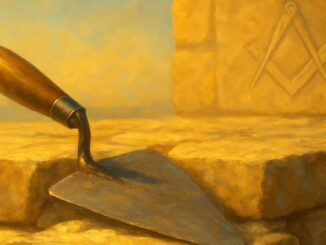
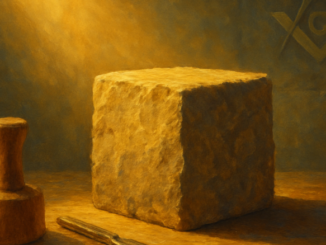
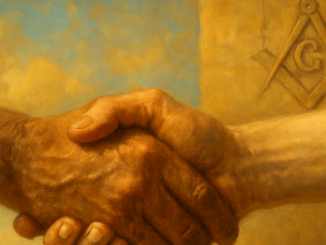
Masonic trowel symbolizing connection and the philosophy of building
Philosophy & Ethics

The Trowel: Masonic Philosophy of Building Yourself

You may have come across the name “Lodge The Trowel” — one of the well-known Masonic lodges in the Netherlands. But what does that name actually mean? And more importantly, what can you learn from the philosophy behind this symbol, whether you’re a Freemason or not? The trowel is far more than a builder’s tool. It’s an invitation to work daily on connection — with yourself, with others, and with the world around you. Why Name a Lodge After the Trowel? The name of a Masonic lodge is never chosen at random. Every lodge carries a name that points to an ideal, a symbol, or an aspiration. A lodge named after the trowel refers to the tool that masons use to spread mortar between stones. Without the trowel, a wall is nothing more than a loose pile of bricks. With the trowel, those individual pieces become a unified structure — one that endures. In Freemasonry, the trowel symbolizes the act of binding people together. Where the hammer and chisel shape and refine individual stones, the trowel is what creates cohesion. It is the tool of community, of brotherhood, of smoothing out the rough edges between people. A lodge that bears […]
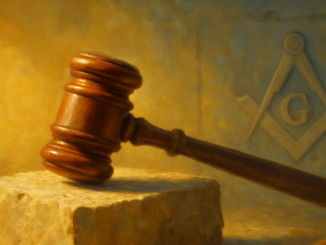
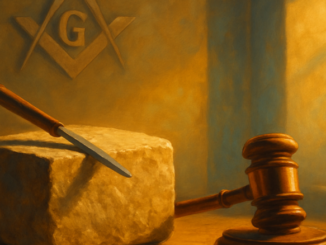
Masonic gavel resting on a rough ashlar stone symbolizing justice and growth
Philosophy & Ethics

The Judge’s Gavel: Justice as an Inner Building Stone

A courtroom delivers its verdict. Twenty years in prison for an act of irreversible violence. The gavel strikes wood, and in that single blow, something resonates far beyond legal statutes and procedural formality. What does justice truly mean when we look beyond the courtroom walls? In Freemasonry, the gavel is one of the most powerful working tools — not wielded to condemn, but to shape. A recent high-profile sentencing invites us to reflect on the deeper layers of guilt, restoration, and the moral responsibility every human being carries within. The Gavel: An Instrument of Judgment and Formation In the courtroom, the judge wields a gavel to affirm a ruling. It marks a moment of finality — a decisive conclusion. But look a little longer at this gesture, and you’ll discover that the same instrument carries an entirely different meaning in other contexts. The stonemason uses his mallet to work rough stone, slowly and deliberately shaping something that is not yet finished. In the Masonic tradition, this gavel symbolizes the willpower with which we shape ourselves, chipping away at the imperfections of our character — not through force, but through patience and self-awareness. A twenty-year prison sentence for a violent crime […]

Stone foundation being built symbolizing Masonic inner kingdom building
Christianity

Second Samuel: Building an Inner Kingdom Stone by Stone

Imagine that after years of preparation, you finally receive the responsibility you’ve been working toward. A new leadership role, your own business, or perhaps parenthood. The question that arises isn’t just how you’ll fill that role — it’s who you want to be within it. Second Samuel, the tenth book of the Old Testament, tells exactly this kind of story. It chronicles the establishment of a kingdom, but its symbolism reaches far beyond political power. Read through the lens of Freemasonry, and it unfolds as a guide for building an inner kingdom — stone by stone. The Heart of Second Samuel: From Warrior to Builder Second Samuel covers the reign of King David, from his anointing to the later years of his rule. Where the first book centered on the struggle for recognition, this sequel explores what happens after that recognition has been won. David conquers the city that would become his capital. He brings the Ark of the Covenant to its resting place and receives a promise that will endure across generations. But the book also reveals his deeply human weaknesses: moral failings, family conflicts, and the anguish of loss. For the Freemason, this narrative follows a familiar pattern. […]

A plumb line hanging against rough stone symbolizing Masonic integrity
Christianity

Amos and the Voice of Justice: A Prophet for Builders

You probably know the feeling: you see something going wrong around you, but you hesitate to speak up. Who are you to raise your voice? You’re no expert, no leader, no authority. And yet, something keeps gnawing at you. That very tension lies at the heart of the Book of Amos — a text written over 2,700 years ago that still resonates with anyone who wrestles with the question: when should I speak, and when should I remain silent? A Herdsman Becomes a Prophet Amos was no priest, no scholar, and no man of rank. He describes himself as a herdsman and a dresser of sycamore figs from the small village of Tekoa. He had no formal training in sacred scripture and held no position in the temple. Yet he traveled to the northern kingdom of Israel to speak words that have echoed through the centuries. His message was uncomfortable: he called out those in power for their injustice, their greed, and their neglect of the most vulnerable members of society. Why should this matter to you? Perhaps you recognize that familiar hesitation — the reluctance to speak up when you see something that isn’t right. The nagging doubt about […]

Gavel and chisel on a rough ashlar stone symbolizing Masonic self-work
Freemasonry & Society

Intent and Responsibility: Lessons From the Law for Freemasons

A new law is making headlines: it criminalizes the glorification of terrorism, but only when there is proof of intent. That single word — intent — touches on something profound. What does it truly mean to act consciously? And why does the distinction between deliberate choice and careless behavior matter so deeply, both in a courtroom and in the quiet reckonings of your own conscience? The Weight of a Single Word In legal language, intent sounds dry and technical. But behind that term lies an entire view of what it means to be human. The law assumes you are only truly responsible for something when you did it consciously — when you knew what you were doing and chose to continue anyway. That is no minor principle. It says we should not condemn people for unintended consequences. It demands that we distinguish between a misstep and a deliberate choice. This nuance is not only relevant in courtrooms. It touches on how you see yourself when you look in the mirror. How much of what you do is truly conscious? And how much simply happens — out of habit, conformity, or inattention? Consciousness as the Art of Living Within Freemasonry, this […]

Open book with Montaigne Essays symbolizing vigilance and Masonic reflection
Content & Summary

Montaigne on the Dangerous Hours of Negotiation

In the sixth essay of the first book of his Essays, Michel de Montaigne issues a warning that remains strikingly relevant today: it is precisely when parties appear to be reaching agreement that danger can be at its greatest. This short but powerful essay examines the human tendency to let our guard down the moment peace seems within reach. Centuries later, the question remains — what can we still learn from this penetrating observation, and how does it speak to those who pursue not only worldly wisdom but also inner development? The Core Idea of the Essay Montaigne opens with a clear thesis: the moments when enemies enter into negotiation are often the most dangerous of the entire conflict. His reasoning is as simple as it is unsettling. As soon as people believe that peace is near, their attention slackens. Weapons are set aside, guards are reduced, and trust increases. It is in precisely this vulnerable state that an adversary may strike. It is not open warfare that poses the greatest threat, but rather the twilight zone where hope and danger converge. This insight extends far beyond the battlefield. Montaigne describes a universal human pattern: we tend to abandon our […]

Freemason contemplating shadow and light in a lodge setting
Personal Development & Leadership

The Shadow Side of Leadership: Lessons from Freemasonry

We love talking about the bright side of leadership — inspiring others, building connections, setting a vision. But what if the greatest challenge a leader faces isn’t out there in the world, but lurking in the darker corners of their own personality? Inside the lodge, Freemasons learn something deeply uncomfortable: before you can lead others, you must first confront your own shadow. A Conversation Nobody Wants to Have Picture this: a seasoned Freemason and a newly initiated Brother sit across from each other in a quiet room of the lodge building. Candlelight throws long shadows across the walls. The younger man asks, “How do I become a better leader?” The elder Brother smiles and responds with a question of his own: “Tell me first about your greatest failures. Not your successes — you already know those. Tell me where your ego got in the way.” This isn’t a hypothetical scenario. Conversations like these have been taking place in lodges around the world for centuries. While the mainstream discussion around leadership tends to focus on skills, strategies, and charisma, Freemasonry poses a fundamentally different question: what kind of person are you really, and do you have the courage to face that […]

Vrijmetselarij - De Eerste Graad Vrijmetselarij (Leerling) – Jouw Avontuur Begint
Spiritual Traditions

The First Degree in Freemasonry: Your Journey Begins Here

The First Degree in Freemasonry — known as the Entered Apprentice — is far more than a simple membership ceremony. It marks the beginning of a deeply personal and symbolic journey, one that has the power to fundamentally change how you see the world and your place within it. In this initial stage, you don’t just learn about Freemasonry — you begin to discover yourself. The First Degree lays the foundation upon which everything that follows is built. It is your starting point, your call to awareness, and the first step in a profound transformation. The Entered Apprentice: A Gateway to Deeper Understanding Freemasonry is built upon three foundational degrees: the Entered Apprentice, the Fellowcraft, and the Master Mason. The First Degree is the most crucial beginning. As an Entered Apprentice, you learn what it truly means to live consciously — to ask questions rather than chase answers, and to examine your own behavior with honesty and humility. From the moment of your initiation, you gain access to a rich world of symbolism, ritual, and reflection. But none of this is passive or theoretical. It is an active invitation to work on your own rough ashlar — to shape yourself […]

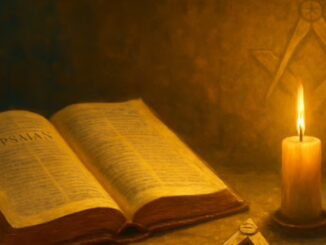
Open book of Psalms with Masonic square and compasses symbolizing wisdom
Christianity

Psalms and Masonic Symbolism: Practical Wisdom for Daily Life

We all know those moments — a chaotic day spiraling out of control, a difficult decision that refuses to resolve itself, or a stretch of uncertainty that just won’t lift. The Psalms, a collection of 150 songs from the Old Testament, offer surprisingly practical guidance for exactly these situations. In Freemasonry, these ancient texts serve as a rich source of symbolism that can help you take concrete steps in your personal development. This article explores how to translate the imagery of the Psalms into everyday application. The Psalms as a Toolbox for Life Written over the course of centuries, the Psalms contain songs for every human experience: joy, sorrow, fear, gratitude, and wonder. For Freemasons, this is especially relevant because the Volume of the Sacred Law holds a central place in the lodge. The Psalms are often found open upon it as a symbol of wisdom and direction. But how do you translate ancient poetry into something meaningful for your life today? The answer lies in recognizing universal patterns. When a psalmist sings of walking through a dark valley, you may recognize your own season of uncertainty. When the text speaks of building a house upon a rock, you can […]

Symbolic representation of a man of good repute in Freemasonry
Philosophy & Ethics

Man of Good Repute: What It Means in Freemasonry

In Freemasonry, the concept of being a “man of good repute” comes up frequently. It is one of the core values of the fraternity and often raises questions among those considering membership. What does it truly mean to be a man of good repute? And why does Freemasonry place such importance on this principle? A Moral Foundation A man of good repute is someone who lives with integrity and genuine respect for others. This does not mean you need to be perfect or that you can never make mistakes. Rather, it speaks to a moral foundation — honesty, reliability, and a sincere commitment to self-improvement. Freemasonry is a brotherhood in which members work together toward personal growth and the betterment of society. To achieve this, mutual trust is essential. A man of good repute is someone the brethren can rely on, someone they can place their confidence in, and someone who takes the values of Freemasonry seriously. Not About Status or Power It is important to understand that being a man of good repute has nothing to do with social status, wealth, or influence. It is entirely about character. Whether you are a carpenter, a lawyer, or an artist, what […]