
Compliance is often mistaken for weakness. Those who yield, so the prejudice goes, must lack backbone. But is that really the case? Within the spiritual tradition of Freemasonry, compliance takes on an entirely different meaning — not as spineless conformity, but as a deliberate choice to place harmony above ego. This article explores that fascinating virtue, peeling back its deeper layers to reveal why bending can sometimes be the wisest thing a person can do.
What Do We Really Mean by Compliance?
Let’s start at the beginning. Compliance — or as the French so elegantly express it, the art of being accommodating — literally means being willing to make room for the other. It is the ability to temporarily set aside your own wishes or viewpoints for the benefit of the greater whole.
But this immediately raises a question: where is the line between healthy compliance and unhealthy self-denial? This is precisely the tension that spiritual traditions, including Freemasonry, have grappled with for centuries. Marcus Aurelius wrote in his Meditations that the wise person adapts to circumstances the way water adapts to the shape of its vessel — without losing its essence. That is the key: adapting without losing yourself.
Does Compliance Have a Place in the Lodge?
Absolutely — and that place is more fundamental than you might expect. In Freemasonry, brethren work together on what is symbolically called the building of the Temple of Humanity. Imagine it: dozens of different characters, backgrounds, and convictions all collaborating on a single shared structure. Without some measure of compliance, this project would collapse before the first stone was laid.
The ritual itself teaches this lesson continuously. Every brother has his place, his task, his moment to speak and his moment to remain silent. This is not suppression of individuality but an exercise in recognizing the larger pattern. Johann Wolfgang von Goethe, himself an active Freemason, understood this deeply. He regarded the lodge as a training ground for the soul — a place where one learns to connect the personal with the collective.
True compliance is not weakness, but the spiritual strength to choose harmony over being right.
But Don’t You Lose Yourself by Always Giving In?
This is the crucial question, and the answer demands nuance. There is a fundamental difference between compliance that springs from wisdom and compliance that springs from fear. The first is a conscious choice, made from a position of inner strength. The second is an escape, driven by the desire for approval or the dread of conflict.
Plato already distinguished in his dialogues between the person who bows because he perceives the greater good and the person who bows because he fears confrontation. The first acts from virtue; the second from deficiency. In Freemasonry, this distinction is practiced constantly. The ritual asks for surrender to a greater whole, but never for the abandonment of your inner compass. On the contrary: the development of that compass lies at the very heart of the spiritual journey from Entered Apprentice to Fellow Craft to Master Mason.
How to Tell Wise Compliance from Spineless Conformity
There are several touchstones you can apply. Wise compliance feels internally like a gift you consciously give. Spineless conformity feels like something being taken from you. Wise compliance strengthens the relationship and the shared purpose. Spineless conformity breeds resentment and exhaustion.
With wise compliance, you maintain inner peace even as you outwardly yield. You can clearly articulate why you made this choice. It serves a purpose larger than your own comfort. And you would make the same choice again if you could turn back time.
Aristotle called this finding the mean between two extremes. Too much flexibility makes you characterless; too little makes you rigid and intolerable. The virtue lies in finding the right measure, calibrated to the situation at hand. This requires practice, self-reflection, and unflinching honesty with yourself.
The Mirror of Masonic Ritual
In Freemasonry, the ritual functions as a mirror for this learning process. Every action, every word, every silence in the lodge invites reflection: Where am I holding firm out of wisdom, and where out of stubbornness? Where am I yielding out of love for the whole, and where out of fear of rejection? These questions are never asked aloud, but they resonate within the symbolic actions that generations of Freemasons before us have also performed.
The Deeper Spiritual Lesson
Perhaps the deepest lesson is that compliance is a form of love. Not romantic love, but the brotherly love that recognizes the other as equal and valuable. It is the willingness to pause your own story in order to truly listen to someone else’s. This is not a loss of self — it is an enrichment.
Spinoza wrote that whoever is guided by reason strives as much as possible toward harmony with others. Compliance, understood as a spiritual exercise, is precisely that: a conscious striving toward concord — not by losing yourself, but by placing yourself in connection with the larger fabric of human relationships.
On closer examination, compliance turns out to be no sign of weakness at all, but a refined spiritual skill. It requires the ability to distinguish between bending out of wisdom and bending out of fear. In Freemasonry, this art is practiced daily — in the ritual, in brotherly fellowship, in the shared labor of building something greater than the individual. Those who take this lesson to heart discover that true strength does not lie in rigidity, but in the capacity to consciously make room for the other without ever losing themselves in the process.
Copyright text & image: devrijmetselaar.nl
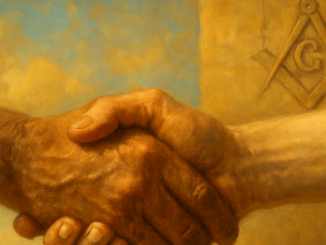
Texts are based on the ideas and content of the author of devrijmetselaar.nl, reviewed, corrected, and supplemented with the assistance of OpenAI. Images are created based on the ideas of the author of devrijmetselaar.nl using OpenAI/DALL-E.
Frequently Asked Questions
Is compliance in Freemasonry the same as weakness or giving up your beliefs?
No. In Freemasonry, compliance is a conscious choice made from inner strength, not fear or weakness. True compliance means temporarily setting aside your ego for the greater good while maintaining your core values and inner compass, much like water adapts to its vessel without losing its essence.
How does compliance help Freemasons work together in the Lodge?
Compliance creates the harmony necessary for the Lodge to function as a unified community. Each brother has his own role and moment to contribute, and by respecting this structure and working together toward the common goal of building the Temple of Humanity, individual strengths are amplified rather than diminished.
Can I be an individual Freemason while also practicing compliance?
Absolutely. Freemasonry doesn't suppress individuality; instead, it teaches you to recognize how your personal gifts fit into a larger pattern. The Lodge serves as a training ground for the soul, where members learn to connect their personal strengths with the collective purpose without losing their identity.
What is the difference between healthy compliance and unhealthy self-denial in Freemasonry?
Healthy compliance springs from wisdom and is made from a position of inner strength—a deliberate choice for harmony. Unhealthy compliance comes from fear or the desire for approval. Freemasonry teaches brethren to distinguish between these two by asking for surrender to a greater whole while never asking for abandonment of your inner compass.



Be the first to comment