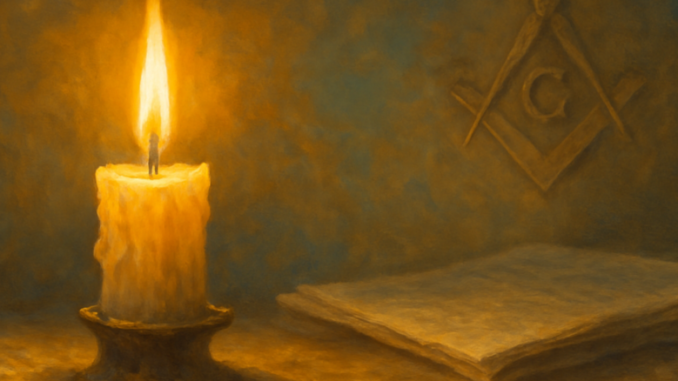
Morning sunlight streams through the tall windows of a lodge building in the north of the Netherlands. A group of Freemasons sit together in silence, their thoughts occupied by the day’s news: a deadly armed robbery at a German bank, a life brutally ended, a suspect apprehended. In the stillness, a question arises — one far older than any lodge: how do we relate to the darkness within humanity, and where do we find the light?
The Shadow in the Headlines
When violent news reaches us, most of us feel a mixture of horror, grief, and perhaps a certain distance. It happened there, not here. It happened to that person, not to me. Yet every encounter with human violence invites us into a deeper inquiry — not to pass judgment on the perpetrator or the victim, but to reflect on the human condition in which both light and darkness dwell.
This tension lies at the very heart of Freemasonry. The search for enlightenment does not begin by denying the shadow but by acknowledging it. The rough ashlar with which every Entered Apprentice begins his journey represents the unrefined human being — complete with flaws, impulses, and the potential for both good and evil. Spiritual growth is not an escape from reality; it is a conscious engagement with it.
The Deeper Question Behind the Incident
A bank robbery that ends in death inevitably raises uncomfortable questions. What drove someone to such a desperate act? What circumstances, inner conflicts, or absence of a moral compass led to this moment? It is tempting to fall into black-and-white thinking: the perpetrator is evil, the victim is innocent. But spirituality asks something different of us.
The Masonic tradition teaches us that every human being is a structure perpetually under construction. Some buildings show cracks from neglect; others have been damaged by external forces too powerful to withstand. This does not mean we excuse or condone violence. It means we try to understand — so that we can contribute to a world where fewer rough stones are left unworked.
Spirituality as a Response to Darkness
How does a spiritually oriented person respond to violence in the world? Not by turning away, not with cynicism, but with a deepened commitment to the good. In the lodge, we speak of spreading light in the darkness. This is not an abstract ideal — it is a daily practice. It begins with ourselves: with the honest question of whether we have contributed today to greater understanding, greater compassion, greater humanity.
The true builder works not only on his own temple but contributes to the temple of all humanity.
This ancient adage reminds us that spiritual growth is never a purely individual pursuit. Every act of violence is a crack in the structure of society. Every act of compassion, however small, is a stone set firmly in its place. The Freemason who hears the news of a bank robbery asks himself: what can I do today to embody the opposite?
The Ritual of Processing
In Freemasonry, ritual plays a central role in processing life’s experiences. Not as a magical formula, but as a structured space for reflection. When we are confronted with the incomprehensible, ritual offers a framework for ordering our thoughts and emotions. It creates a moment of stillness amid the noise and chaos of daily life.
This ritualized approach can also be applied outside the lodge. Taking a moment of silence when hearing tragic news. Lighting a candle. Going for a walk with conscious attention. These are not grand gestures, but they prevent us from growing numb or hardened in the face of the world’s suffering.
The Choice That Returns Every Day
Spirituality in Freemasonry is not a state you achieve and then maintain. It is a continuous choice, a commitment renewed each day. Every morning we wake with the possibility of spreading either light or darkness. Most of us will never be involved in violent crime. But the smaller choices matter just as much: the patience we summon, the kindness we show, the judgment we withhold.
Consider these guiding principles drawn from Masonic wisdom:
Awareness: Acknowledge the shadow within yourself without identifying with it.
Compassion: Approach even those who fail with humanity.
Action: Translate your inner growth into concrete deeds in the world.
Reflection: Take time to process what you see and hear.
The news of a bank robbery in Germany may seem far removed from our daily lives. But the spiritual questions it raises are universal and timeless. They touch the very core of what it means to be human — with all our capacity for both destruction and creation.
In the silence of the lodge, after the ritual has ended, a Freemason rises to his feet. The morning’s news has not been forgotten, but it has been transformed. Not into an answer — for answers do not always exist — but into a renewed intention: to contribute, in his own humble way, to the light. Because spirituality is ultimately not a shield against the darkness of the world. It is the choice, despite everything, to keep building.
Copyright text & image: devrijmetselaar.nl
Texts are based on the ideas and content of the author of devrijmetselaar.nl, reviewed, corrected, and supplemented with the assistance of OpenAI. Images are created based on the ideas of the author of devrijmetselaar.nl using OpenAI/DALL-E.
Frequently Asked Questions
How does Freemasonry help members respond to violence and tragedy in the world?
Freemasonry teaches members to acknowledge both the light and darkness within humanity, rather than deny or ignore it. Through ritual and reflection, Freemasons are encouraged to deepen their commitment to compassion, understanding, and positive action in their daily lives, turning awareness of tragedy into a motivation to contribute meaningfully to society.
What does the 'rough ashlar' represent in Freemasonry?
The rough ashlar is a foundational symbol in Freemasonry that represents the unrefined human being—complete with flaws, impulses, and potential for both good and evil. It reminds members that spiritual growth is not about denying our human nature, but about consciously engaging with reality and refining ourselves through continued self-improvement and moral development.
Is Freemasonry focused only on personal spiritual development?
No, Freemasonry teaches that spiritual growth is never purely individual. Members are encouraged to contribute to the greater good and the 'temple of all humanity' through acts of compassion and understanding. The tradition emphasizes that every member has a responsibility to help build a more enlightened and compassionate society.
How does Freemasonry encourage members to think about people who commit crimes?
Rather than viewing people in black-and-white terms, Freemasonry encourages members to seek understanding of the human circumstances and inner conflicts that may lead to harmful actions. This compassionate approach does not excuse or condone violence, but helps members contribute to a world where more people receive the guidance and moral development needed to choose a better path.


Be the first to comment