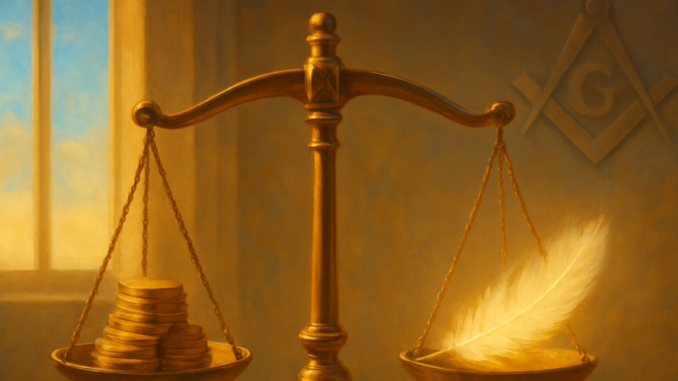
You may have caught the headlines: the FIFA president defending the sale of World Cup shares to investors, insisting there was ‘no obligation’ to disclose or refrain. On the surface, it sounds like a reasonable legal defense. But something about it doesn’t sit right. When someone in a position of immense power says something ‘wasn’t required,’ an immediate question arises — but was it the right thing to do? That tension between what is permitted and what is proper touches something fundamental, something Freemasons have been reflecting on for centuries.
The Difference Between What You May Do and What You Should Do
Every day, we navigate the gap between what is legally allowed and what is genuinely good. You can ignore a colleague who needs help. You can stay silent when injustice unfolds before your eyes. No one will take you to court for it. But deep down, you know there is a different standard — one that isn’t written in any law book but ought to be engraved in your character.
The recent controversy surrounding the sale of shares in the FIFA World Cup perfectly illustrates this tension. When a leader hides behind the phrase ‘no obligation,’ it sounds like a legal shield. But ethics demands far more than simply avoiding criminal liability. Ethics asks whether you could explain your decision to someone you deeply respect — and feel at peace with the answer.
Aristotle and the Virtuous Leader
The Greek philosopher Aristotle wrote extensively about ethics and leadership. For him, a good person was not someone who merely followed the law, but someone who had cultivated virtues: courage, justice, temperance, and practical wisdom. These were not lofty ideals reserved for philosophical debate — they were daily exercises. Every choice you make shapes your character a little more.
Aristotle would likely have raised an eyebrow at the argument ‘it wasn’t required.’ For him, the question was never solely whether something was permitted, but whether it contributed to a good life and a just society. A leader who retreats behind minimal obligations reveals something about his character — not what he is legally entitled to do, but who he is morally.
Freemasonry and the Inner Compass
Within Freemasonry, ethics plays a central role — not as an external system of rules, but as a process of inner development. The rituals and symbols of the lodge are designed to help brethren refine their own moral compass. The focus is not on what the law prescribes, but on what your conscience tells you when no one is watching.
True integrity reveals itself not in what you are allowed to do, but in what you refuse to do when no one is compelling you.
This principle stands in stark contrast to the modern tendency to reduce ethics to compliance — merely ticking boxes and meeting regulatory requirements. Freemasonry reminds us that rules represent only the floor, the bare minimum. The ceiling is something you determine yourself, in silence, in the privacy of your own heart.
The Mirror of Public Office
Anyone who holds a public position lives under a magnifying glass. That is not only uncomfortable — it is also instructive. Public scrutiny acts as a mirror, confronting you with the question: am I living according to the values I claim to represent?
The philosopher Marcus Aurelius, himself a Roman emperor, wrote in his personal journals about this very responsibility. He constantly reminded himself that power is not a license — it is a test. Every single day, he had to choose who he wanted to be. Not because anyone forced him, but because he understood that his choices sent ripples through the world around him.
What This Controversy Teaches Us About Ourselves
It is easy to point fingers at leaders who stumble. But the honest question is: how often do we ourselves settle for the bare minimum? How often do we justify our own choices with phrases like ‘it’s not against the rules’ or ‘everyone does it’?
The World Cup shares controversy is an invitation for self-reflection — not to sit in judgment of others, but to ask ourselves where our own boundaries truly lie. Because ethics doesn’t begin with someone else. Ethics begins in those quiet moments when you decide who you want to be.
Are you transparent even when no one asks you to be? Do you choose what is right even when it might cost you? Do you take responsibility without hiding behind the rules?
Trust: The Building Block That Matters Most
Trust may be the most valuable currency in human relationships. It is not earned by doing what is required, but by consistently acting according to higher principles. Leaders who understand this build something lasting. Leaders who forget it discover that being legally right and having moral authority are two very different things.
In Freemasonry, we speak of building an inner temple. That temple is not made of stone — it is made of choices. Every time you choose integrity over convenience, you lay another stone. Every time you hide behind ‘it wasn’t necessary,’ something crumbles away.
The controversy surrounding the sale of World Cup shares is more than a news cycle. It is an invitation to reflect on what we expect of our leaders — and of ourselves. Freemasonry teaches that true ethics is not about following rules; it is about developing character. It is not about what you are permitted to do, but about who you are when the spotlight fades. That question lingers long after the headlines have been forgotten. And perhaps that is exactly the point.
Copyright text & image: devrijmetselaar.nl
Texts are based on the ideas and content of the author of devrijmetselaar.nl, reviewed, corrected, and supplemented with the assistance of OpenAI. Images are created based on the ideas of the author of devrijmetselaar.nl using OpenAI/DALL-E.
Frequently Asked Questions
How does Freemasonry view the difference between what is legally allowed and what is ethically right?
Freemasonry teaches that ethics extends far beyond mere legal compliance. The craft emphasizes developing an inner moral compass through rituals and reflection, recognizing that true integrity is revealed not by what you are allowed to do, but by what you choose to do when no one is watching. This principle encourages Masons to hold themselves to a higher standard than the minimum requirements of the law.
What role do virtues play in Freemasonry's approach to leadership?
Freemasonry embraces Aristotle's philosophy that virtuous leadership requires cultivating character traits like courage, justice, temperance, and practical wisdom through daily practice. Rather than viewing ethics as external rules, Freemasonry sees these virtues as personal development goals that shape who you become and how you lead others. A true leader's character is measured not by legal loopholes but by the moral choices they make.
How does Freemasonry define integrity?
In Freemasonry, integrity is fundamentally about what you refuse to do when no one is compelling you to refuse it. The craft teaches that true integrity emerges from an inner moral compass refined through reflection and lodge work, not from external compliance with rules. This means that a Mason's character is built on doing what is right because it is right, regardless of whether it is legally required.
Why does Freemasonry focus on personal conscience rather than external rules?
Freemasonry recognizes that rules and regulations represent only the minimum standard—the floor of acceptable behavior. By encouraging brethren to develop a strong inner compass through ritual, symbolism, and self-reflection, the craft helps men set their own higher ethical ceiling. This approach produces leaders and citizens who act with genuine integrity because they have internalized moral principles, not simply because they fear legal consequences.


Be the first to comment