Freemasonry is one of the world’s oldest and most widely recognized fraternal organizations, and at the heart of its structure lies a carefully designed system of degrees. These degrees of Freemasonry are not simply ranks or titles — they are initiatory stages, each carrying its own symbolism, ritual, and philosophical teachings. Understanding how this degree system works offers a window into the rich intellectual and moral tradition that has shaped Freemasonry for centuries. Whether you are a curious newcomer, a family member of a Mason, or someone considering membership, this guide offers a thorough and balanced overview of what the degrees mean, where they come from, and why they continue to matter.
Historical Background of the Masonic Degree System
The origins of the Masonic degree system are rooted in the transition of stonemasons’ guilds from operative (working) craft organizations to speculative (philosophical) brotherhoods during the late 17th and early 18th centuries. The earliest clear evidence of a formal degree structure dates to the founding of the first Grand Lodge in London in 1717, though historians such as David Stevenson have argued persuasively that organized Masonic lodges existed in Scotland as early as the late 16th century.
The initial structure consisted of two degrees — Entered Apprentice and Fellow Craft — mirroring the ranks within a medieval stonemasons’ guild. The third degree, that of Master Mason, emerged and became standardized during the early 18th century, likely around the 1720s. The premier Grand Lodge of England, under figures such as James Anderson — who compiled the famous Constitutions of the Free-Masons in 1723 — helped formalize these rituals and establish the three-degree system as the backbone of what is now called “Craft Masonry” or “Blue Lodge Masonry.”
As Freemasonry spread across Europe and into the Americas, additional degrees were developed by various bodies to expand on the philosophical and allegorical teachings of the Craft. By the mid-18th century, figures such as the Chevalier Andrew Michael Ramsay in France had introduced ideas that inspired so-called “High Degree” Masonry, leading to the eventual development of elaborate systems with dozens of additional degrees. This expansion reflected the Enlightenment spirit of the era — an enthusiasm for knowledge, moral philosophy, and the search for deeper meaning.
The Three Degrees of Craft Masonry
The foundation of virtually all Masonic systems worldwide rests upon the three degrees of the symbolic lodge, commonly referred to as the “Blue Lodge.” These three degrees — Entered Apprentice, Fellow Craft, and Master Mason — represent a journey from initiation and learning, through growth and skill, to full membership and wisdom. Every Freemason begins here, regardless of which additional bodies he may later join.
The First Degree: Entered Apprentice
The First Degree is the rite of initiation into Freemasonry. A candidate who receives this degree is symbolically entering the fraternity as an apprentice — open, humble, and ready to learn. The ceremony draws on the imagery of the medieval stonemason who, as a young man, was apprenticed to learn the tools and principles of the craft. In terms of symbolism, the Entered Apprentice is associated with birth, new beginnings, and the preparation of the raw material of self.
Key symbols introduced at this stage include the gavel, representing the force of conscience used to shape one’s character; the chisel, symbolizing education and refinement; and the rough ashlar, representing the imperfect human being before Masonic teaching begins to have its effect. The candidate is introduced to the concept of Brotherly Love, Relief, and Truth — the three great principles of Freemasonry — and takes his first obligation to the fraternity.
Morally, the Entered Apprentice degree emphasizes the importance of self-discipline, the pursuit of knowledge, and the cultivation of virtue. The teachings at this level are deliberately foundational, encouraging the new Mason to look inward and begin the lifelong process of self-improvement.
The Second Degree: Fellow Craft
The Second Degree represents a stage of intellectual and moral progress. Having been initiated, the Mason is now a Fellow Craft — a craftsman who has developed his skills and is deepening his understanding of the symbolic architecture of Freemasonry. The ritual of this degree places particular emphasis on the liberal arts and sciences, encoded in the medieval concept of the trivium and quadrivium: grammar, rhetoric, logic, arithmetic, geometry, music, and astronomy.
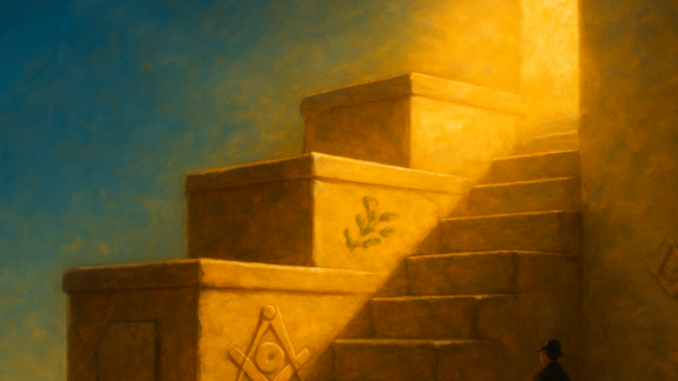
The central symbol of the Fellow Craft degree is the winding staircase, representing the Mason’s ascent toward greater knowledge and understanding. The number of steps varies by jurisdiction, but each step is said to represent a virtue, a stage of life, or one of the seven liberal arts. The Fellow Craft is encouraged to pursue learning not merely for personal advancement but as a means of better serving God and humanity.
The perfect ashlar is introduced at this stage — the polished stone, smooth and ready to be placed in the building — symbolizing a person who has worked on themselves and grown through education and discipline. This degree reflects the Enlightenment values that deeply influenced early Freemasonry: the belief that reason, learning, and moral development are paths to human improvement and social harmony.
The Third Degree: Master Mason
The Third Degree is widely considered the most important and most emotionally resonant of the Masonic degrees. It is here that the candidate experiences the central legend of Freemasonry: the allegory of Hiram Abiff, the legendary architect of King Solomon’s Temple, who is said to have been slain by three ruffians who sought to extort from him the secret word of a Master Mason. Despite threats against his life, Hiram refuses to betray his obligations and is killed. His body is later discovered and given an honorable burial.
The drama of this legend — enacted ceremonially during the degree — carries profound symbolic messages about fidelity, integrity, the inevitability of death, and the hope of resurrection and immortality. The candidate, in experiencing this drama, is taught that loyalty to one’s principles matters more than life itself, and that from death and darkness, light and new life can emerge.
Upon completing the Third Degree, a Freemason is a fully recognized Master Mason — able to visit lodges, participate in all Craft activities, and, if he chooses, petition for membership in appendant bodies that offer further degrees. The Master Mason’s degree is considered complete in itself; the additional degrees offered elsewhere are seen as elaborations upon, not replacements of, the teachings of the Craft.
The York Rite: Expanding the Journey
For many Masons who wish to explore further, the York Rite offers a coherent path of additional degrees organized into three bodies: the Chapter of Royal Arch Masons, the Council of Cryptic Masons, and the Commandery of Knights Templar.
The Royal Arch Degrees
Often described as the completion of the Master Mason’s degree, the Royal Arch is so significant that the United Grand Lodge of England once declared it not a separate degree but “the completion of the third degree.” The Royal Arch degrees — Mark Master, Virtual Past Master, Most Excellent Master, and Royal Arch — develop the allegory of the Temple further, revealing symbolic secrets and expanding on the themes of loss and recovery.
Thomas Smith Webb, an influential American Masonic ritualist of the early 19th century, helped shape the York Rite in the United States, codifying its rituals and making them accessible to a growing Masonic population. The Royal Arch is particularly celebrated for the philosophical depth it adds to the Master Mason’s journey.
The Cryptic Degrees and Knights Templar
The Council of Cryptic Masons confers the degrees of Royal Master, Select Master, and Super Excellent Master, which fill in narrative details of the Temple legend and introduce further moral lessons about secrecy, fidelity, and wisdom. The Commandery of Knights Templar, unique among York Rite bodies, has a distinctly Christian focus and confers the Orders of the Red Cross, Malta, and the Temple, drawing upon the imagery of medieval Christian chivalry.
The Scottish Rite: A System of 33 Degrees
Perhaps the most widely known of all Masonic appendant bodies is the Ancient and Accepted Scottish Rite, which confers degrees numbered from the 4th through the 32nd, with the honorary 33rd degree awarded for exceptional service. Despite its name, the Scottish Rite did not originate in Scotland; it developed primarily in France and the Caribbean in the mid-18th century and was formally organized in the United States in 1801 with the establishment of the Supreme Council in Charleston, South Carolina.
The Scottish Rite degrees are divided into four bodies:
- Lodge of Perfection (4°–14°): Degrees focused on the construction and loss of the Temple of Solomon, and the search for lost wisdom.
- Chapter of Rose Croix (15°–18°): Degrees exploring philosophical themes of death, darkness, and resurrection, heavily influenced by Rosicrucian symbolism.
- Council of Kadosh (19°–30°): Degrees dealing with knightly and philosophical themes, including explorations of justice, religious tolerance, and Masonic history.
- Consistory (31°–32°): The final degrees conferred upon all candidates, emphasizing the Scottish Rite’s core values of reverence, justice, and brotherly love.
The 33rd degree, officially known as Inspector General Honorary, is conferred by the Supreme Council and is not applied for — it is bestowed upon 32nd-degree Masons who have made outstanding contributions to Freemasonry or to their communities. Famous recipients of the 33rd degree have included Albert Pike, whose monumental work Morals and Dogma (1871) remains one of the most comprehensive expositions of Scottish Rite philosophy ever written, as well as Albert G. Mackey, one of the foremost Masonic scholars of the 19th century.
The Shriners and Other Masonic Bodies
Beyond the York and Scottish Rites, numerous other Masonic bodies offer their own degrees and orders, each with distinct traditions and charitable missions. The Ancient Arabic Order of the Nobles of the Mystic Shrine — universally known as the Shriners — requires membership as a Master Mason (and in the United States, often as a Scottish or York Rite Mason) before joining. The Shriners are perhaps best known for their extensive network of children’s hospitals, making them one of North America’s most impactful charitable institutions.
Other appendant bodies include the Order of the Eastern Star (open to both men and women related to Master Masons), the Royal Order of Scotland, the Societas Rosicruciana (open to Master Masons with a Christian belief), and the Order of DeMolay and Job’s Daughters, which cater to young people with Masonic family connections. Each of these bodies has its own degree structure and philosophical focus, but all trace their roots to the foundation of the three Craft degrees.
Symbolism and Philosophy Across the Degrees
One of the most remarkable aspects of the Masonic degree system is the consistency and depth of its symbolic language. Throughout all the degrees — from the rough ashlar of the First Degree to the philosophical heights of the Scottish Rite — Freemasonry employs the tools and imagery of architecture and stonemasonry as metaphors for the building of human character and the ideal society.
The square and compasses, the universal symbol of Freemasonry, appear throughout the degrees as reminders of the Mason’s obligation to live within the bounds of morality (the square) and to keep his passions and desires in proper proportion (the compasses). The Volume of Sacred Law — in most English-speaking lodges, the Bible — is always open on the altar, reminding Masons that their work takes place in acknowledgment of a higher moral authority, which each Mason understands according to his own faith.
The degree system also reflects a deeply humanistic philosophy. Freemasonry does not claim to be a religion, but it insists that every member believe in a Supreme Being — described in Masonic writings as the Grand Architect of the Universe. This inclusive approach to the divine allowed Freemasonry to embrace men of diverse religious backgrounds at a time when sectarian conflict was common, making the lodge a rare space of tolerance and intellectual freedom. Enlightenment thinkers such as Voltaire, who was initiated as a Freemason in Paris in 1778 just weeks before his death, recognized this spirit of rational inquiry and brotherhood.
The Degrees Today: Relevance and Practice
In contemporary Freemasonry, the degree system remains the living heart of the organization. While social and charitable activities are important aspects of lodge life, it is the conferral and study of the degrees that distinguishes Freemasonry from other civic organizations. Modern lodges invest considerable effort in the quality of degree work — the careful performance of ritual, the thoughtful explanation of symbolism, and the mentorship of new members.
In many jurisdictions, educational programs such as the Lodge Education Officer system encourage Master Masons to revisit the degrees they have already received, understanding them more deeply with each encounter. This approach reflects a central Masonic truth: the degrees are not a curriculum to be completed and forgotten, but a lifelong conversation between the Mason and his own conscience, conducted through the language of symbol and allegory.
Digital resources, Masonic research lodges (known as lodges of research or lodges of instruction), and publications by bodies such as the Philalethes Society have made Masonic education more accessible than ever, ensuring that the wisdom encoded in the degrees continues to be explored by new generations of Freemasons around the world.
Frequently Asked Questions About the Degrees of Freemasonry
How many degrees are there in Freemasonry?
The answer depends on which branch of Freemasonry you are referring to. The foundational Craft or Blue Lodge Masonry has three degrees: Entered Apprentice, Fellow Craft, and Master Mason. The Scottish Rite adds degrees numbered 4 through 32, with the honorary 33rd degree. The York Rite has its own set of additional degrees organized through the Chapter, Council, and Commandery. In total, depending on the appendant bodies involved, a Mason could be exposed to over thirty distinct degrees, though the three Craft degrees are universally recognized as the foundation.
Do higher degrees mean higher authority in Freemasonry?
This is a very common misconception. In Freemasonry, higher degrees do not confer authority over lower-degree members within the Craft lodge. A 32nd-degree Scottish Rite Mason, for example, has no authority over a Master Mason in a Blue Lodge setting. The additional degrees represent a deepening of philosophical and symbolic education, not a hierarchy of command. In fact, within a Craft lodge, it is the elected officers — particularly the Worshipful Master — who hold authority, regardless of what appendant degrees they may hold.
How long does it take to receive all the degrees?
The pace varies significantly by jurisdiction and individual lodge. In many jurisdictions, a candidate must wait a set period between degrees — ranging from a few weeks to several months — to allow time for reflection and study. Receiving the three Craft degrees might take anywhere from a few months to a year or more. Pursuing Scottish Rite or York Rite degrees after that can take additional years, depending on the lodge’s schedule and the candidate’s commitment. Some bodies offer “reunion” weekends where multiple degrees are conferred over a short period, though many Masons prefer the traditional, gradual approach.
Is the 33rd degree the highest degree in Freemasonry?
The 33rd degree is the highest degree in the Scottish Rite system and is perhaps the most widely recognized of all “higher” Masonic degrees. However, other Masonic bodies have their own equivalent honors. In the York Rite, the Order of the Knights Templar is seen as the pinnacle of that system. And as mentioned above, no additional degree supersedes the standing of a Master Mason in the Craft lodge. The 33rd degree is specifically an honor of the Supreme Council of the Scottish Rite and is awarded in recognition of exceptional service.
Can women receive the degrees of Freemasonry?
Traditional or “regular” Freemasonry, as recognized by the United Grand Lodge of England, restricts its degrees to men. However, there exist several well-established “co-Masonic” or “mixed” grand lodges that confer the degrees upon both men and women, as well as entirely female grand lodges — particularly in France and the United Kingdom — that confer the full range of Masonic degrees exclusively to women. Additionally, the Order of the Eastern Star and similar bodies offer degree-based initiatic experiences to women with Masonic family connections. The question of gender inclusion continues to evolve differently across jurisdictions and Masonic bodies around the world.
Read more about this topic
- All articles in this category: Freemasonry & Society
- What Is Freemasonry? Origins, Values, and Philosophy
- What is Freemasonry?
- What is Freemasonry?
- The Human Catapult: On Daredevils, Trust, and Brotherhood
- Falling Inflation, Rising Worries: A Philosophical Exploration
Frequently Asked Questions
What are the three degrees of Freemasonry?
The three degrees of Craft Masonry, also called Blue Lodge Masonry, are Entered Apprentice, Fellow Craft, and Master Mason. These degrees represent a progressive journey from initiation and learning, through skill development, to full membership and wisdom. Every Freemason begins with these foundational degrees regardless of any additional bodies they may later join.
How old is the Masonic degree system?
The formal degree system dates back to the founding of the first Grand Lodge in London in 1717, though organized Masonic lodges may have existed in Scotland as early as the late 16th century. The three-degree structure was standardized by the early 18th century through the work of figures like James Anderson, who compiled the Constitutions of the Free-Masons in 1723.
Where did the Masonic degrees come from originally?
The Masonic degree system evolved from medieval stonemasons' guilds during the late 17th and early 18th centuries as these craft organizations transitioned from operative (working) trades to speculative (philosophical) brotherhoods. The initial two degrees—Entered Apprentice and Fellow Craft—directly mirrored the ranks within these guilds before the Master Mason degree was added.
Are there degrees beyond the three Blue Lodge degrees?
Yes, additional higher degrees were developed by various Masonic bodies starting in the mid-18th century, inspired by Enlightenment philosophy and figures like the Chevalier Andrew Michael Ramsay. These systems expand on the philosophical and allegorical teachings of the Craft, though the three Blue Lodge degrees remain the foundation of all Freemasonry.

Be the first to comment