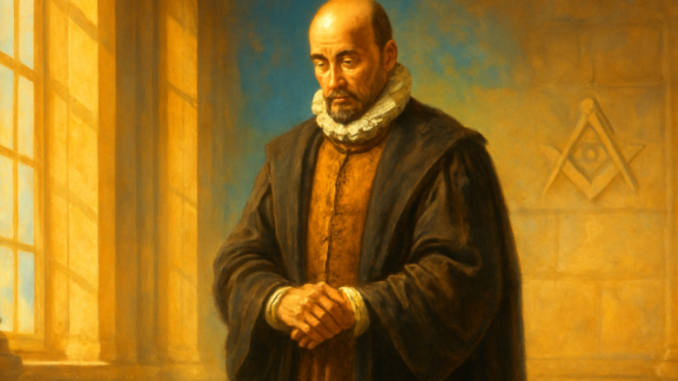
A candle flickers in Michel de Montaigne’s study. He stares at a letter just delivered — a request to mediate a family dispute. His first instinct is to respond immediately, pick a side, cut through the knot. But he sets down his pen. Waiting, he has come to understand, is sometimes the wisest course of action. In his thirty-second essay of the first book, Montaigne explores precisely this theme: why we should not impose our will too hastily, and what happens when we do.
The Core Idea of the Essay
In this short but powerful essay, Montaigne argues that we harm ourselves when we bind our will too stubbornly to particular outcomes. He observes that many people latch onto desires, opinions, or intentions as if their entire being depended on them. This attachment to specific results not only breeds frustration when reality unfolds differently, but also limits our inner freedom and our capacity to truly live.
Montaigne advocates for a certain looseness in the way we handle our own desires. This is not a plea for passivity or indifference, but for conscious restraint. By relinquishing the need to control everything, by leaving room for the unexpected, we preserve our peace of mind and remain flexible enough to respond to life as it actually unfolds.
Historical Examples as Mirrors
As is customary in his essays, Montaigne draws from classical antiquity to illustrate his points. He references statesmen and generals whose inflexibility led not only to their own ruin but also to the destruction of those they governed. History demonstrates time and again, he argues, that rigidity leads to downfall, while adaptability fosters survival and even flourishing.
Particularly striking is his observation about rulers who elevate their will to the status of law. Montaigne notes that those who possess the power to enforce their desires are often the ones who suffer most from the consequences. Their subjects obey, but the ruler himself becomes entangled in a web of unforeseen repercussions. The voices of ancient philosophers Seneca and Plutarch echo through these passages — thinkers whose works Montaigne studied avidly and who taught him that true sovereignty begins with sovereignty over oneself.
The Art of Waiting
A central element in this essay is the concept of patience — not as passive resignation, but as an active virtue. Montaigne describes how he himself learned not to act immediately when a situation stirs him. He waits, observes, and lets the initial emotions subside. Only then, when judgment is clear and passions have calmed, does he make a decision.
Those who impose their will too quickly rob themselves of the chance to truly understand what they actually want.
This approach demands a kind of self-discipline that goes far beyond simply doing nothing. It requires an ongoing dialogue with yourself — a willingness to examine your own motives and to distrust your first impulses. Montaigne sees this as a form of inner freedom: whoever is not driven by immediate desires is truly free to choose.
The Connection to Freemasonry
The themes of this essay resonate deeply with the symbolic language of Freemasonry. In the Masonic tradition, the working of the rough ashlar plays a central role: the human being as raw material, patiently and carefully transformed into a perfect cube. This process cannot be rushed or forced. It demands time, attention, and the willingness to make mistakes and learn from them.
The square and compasses — the core tools of Masonic symbolism — remind the Brother that precision and measure are essential. A wall erected too quickly without consulting the square will stand crooked. In much the same way, Montaigne warns that decisions made in haste often lead to distortion in our character and our relationships.
There is a profound parallel here between Montaigne’s philosophy and the Masonic journey. Both demand that a man resist the urge to act on raw impulse. Both insist that genuine progress — whether moral, intellectual, or spiritual — comes through disciplined restraint rather than forceful assertion. The Entered Apprentice learns early that the rough stone yields to patient labor, not to violent blows. Montaigne, writing centuries before modern Freemasonry took its organized form, arrived at remarkably similar conclusions through his own introspection.
Practical Lessons for Everyday Life
What does Montaigne’s wisdom mean in practical terms for our own time? In a world that glorifies speed and instant results, his message sounds almost rebellious. He invites us to:
- Delay important decisions until the first wave of emotion has passed
- Examine our attachment to specific outcomes
- Make room for uncertainty and the unexpected
- Accept that control is often an illusion
This attitude is not a recipe for indecisiveness. On the contrary, Montaigne argues that those who learn to wait ultimately make better and more thoughtful choices. The paradox is that by wanting less, we often achieve more.
The Timeless Relevance of Restraint
More than four centuries after Montaigne’s death, his insight remains strikingly relevant. In our age of constant stimulation and instant gratification, the art of waiting may be more important than ever. Social media reward quick reactions, the economy demands immediate results, and our entire lives seem oriented toward minimizing any period of waiting. It is precisely for this reason that Montaigne’s wisdom offers a counterbalance — a reminder that human growth, much like the working of stone, requires time and patience.
Montaigne’s thirty-second essay is a small but valuable meditation on self-mastery and the art of patience. By acknowledging that our first impulses are rarely our wisest counselors, he opens the way toward a richer and more balanced existence. For the Freemason working his rough ashlar, for anyone striving toward self-knowledge, this essay holds a timeless lesson: true strength lies not in forcing your will upon the world, but in the ability to temper that will when wisdom demands it.
Copyright text & image: devrijmetselaar.nl
Texts are based on the ideas and content of the author of devrijmetselaar.nl, reviewed, corrected, and supplemented with the assistance of OpenAI. Images are created based on the ideas of the author of devrijmetselaar.nl using OpenAI/DALL-E.

Be the first to comment