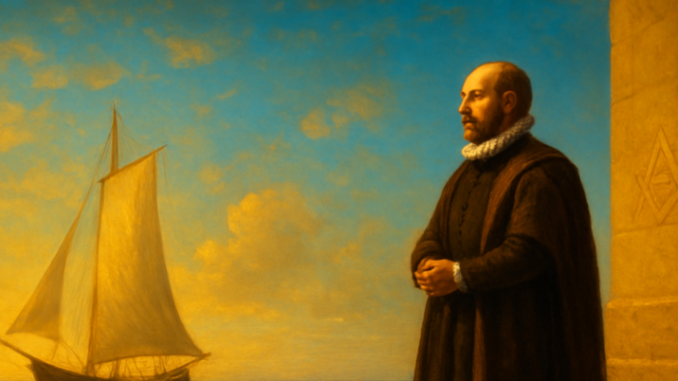
A feather. A simple feather, worn by a man from a distant land. To the sixteenth-century European, it was a curiosity — an exotic souvenir from the New World. But to Michel de Montaigne, that same feather became a mirror, a symbol that raised an uncomfortable question: who, exactly, is the barbarian here? In his essay On Cannibals, Montaigne turns the gaze inward and confronts the reader with the shadow side of their own civilisation. More than four centuries later, this essay remains a powerful invitation to self-reflection — a theme that also lies at the very heart of Freemasonry.
The Occasion: Encounters with the New World
Montaigne wrote this essay around 1580, at a time when stories about newly discovered continents were flooding into Europe. He drew on the accounts of explorers, but also on something far more personal. He had actually met three indigenous Brazilians who had been brought to the French court. Through an interpreter, he asked them about their way of life, their customs, and their impressions of Europe. It is these direct encounters that give the essay a remarkable sense of authenticity.
The title sounds deliberately provocative, and Montaigne chose the word “cannibals” with full intention. He wanted to force his readers to look beyond the initial shock. What does it truly mean to call someone a barbarian? And from what vantage point do we make that judgement?
The Core Idea: The Reversed Mirror
The central theme of the essay is cultural relativism before the term even existed. Montaigne argues that we are naturally inclined to label anything that deviates from our own customs as barbaric. But he asks: is that not the very definition of prejudice? The Tupinambá people of Brazil did indeed consume their enemies after battle, but this ritual carried a specific meaning within their culture — a form of both vengeance and tribute.
We call barbarous whatever does not fit our own customs, while remaining blind to the cruelty within our own civilisation.
Montaigne then compares these practices with the horrors Europeans inflicted upon one another during the Wars of Religion. People were burned alive, tortured, and torn to pieces — not after death, but while they still breathed. Which civilisation, then, is truly barbaric? The question hangs in the air like a mirror held up before us.
Key Examples and Observations
Montaigne describes the society of the Tupinambá with striking admiration. He calls their life “natural” and praises their freedom from the afflictions that plagued Europe: no corruption, no lies about property, no greed. Their villages knew no poverty because possessions were shared. Their wars were not fought to conquer land but to demonstrate courage.
Several details stand out. A prisoner of war was treated with hospitality for months before the ritual took place. The captive showed no fear, only pride — something Montaigne compares to Stoic virtue. And when the three Brazilians visited France, they expressed astonishment at the extreme inequality between rich and poor, unable to comprehend why the destitute did not seize the wealthy by the throat.
These observations are not naive romanticisation. Montaigne fully acknowledges the rawness of their customs, but he refuses to simply dismiss them as inferior. Instead, he searches for the internal logic of their worldview — an approach that was truly exceptional for his time.
The Symbolic Layer: The Feather and the Mirror
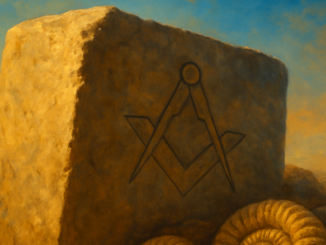
When we read this essay through a symbolic lens, a deeper layer reveals itself. The feather worn by the Brazilian becomes more than an ornament. It transforms into a symbol of lightness — of an existence unburdened by the weight of possessions and deceit. And then there is the mirror, a recurring image in Montaigne’s philosophy. In Freemasonry, the mirror plays an equally central role: the Entered Apprentice is invited to examine himself before he presumes to judge others.
The essay functions as a kind of symbolic initiation. The reader begins with a judgement, armed with certainties about civilisation and barbarism. Gradually, those certainties are undermined. By the end, what remains is not a verdict on the other, but a question about the self. This process of unlearning is precisely what the Freemason undergoes: the shedding of prejudices in order to arrive at deeper understanding.
The Enduring Relevance of Humility
Montaigne’s essay is not a plea for moral relativism — the notion that anything goes. It is a call for intellectual humility. Before we judge, we must seek to understand. Before we condemn, we must examine ourselves. This attitude resonates powerfully with the Masonic principle that every human being is imperfect and that wisdom begins with recognising one’s own shortcomings.
In an age of snap judgements and hardened positions, this essay offers a much-needed antidote. It reminds us that every culture, every community, has its own internal logic. That does not mean we must approve of everything, but it does mean we should take the effort to understand before we speak.
With On Cannibals, Michel de Montaigne wrote an essay far ahead of its time. By turning the mirror around, he reveals that barbarism is not determined by geography but lurks in our blindness to our own cruelty. The feather of the Brazilian becomes a symbol of lightness and purity — a reminder of an existence free from the burdens we impose upon ourselves. For anyone willing to look into that mirror, a path opens toward deeper self-examination, a journey that Freemasonry, too, regards as the highest pursuit.
Copyright text & image: devrijmetselaar.nl
Texts are based on the ideas and content of the author of devrijmetselaar.nl, reviewed, corrected, and supplemented with the assistance of OpenAI. Images are created based on the ideas of the author of devrijmetselaar.nl using OpenAI/DALL-E.

Be the first to comment