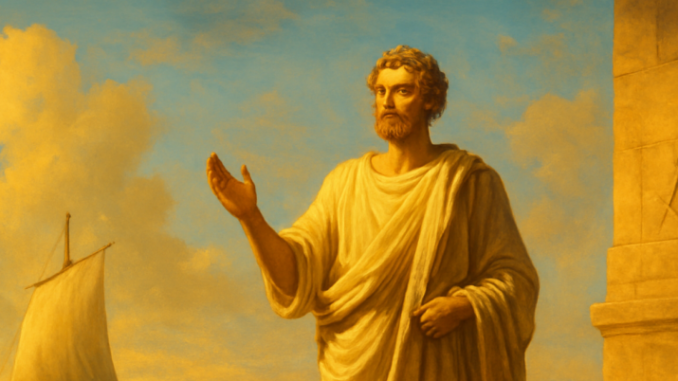
Why would a Roman emperor — the most powerful man in the known world — begin his private journal with a long list of everything he owes to other people? Book I of the Meditations of Marcus Aurelius reads as an extended letter of gratitude to family, teachers, and friends. This is not false modesty or diplomatic courtesy. It is a deliberate philosophical choice. And in that choice, an ancient vision of personal growth unfolds that remains remarkably relevant today: we are shaped by those who came before us.
What Makes Book I So Remarkable?
Unlike the remaining eleven books of the Meditations, which are filled with self-reflection and philosophical reasoning, Book I consists almost entirely of acknowledgments. Marcus Aurelius names seventeen individuals — from his grandfather to his philosophy tutors — and describes precisely which virtue or life lesson he learned from each one. This is no superficial politeness. It is a systematic accounting of moral debts.
Why would a powerful ruler do this? The answer lies in the Stoic philosophy Marcus practiced. For the Stoics, wisdom is never a solo achievement. It is the result of a chain of transmission. Every master stands on the shoulders of those who came before. By acknowledging his sources, Marcus places himself within a tradition that reaches far beyond his own lifetime.
The Specific Lessons Marcus Names
The sequence begins with his grandfather Verus, from whom he learned “gentleness of character.” From his father, he inherited “modesty and manly dignity.” His mother taught him “piety, generosity, and the avoidance of malicious gossip.” But it is his philosophical teachers who receive the most attention. Rusticus led him to abandon rhetorical vanity and focus on what truly matters. Apollonius showed him how to remain steadfast without becoming rigid. Sextus taught him tolerance and goodwill toward others.
What stands out is how concrete these lessons are. Marcus does not write in abstractions — he writes in behaviors. From Maximus, he learned “self-control and steadfastness in all circumstances.” From Alexander the Platonist, he learned “not to say too often, or without real necessity, that one is too busy.” These are practical wisdoms, immediately applicable to daily life.
What This Tells Us About Personal Development
Here we touch on a fundamental question: do we shape ourselves, or are we shaped? Marcus Aurelius offers a nuanced answer. Yes, we make choices and bear responsibility for our character. But those choices are made possible by the examples we receive. Without teachers who illuminate the path, we would be groping in the dark.
Gratitude toward teachers is not a sign of weakness — it is a mark of wisdom. To acknowledge what you have received is to understand that virtue is transmitted from person to person, across time and circumstance.
This insight also sheds light on why brotherhoods and fraternal orders throughout history have placed such great value on the master-apprentice relationship. The idea that knowledge and wisdom are passed from generation to generation — like a torch handed from one bearer to the next — runs through many traditions. The ritual of initiation, in which an elder guides the younger, mirrors exactly what Marcus describes in Book I.
The Parallels with Freemasonry
The connections are striking. In Freemasonry, the figure of the teacher and mentor plays a central role. The symbolic journey from Entered Apprentice to Fellow Craft to Master Mason is, at its core, a journey of receiving, processing, and passing on. Each degree brings new insights, transmitted by brethren who have walked the same path before. Just like Marcus Aurelius, a Freemason does not begin his journey in isolation, but within a living chain of transmission.
The emphasis on specific virtues also resonates deeply. Marcus names justice, temperance, courage, and wisdom — the four cardinal virtues that hold a prominent place in Masonic tradition as well. The working of the rough ashlar, a central symbol in Freemasonry, is nothing less than the shaping of one’s own character after the example of those who came before.
There is something profoundly Masonic about the way Marcus catalogues his debts. The Lodge itself functions as a space where lessons are received not primarily from books, but from the living example of fellow members. The senior Mason who demonstrates patience, the brother who embodies integrity under pressure — these are the Apolloniuses and Maximuses of our own time.
What Can We Learn from Book I?
The lesson of Book I is at once simple and profound: take the time to recognize who has shaped you. This is not a nostalgic exercise but an active form of self-knowledge. By tracing which people awakened which virtues in you, you gain sight of the foundations of your own character. And with that insight comes responsibility: what are you passing on to the next generation?
Marcus Aurelius never wrote the Meditations for publication. They were personal notes, intended to keep himself honest and sharp. That he began with gratitude says something essential. Before you can reflect on how to live, you must first acknowledge that you do not stand alone. Wisdom is not a possession — it is a gift, received and passed forward.
Consider his own summary of what he received:
From grandfather Verus: gentleness and the mastery of passion.
From Rusticus: simplicity in writing and thinking.
From Apollonius: freedom and steadfastness.
From Sextus: goodwill and tolerance.
From Maximus: self-control in all circumstances.
Book I of the Meditations is an invitation to reflect. Who have been your teachers? Which virtues did you receive from them — consciously or unconsciously? And what are you passing on to those who come after you?
Marcus Aurelius, the most powerful man of his age, began his most personal work with a gesture of humility. That gesture continues to resonate — in the stillness of the Lodge, in the conversation between generations, and in every sincere effort to become a better person. The rough stone is never shaped alone. It is shaped by every hand that guides the chisel, by every voice that offers counsel, and by every example that shows us what we might yet become.
Copyright text & image: devrijmetselaar.nl
Texts are based on the ideas and content of the author of devrijmetselaar.nl, reviewed, corrected, and supplemented with the assistance of OpenAI. Images are created based on the ideas of the author of devrijmetselaar.nl using OpenAI/DALL-E.
Frequently Asked Questions
How does Marcus Aurelius' approach to gratitude relate to Freemasonry?
Marcus Aurelius demonstrates the same principle that Freemasonry has upheld for centuries: that personal growth comes through mentorship and the transmission of wisdom from experienced members to those beginning their journey. By publicly acknowledging his teachers, Marcus shows that recognizing our debts to those who guide us is not weakness but rather a cornerstone of character development, much like the master-apprentice relationship that forms the foundation of Masonic education and brotherhood.
Why did a powerful emperor like Marcus Aurelius write a book of gratitude?
Marcus Aurelius understood that true strength and wisdom come not from isolation but from standing on the shoulders of those who came before us. His deliberate choice to begin his private journal with acknowledgments of his teachers reflects the Stoic philosophy that virtue is transmitted person to person across generations—a principle that Freemasonry has embraced in its commitment to preserving and passing down timeless wisdom through its ranks.
What can modern Freemasons learn from Marcus Aurelius' Book I?
Marcus Aurelius teaches us that acknowledging our mentors strengthens rather than diminishes us, and that the specific, practical lessons we receive from experienced guides are more valuable than abstract philosophy. This directly parallels the Masonic tradition of honoring the Masters and teachers who illuminate our path, reminding us that fraternal organizations thrive when members recognize the chain of wisdom connecting them to their predecessors and commit to passing it forward.
How does the master-apprentice relationship in Freemasonry compare to Marcus Aurelius' teachings?
Just as Marcus Aurelius named seventeen individuals and described the concrete virtues he learned from each, Freemasonry structures its degrees and mentorship to ensure that specific, practical wisdom is transmitted from experienced members to candidates. Both systems recognize that personal development is not achieved in isolation but through intentional relationships with guides who embody the principles worth learning, creating an unbroken chain of moral and philosophical transmission.


Be the first to comment