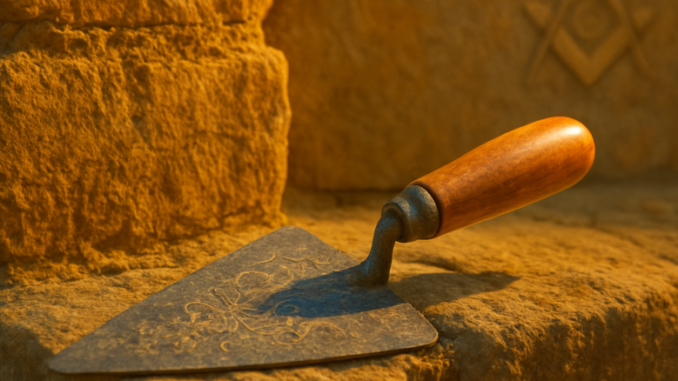
A trowel rests on the work table. It is a simple tool, designed to spread mortar between stones, to fill gaps, to bind loose elements into a unified whole. Yet the lodge that bears this name — Lodge De Troffel — carries a philosophical mission that reaches far beyond the stonemason’s craft. Where other lodges choose names that evoke light, wisdom, or cosmic order, this brotherhood takes its identity from an instrument concerned with what lies between the stones. And it is precisely there, in the joints, in the spaces between, that the essence of human coexistence may well reside.
The Tool That Builds Nothing but Binds Everything
Pick up a trowel and you notice something remarkable. Unlike the gavel that strikes, the chisel that cuts, or the square that measures, the trowel is a tool without aggression. Its motion is smoothing, reconciling, complementary. It adds where something is missing. Strictly speaking, the trowel builds nothing — it only makes it possible for what has been built to remain standing.
In Freemasonry, this instrument represents the art of connection. When a lodge takes the name De Troffel — The Trowel — it makes a deliberate philosophical choice. It places neither the individual stone nor the architecture of the finished edifice at the center, but rather the fabric that holds everything together. This is a humble yet profoundly meaningful position.
The Philosophy of the In-Between Space
The Greek philosopher Aristotle wrote that the whole is greater than the sum of its parts. But he did not elaborate on what exactly constitutes that “greater.” Centuries later, the philosopher Martin Buber approached this mystery through his concept of encounter: the truly human does not arise in the self, nor in the other, but in the space between them. The trowel is the instrument of that in-between space.
A lodge that chooses this name positions itself within a philosophical tradition that values relationship over substance. It is not the individual brethren who make the lodge, but what flows between them when they come together. Just as mortar only gains meaning when applied between stones, brotherhood only takes shape through actual connection.
The trowel reminds us that connection is not a byproduct of building — it is the very precondition for it.
Spreading Mortar as a Ritual Act
Watch a mason working with a trowel. The movement is rhythmic, almost meditative. There is a care to it that goes beyond functional necessity. The mortar must be spread precisely — not too thick, not too thin. The joint must be filled without overflowing. This demands attention, patience, and practice.
In a symbolic sense, this spreading motion becomes a metaphor for how we deal with the imperfections in our relationships. Every person has rough edges, flaws, and neglected corners. The trowel teaches us not to ignore or condemn these, but to soften where possible and to fill where needed. This is not naive optimism but a practical wisdom reaching back to Stoic thinkers like Marcus Aurelius, who wrote that we must accept others as they are while continuing to improve ourselves.
The Mortar of Tolerance
What is the mortar with which the trowel works? In Freemasonry, it is most often interpreted as brotherly love or tolerance. It is the binding agent that allows different personalities, backgrounds, and convictions to coexist within a single space. Without this mortar, every construction falls apart, no matter how beautifully crafted the individual stones may be.
Lodge De Troffel carries in its very name the charge to actively apply this binding agent. Not to wait passively for harmony to emerge on its own, but to deliberately work toward connection. This is a philosophical stance with deeply practical consequences.
Joining in a Fragmented World
In an age when polarization seems commonplace and differences of opinion frequently lead to estrangement rather than dialogue, the trowel takes on a striking relevance. It calls us back to an almost forgotten art: bridging without leveling, connecting without merging.
The philosopher Emmanuel Levinas argued that ethics begins with the recognition of the other as truly other. The trowel fills the joint between self and other while leaving the stones intact. It respects difference while making connection possible. This is a subtle but essential distinction — one that resonates deeply in our current cultural moment.
The trowel does not build walls, but makes walls possible. It works in the spaces between, not on the surface. Its power lies in gentleness rather than force. And it demands patience, presence, and a careful eye for detail.
The Invisible Labor of the Trowel
Perhaps the most telling quality of the trowel is that its work eventually becomes invisible. Once a wall is complete, nobody sees the mortar anymore — only the stones. The trowel labors for the whole, not for its own glory. It is, in the truest sense, an instrument of humility.
For Freemasons who gather under the name De Troffel, this serves as a permanent reminder. The work that truly matters is often the work no one sees. The small gestures of kindness. The moments of genuinely listening. The patience with one another’s shortcomings. These are the quiet, smoothing motions with which brotherhood is cemented — unseen, yet holding everything together.
A trowel is a simple tool. But for those who take the time to consider what it represents, it reveals a complete philosophy of human connection. Lodge De Troffel carries in its name the ongoing charge to work in the spaces between — to join what has been separated, to bind what threatens to fall apart. In a world that sometimes forgets how stones are held together, this ancient instrument reminds us of the gentle power of the joint. It is not the stones that make the building, but what flows between them when we are willing to smooth, to fill, and to heal.
Copyright text & image: devrijmetselaar.nl
Texts are based on the ideas and content of the author of devrijmetselaar.nl, reviewed, corrected, and supplemented with the assistance of OpenAI. Images are created based on the ideas of the author of devrijmetselaar.nl using OpenAI/DALL-E.
Frequently Asked Questions
What does the name 'Lodge De Troffel' mean and why is it significant?
Lodge De Troffel takes its name from the trowel, a mason's tool used to spread mortar and bind stones together. Rather than focusing on individual achievement or the finished structure, this lodge philosophically emphasizes the connections and relationships that hold a community together, making it a meaningful symbol of brotherhood and unity.
How does Freemasonry use the trowel as a teaching tool?
The trowel represents the art of connection and relationship in Freemasonry, teaching members that brotherhood is built through the space between people, not through individuals alone. The careful, meditative act of spreading mortar becomes a metaphor for how we address imperfections in relationships—softening rough edges and filling gaps with care and patience.
What philosophical principles does Lodge De Troffel follow?
Lodge De Troffel draws from philosophical traditions that value relationship over individual substance, including Martin Buber's concept of encounter and Aristotelian thought. The lodge teaches that true connection is not a byproduct of building community, but rather the essential precondition for it—emphasizing practical wisdom and the importance of what binds people together.
Is the trowel considered an important symbol in Freemasonry?
Yes, the trowel holds special significance in Freemasonry as a tool of reconciliation and unity that builds nothing by itself but enables everything to stand. Unlike more aggressive tools, the trowel represents a philosophy of harmony and complementary action, making it a powerful symbol of the peaceful, constructive values central to Masonic brotherhood.

Be the first to comment