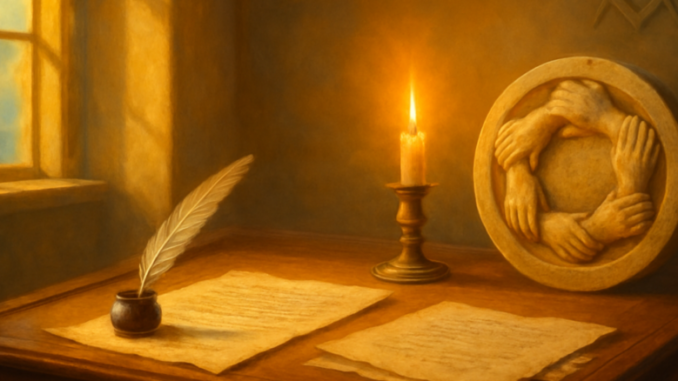
The history of philosophy reveals a fascinating pattern: thinkers who grew up as the eighth child in large families often developed a remarkable sensitivity to brotherhood and human connection. These philosopher-brothers sought not only truth but also the art of living together. How does this perspective compare to Freemasonry, which likewise places the figure of the brother at its very center? And what can this comparison teach us about the role of art as a binding force between people?
The Eighth Child: A Philosopher Shaped by Brotherhood
In eighteenth-century France, Denis Diderot was born as the eighth child in a large household in Langres. His position in the family pecking order profoundly shaped his view of human relationships. As one of the youngest in a crowded home, he learned to share, to wait, and above all, to listen — skills that would define both his character and his life’s work.
Diderot, the philosopher who grew up as a brother among many brothers and sisters, developed an encyclopedic way of thinking that sought to connect every field of knowledge. His magnum opus, the Encyclopédie, was never a solitary enterprise. It was a fraternal project in which dozens of thinkers collaborated. He understood intuitively that great works arise from collective effort, not from isolated genius. The dynamics of a large family had taught him that truth emerges from dialogue, not monologue.
The Freemason as Brother: A Different Kind of Bond
Freemasonry also places the brother at the heart of its tradition, but here brotherhood is not born from blood — it is born from choice. When a man is initiated into the lodge, he becomes a brother among brothers, regardless of his background, social standing, or family history. This chosen brotherhood carries a different weight than the familial bonds that shaped philosophers like Diderot.
Where the eighth child learns to navigate among established positions and already-formed personalities, the newly initiated Freemason enters a brotherhood of equals who have all undergone the same ritual journey. Yet both forms of brotherhood share a common element: the recognition that no person stands alone. We only truly flourish in connection with others.
Art as the Shared Language of Brothers and Philosophers
It is in the realm of art that the worlds of the philosopher-brother and the Masonic brother converge most powerfully. Diderot did not limit himself to philosophical treatises. He wrote plays, novels, and art criticism. He understood that art reaches people at a level that pure reason cannot touch. His Salons — his reports on the Parisian art exhibitions — remain among the earliest and finest examples of art criticism in the Western tradition.
Art is the language in which brothers recognize one another without words — in which the eighth child and the initiated feel the same truth.
In Freemasonry, art occupies an equally central place. The lodge itself is a work of art composed of symbolism, where architecture, sculpture, and ritual merge into a unified whole. Wolfgang Amadeus Mozart, himself a Freemason, composed works steeped in Masonic themes. His opera Die Zauberflöte (The Magic Flute) gives musical expression to the journey from ignorance to enlightenment — a theme that speaks directly to both the philosopher and the Freemason.
What Both Worlds Share
The philosopher who grew up as the eighth child in a large family and the Freemason who became a brother through initiation share a fundamental insight: human dignity springs from mutual recognition. Both learned, in their own ways, that the individual only comes into full bloom within a community that acknowledges and challenges him.
The family teaches the child that there is room for everyone at the table. The lodge teaches the brother that all people are equal in their search for light. And art offers both a medium through which this insight can be expressed, shared, and passed on to others.
The Artist as Mediator
Johann Wolfgang von Goethe, who was both a towering poet and an active Freemason, embodied this synthesis perfectly. His Faust is a quest for knowledge and redemption that transcends the boundaries of the individual self. Goethe understood that art is not mere decoration — it is an essential means of sharing and deepening human experience. In his poetry about Freemasonry, he wrote of the chain of brothers reaching across the centuries, linking past, present, and future in an unbroken bond.
Goethe’s example shows us that the artist can serve as a mediator between the private world of personal experience and the communal world of shared meaning. This is precisely the role that art plays in both the philosopher’s study and the Masonic lodge — it transforms individual insight into collective wisdom.
What We Can Learn
The comparison between the eighth child who becomes a philosopher and the man who becomes a Freemason reveals a deeper truth about human connection. Both traditions recognize that wisdom does not grow in isolation. Whether you learn to share out of the necessity of a large family or through the voluntary choice of a fraternal order, the result is strikingly similar: a realization that the other person is not a threat but a mirror and a teacher.
Art functions as the great equalizer in both worlds. A painting by Rembrandt, a symphony by Mozart, a poem by Goethe — each speaks to anyone willing to listen, regardless of birth order or lodge membership. In beauty, the philosopher and the Freemason, the sibling and the brother, find common ground that transcends all distinctions.
The eighth child who became a philosopher and the man who became a brother through initiation walk parallel paths toward the same insight: that human flourishing requires cooperation. The art they both cherished is not a luxury but a vital necessity — a language that connects where words fall short. In a world that seems to grow ever more individualistic, these traditions remind us that we only become fully human in the recognition of our brothers and sisters, whether that bond was forged by blood or by choice.
Copyright text & image: devrijmetselaar.nl
Texts are based on the ideas and content of the author of devrijmetselaar.nl, reviewed, corrected, and supplemented with the assistance of OpenAI. Images are created based on the ideas of the author of devrijmetselaar.nl using OpenAI/DALL-E.
Frequently Asked Questions
How did being the eighth child influence Denis Diderot's philosophical approach?
Growing up as the eighth child in a large French household taught Diderot essential skills like sharing, listening, and patience. These formative experiences shaped his belief that truth emerges from dialogue rather than isolated thought, ultimately influencing his collaborative approach to the Encyclopédie, which he viewed as a fraternal project bringing together dozens of thinkers rather than a solitary endeavor.
What is the key difference between familial brotherhood and Masonic brotherhood?
Familial brotherhood, as experienced by eighth children like Diderot, is born from blood and family circumstance within established hierarchies. Masonic brotherhood, by contrast, is chosen and unites men as equals regardless of their background or social standing, with all members having undergone the same ritual initiation. Despite this difference, both recognize that human flourishing depends on meaningful connection with others.
How does art connect the philosophy of eighth children with Freemasonry?
Art serves as the shared language where philosopher-brothers and Masonic brothers converge most powerfully. Rather than limiting himself to theoretical treatises, Diderot engaged in plays, novels, and art criticism, demonstrating that art is a binding force that transcends traditional boundaries and enables people to communicate profound truths through creative expression rather than argument alone.

Be the first to comment