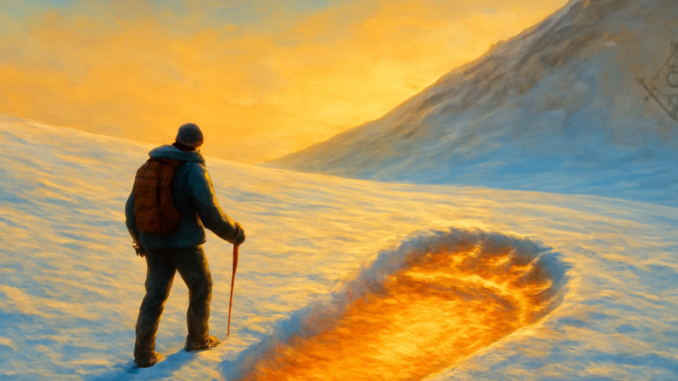
Picture yourself standing on the flanks of the world’s highest mountain, surrounded by ancient ice and silence. You are not alone. Thousands of climbers have come before you, and each one left something behind — not just footprints, but something far more human: their body heat, their waste, their urine. Recent research has revealed that even these seemingly insignificant acts contribute to the accelerated melting of the glacier. It is a confronting insight that raises a deeper question: what are you leaving behind?
Small Actions, Great Consequences
Recent studies have shown that the warm urine of climbers on Mount Everest measurably contributes to the melting of the Khumbu Glacier. It sounds almost absurd — how can something as trivial as relieving yourself in the snow affect something as vast as a glacier? Yet this is precisely what happens when thousands of people visit the same place year after year. The sum of all those small actions creates an unintended chain reaction.
Freemasons will recognize this principle immediately. In lodge, we constantly speak of building the inner temple, stone by stone. But the same logic works in reverse: every rough stone you leave unworked, every small negligence you ignore, contributes to a larger pattern. Your personality is not a fixed thing. It is the result of countless small choices — some conscious, many unconscious.
The Mirror of the Mountain
Mount Everest has always carried an air of the mystical. For many, the mountain symbolizes the ultimate striving toward greatness — a victory over oneself. But the mountain is also a mirror. It reveals not only our strength and determination but also our weaknesses and blind spots. The melting glacier confronts us with an uncomfortable truth: even in our most elevated moments, we leave behind a trace we would rather not see.
The philosopher Baruch Spinoza once wrote that a person must learn to know himself in order to be truly free. That self-knowledge extends far beyond admiring your finest moments. It demands honesty about your shadow side, your habits, the small compromises you make when no one is watching. In Freemasonry, we call this working the rough ashlar — the patient refining of your character, including the parts you would rather keep hidden.
Character as a Lifelong Craft
What makes your personality what it is? Not the grand decisions alone, but the fabric of daily choices. The way you respond when you are tired. Whether you pick up litter that is not yours. Whether you put in that extra effort when it does not seem strictly necessary. Johann Wolfgang von Goethe, himself a Freemason, wrote that character is formed in the stream of life, not in the silence of isolation.
Character is not a finished product — it is an ongoing creation in which every small action counts.
The climbers on Everest undoubtedly had noble intentions. They sought adventure, self-conquest, perhaps even spiritual experience. But the cumulative effect of their presence tells a different story. It invites humility: your intentions are not always equal to your impact. True responsibility requires awareness of both.
The Freemason as Steward
In Freemasonry, there is an ancient concept that is profoundly relevant here: stewardship. You are not the owner of the world around you, but its temporary caretaker. This applies to the earth, to your relationships, and to your own character. It has been entrusted to you, and it is your duty to leave it in better condition than you found it.
The melting glacier reminds us that stewardship goes beyond good intentions. It demands concrete action — thoughtful consideration of the traces you leave behind. Not only on a mountain, but in every space you enter: your family, your workplace, your community. The question is not whether you have an impact, but what kind of impact you choose to have.
From Awareness to Action
Perhaps you recognize this feeling: you read about a problem somewhere far away and feel a brief pang of discomfort, followed by a sense of powerlessness. What can you possibly do about a melting glacier in Nepal? But the lesson does not lie in solving that particular problem. The lesson lies in translating this insight into your own life.
What small habits do you have that unintentionally cause harm? Where do you look away because the consequences are not immediately visible? How would you act if you knew that every single choice matters?
Freemasonry offers no ready-made answers to these questions. What it does offer is a method: the regular practice of returning to yourself, honestly examining your actions, and continuously refining your character. Not to become perfect, but to live more consciously.
The Warmth You Leave Behind
There is a beautiful ambiguity in the image of warmth. The warmth of urine melts the ice, but warmth can also connect, comfort, and give life. The question is which kind of warmth you choose to leave behind. The warmth of thoughtlessness, or the warmth of conscious attention? The Freemason strives for the latter — a presence that warms without burning, that contributes without depleting.
The melting glacier on Mount Everest is more than a story about climate. It is an invitation to self-examination. Your character, like that glacier, is shaped by countless small influences — day after day, choice after choice. The question that remains is simple but demanding: what trace do you want to leave behind?
In Freemasonry, we learn that the answer does not lie in grand gestures but in the sustained attention we give to every stone we lay. Each day presents a new opportunity to work the rough ashlar with greater care, to act as a worthy steward of the life entrusted to us. The mountain does not judge — it simply reflects. What it shows us is up to the choices we make, one small, deliberate act at a time.
Copyright text & image: devrijmetselaar.nl
Texts are based on the ideas and content of the author of devrijmetselaar.nl, reviewed, corrected, and supplemented with the assistance of OpenAI. Images are created based on the ideas of the author of devrijmetselaar.nl using OpenAI/DALL-E.
Frequently Asked Questions
What is the main Masonic lesson about the melting glacier on Mount Everest?
The article uses the melting Khumbu Glacier as a metaphor for how small, seemingly insignificant personal actions accumulate to create larger consequences. In Masonic terms, this parallels the principle of building the inner temple stone by stone — every small choice, whether conscious or unconscious, contributes to shaping your character. Just as thousands of climbers' small acts of leaving waste measurably contribute to glacier melting, your daily choices accumulate to define who you are.
How does Freemasonry relate to self-knowledge and character development?
Freemasonry emphasizes the concept of 'working the rough ashlar' — the patient refining of your character over a lifetime. This process requires honest self-knowledge that extends beyond celebrating your strengths; it demands honesty about your shadow side, habits, and the small compromises you make when no one is watching. As the article notes, true freedom comes from understanding yourself completely, including the parts you would rather keep hidden.
Why does the article describe Mount Everest as a mirror?
Mount Everest serves as a mirror because it reveals not only our strength and determination but also our weaknesses and blind spots. The melting glacier confronts climbers with an uncomfortable truth: even in our most elevated moments of achievement, we leave behind traces of our impact that we would rather not acknowledge. This symbolizes how character is revealed through our everyday actions and the consequences they create, not just through grand decisions.

Be the first to comment