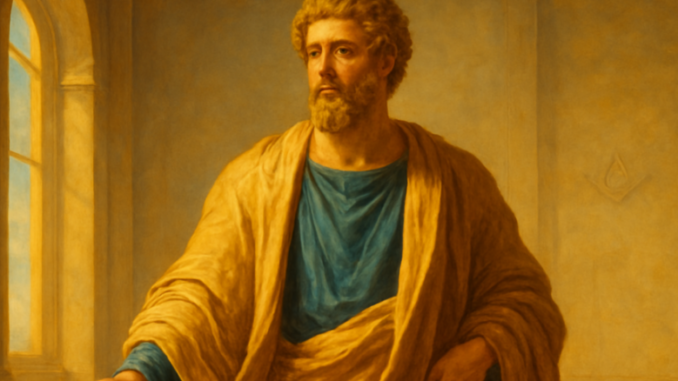
It is evening in the lodge. Candle flames flicker gently as the brethren sit in silence, each absorbed in thought after a night of ritual and reflection. An older brother opens a well-worn book and reads aloud: “Consider how much has already changed in the world. Everything flows.” The words of Marcus Aurelius, nearly two thousand years old, fill the room as though they were written yesterday. What the Roman emperor-philosopher captured in his Meditations about change and constant flux touches the very heart of what Freemasons seek: wisdom that endures amid the eternal cycle of becoming and passing away.
The River of Heraclitus in the Roman Camp
Marcus Aurelius likely wrote the fourth book of his Meditations during his military campaigns along the northern frontiers of the Roman Empire. Surrounded by war and uncertainty, he sought solace in Stoic philosophy — a tradition inherited from thinkers such as Epictetus and Seneca. Central to Book IV is the idea that everything exists in constant motion, an echo of the ancient Greek philosopher Heraclitus, who famously declared that one can never step into the same river twice. For Marcus Aurelius, this was no cause for despair. Rather, it was a path to inner freedom. If everything is transient, why cling to wealth, fame, or even the body itself?
This thought offers a surprising bridge to Freemasonry. Within the lodge, a Mason learns that outward things are impermanent. The ritual reminds the brother that he enters as a rough stone and dedicates himself to refinement — knowing full well that the work is never finished. The constant flow Marcus Aurelius describes is no different from the continual labor upon one’s own soul that every Freemason undertakes.
Change as a Source of Connection
One of the most striking passages in Book IV concerns the interconnectedness of all things. Marcus Aurelius writes that we are all part of one great, living cosmos. What happens to one person inevitably affects another. This vision of cosmic unity resonates deeply with the Masonic ideal of brotherhood. Where the emperor-philosopher speaks of a shared logos — a universal reason that binds all human beings — the Freemason speaks of the chain of union that links brethren across the globe.
The recognition that everything flows and changes does not weaken brotherhood; it makes it stronger. Brotherhood becomes a conscious choice made in full awareness of impermanence. This connection is neither accidental nor sentimental — it is a philosophical stance. Both the Stoic and the Freemason acknowledge that the individual truly flourishes only in relation to others. It is the interplay between self and community that defines both traditions.
Inner Growth in a Changing World
In Book IV, Marcus Aurelius emphasizes that the only thing truly within our control is our own thoughts and reactions. The external world shifts constantly, but the inner citadel can stand firm. This is a core idea that also sits at the heart of Freemasonry. The search for light and knowledge is ultimately an inward journey. A brother learns not only from books or masters but above all through self-reflection and the cultivation of personal virtue.
The Meditations offer practical guidance for this inner work. Marcus Aurelius advises beginning each morning by considering what obstacles one might encounter and how to meet them with equanimity. This practice is strikingly similar to the Masonic habit of regular self-examination — evaluating one’s actions and adjusting course on the path toward moral perfection.
The Search for Truth as an Anchor
Amid all the flux, both the Stoic and the Freemason seek something enduring: truth. Marcus Aurelius writes that one should not be swept away by opinions or apparent certainties but should always ask what is genuinely true. This critical inquiry — free from prejudice and conducted with an open mind — is precisely what the Freemason pursues in his quest for light.
The parallel deepens when we consider that neither tradition imposes dogma. Stoic philosophy invites personal investigation, just as Freemasonry preaches no fixed doctrine but instead offers a method for personal discovery. In both cases, the journey itself matters more than arriving at any final destination.
Virtue as the Constant in the Current
If everything changes, what remains? For Marcus Aurelius, the answer is clear: virtue. Justice, courage, temperance, and wisdom are the anchor points in a sea of change. They form the core of a life well lived, regardless of what the external world brings. Freemasons will recognize in this the emphasis on virtuous living that runs through every degree and ritual. What matters is not what a person possesses or achieves, but who he is and how he acts.
Justice: acting with honesty and respect for others.
Courage: standing firm in adversity without bitterness.
Temperance: maintaining balance in both prosperity and hardship.
Wisdom: discerning what can be changed from what cannot.
These virtues are not only the pillars of Stoic philosophy — they are also the building blocks with which the Freemason works upon himself. They are the constant within the constant flow.
A Dialogue Across the Centuries
It is no coincidence that the Meditations of Marcus Aurelius continue to inspire generation after generation. The questions he raises about change, interconnectedness, and inner growth are universal. Freemasons, whatever their background or belief, find in his words a mirror for their own quest. Stoic teaching and Freemasonry meet in the shared recognition that life is a continual labor — not in spite of change, but because of it.
The words of Marcus Aurelius in Book IV remind us that change is not a threat but an invitation — an invitation to grow, to connect, and to anchor ourselves in virtue while the world transforms around us. For the Freemason, this ancient Stoic wisdom is not a relic of the past but a living companion on the journey toward light. In the lodge, as in the emperor’s private journal, the same truth echoes across the centuries: everything flows, yet the work upon the self endures.
Copyright text & image: devrijmetselaar.nl
Texts are based on the ideas and content of the author of devrijmetselaar.nl, reviewed, corrected, and supplemented with the assistance of OpenAI. Images are created based on the ideas of the author of devrijmetselaar.nl using OpenAI/DALL-E.
Frequently Asked Questions
How does Marcus Aurelius's philosophy of change relate to Freemasonry?
Marcus Aurelius's Stoic teachings about constant flux and impermanence directly parallel Masonic practice. Both traditions recognize that outward things are transient and temporary. In Freemasonry, a Mason enters as a rough stone and dedicates himself to continual refinement, understanding that the work is never finished. This mirrors Marcus Aurelius's idea that constant motion and change are not causes for despair, but rather paths to inner freedom and self-improvement.
What did Marcus Aurelius mean by 'everything flows' and where did this idea originate?
Marcus Aurelius's concept of 'everything flows' echoes the ancient Greek philosopher Heraclitus, who famously said one can never step into the same river twice. This idea represents the philosophy that everything exists in constant motion and nothing remains static. Marcus Aurelius, writing during military campaigns on the Roman Empire's northern frontiers, embraced this Stoic understanding as a path to freedom, arguing that if everything is transient, one should not cling to wealth, fame, or even the body itself.
How does the Stoic concept of interconnectedness connect to Masonic brotherhood?
Marcus Aurelius taught that all humans are part of one great, living cosmos bound by a universal reason called the logos. This vision of cosmic unity resonates with the Masonic ideal of brotherhood and the symbolic 'chain of union' that links Freemasons across the globe. The recognition that everything flows and changes strengthens rather than weakens brotherhood, as it becomes a conscious choice made in full awareness of impermanence and our shared human condition.


Be the first to comment