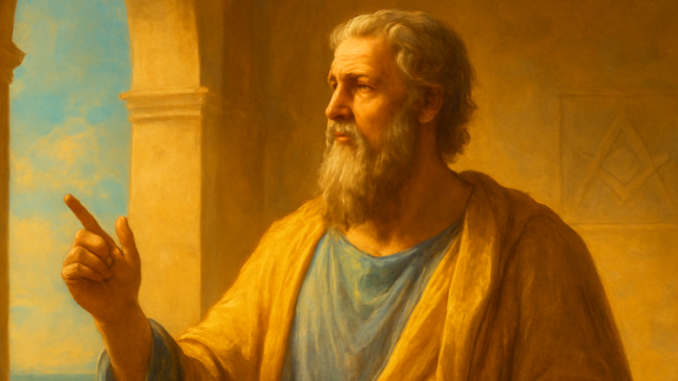
A young man of striking beauty enters the room. He is praised for his outward appearance, but Socrates wants to know: does he also possess inner beauty? This is how Plato’s dialogue Charmides opens — one of the earliest philosophical investigations into the virtue of temperance. It is a conversation that seemingly leads nowhere, yet therein lies its deeper lesson. For Freemasons, who regard self-knowledge as the very foundation of their work, this dialogue offers a mirror that has lost none of its clarity in over two thousand years.
The Setting: An Encounter at the Gymnasium
The dialogue takes place in an Athenian gymnasium, where Socrates has just returned from the Battle of Potidaea. Critias — an influential statesman and cousin of Plato — introduces him to the young Charmides. This young man is widely admired for his physical beauty, but Socrates immediately raises the question that will dominate the entire conversation: does Charmides also possess inner virtue? Specifically, he wants to know whether the youth has temperance, known in Greek as sophrosyne.
This concept resists simple translation. Sophrosyne encompasses moderation, self-control, modesty, and a deep awareness of one’s own limitations. It is the virtue that prevents a person from acting with hubris or overstepping their bounds. Socrates treats its absence as a sickness of the soul that must be healed — with temperance itself as the remedy.
Three Definitions That Fail
Charmides makes three attempts to define temperance. First, he suggests it is a kind of calmness or composure — a quiet, measured way of acting. Socrates refutes this by pointing to situations where speed and decisiveness are clearly virtuous. An athlete or a thinker who acts sluggishly where agility is required demonstrates not temperance but incompetence.
His second definition proposes that temperance is a sense of shame — a form of modesty before others. Socrates dismisses this too, citing Homer: shame is not always beneficial for a person in need. A poor man who is too ashamed to ask for help suffers unnecessarily. Shame can be either good or bad, while temperance, by definition, must always be good.
The third attempt is more interesting: temperance, Charmides suggests, means minding one’s own affairs and not meddling in other people’s business. But here too a problem emerges. A craftsman who does only his own work also serves others. A physician heals others, not himself. The distinction between one’s own affairs and those of others proves untenable.
Self-Knowledge as the Key
Critias takes over the conversation and elevates the discussion to a deeper level. He argues that temperance ultimately comes down to self-knowledge — knowing oneself, just as the Delphic Oracle prescribes with its famous inscription: Know Thyself. This seems like a breakthrough, but Socrates digs further. What does it actually mean to know yourself? Is it a kind of knowing that knows what it knows and what it does not know?
Temperance, in this reading, becomes the awareness of what one knows and what one does not know — the honesty to acknowledge one’s own limits.
Here the dialogue encounters a paradox. Can knowledge take itself as its own object? Can the eye see itself, or does it need a mirror? Socrates doubts whether such reflexive knowledge is even possible. And even if it exists, the question remains whether it can make a person happy. Knowing that you do not know something does not, by itself, produce practical wisdom.
The Unresolved Question
The dialogue ends without a definitive answer. This is characteristic of Plato’s early works — the so-called aporetic dialogues. The aim is not to deliver a watertight definition but to compel both the interlocutors and the reader to think more deeply. The question of what temperance truly is remains unanswered, yet the search itself has value. By testing and rejecting each definition, the contours of the virtue become visible — like a figure slowly emerging from an unworked block of marble.
Symbolic Meaning for Freemasons
The Charmides resonates deeply with Freemasonry. The inscription Know Thyself, which stands at the heart of the dialogue, is also one of the core principles of the Craft. The rough ashlar that must be shaped into a perfect cube represents precisely this inner labor. Temperance is not a passive quality but an active attitude of continuous self-questioning.
The symbolism of the mirror returns here as well. Just as Socrates asks whether knowledge can know itself, so the Freemason stands in the lodge surrounded by symbols that invite reflection. The square and compasses are not merely tools — they are mirrors that reveal the relationship between passion and reason. The rough stone shows our own imperfections; the apron reminds us of the work that still lies ahead.
The Rough Ashlar as Self-Knowledge
Plato demonstrates that temperance cannot be acquired by memorizing a formula. It is a process — a lifelong labor upon the self. This aligns seamlessly with the Masonic understanding that initiation is not an endpoint but a beginning. Each degree marks a new awareness of what one does not yet know. The Entered Apprentice discovers his own ignorance. The Fellowcraft learns to collaborate with others. The Master Mason recognizes that wisdom is never complete.
The young Charmides, however handsome he may be, still lacks the inner temperance that Socrates seeks. His beauty is external, superficial. True beauty arises only when the soul knows and governs itself. This is the message Plato leaves his readers — and one that Freemasons recognize in their rituals: do not labor on the façade, but on the foundation.
After more than two millennia, Plato’s Charmides remains a powerful invitation to self-examination. The dialogue offers no answers, but it asks the right questions. What does it truly mean to know yourself? How does outward appearance relate to inner virtue? For Freemasons, this ancient text serves as a philosophical mirror — one that reflects the symbolic journey from rough stone to polished ashlar, from surface beauty to the enduring work of building character from the inside out.
Copyright text & image: devrijmetselaar.nl
Texts are based on the ideas and content of the author of devrijmetselaar.nl, reviewed, corrected, and supplemented with the assistance of OpenAI. Images are created based on the ideas of the author of devrijmetselaar.nl using OpenAI/DALL-E.
Frequently Asked Questions
What is sophrosyne and why is it important in Plato's Charmides?
Sophrosyne is the Greek concept of temperance that encompasses moderation, self-control, modesty, and awareness of one's own limitations. It is the virtue that prevents hubris and overstepping boundaries. In Charmides, Socrates treats the absence of sophrosyne as a sickness of the soul that must be healed, making it central to the dialogue's investigation of inner virtue and self-knowledge.
Why does Socrates reject Charmides' first definition of temperance as calmness?
Socrates refutes the definition of temperance as calmness by pointing out that speed and decisiveness are clearly virtuous in certain situations. He argues that an athlete or thinker who acts sluggishly when agility is required demonstrates incompetence rather than temperance, proving that calmness alone cannot define this virtue.
How is Plato's Charmides relevant to Freemasonry?
For Freemasons, who regard self-knowledge as the foundation of their work, Charmides serves as a mirror for exploring inner virtue and temperance. The dialogue's investigation into what true temperance means offers philosophical guidance that remains applicable after over two thousand years, supporting the Masonic emphasis on personal development and understanding one's own limitations.


Be the first to comment