Masonic mosaic pavement symbolizing unity of opposites and friendship
Symbolism & Rituals

Without Judgment: The Symbolism of the Extraordinary Friend

Imagine that the most valuable friendship in your life is one you never sought out — one that fits no category, defies every label, and forces you to reconsider all your definitions of human connection. Wouldn’t that be precisely the kind of bond that reveals the most about who you truly are? The Paradox of the Unnameable Some relationships resist classification. Not because they lack significance, but because they are so essential that every label falls short. Acquaintance? Too shallow. Friend? Too loaded with the expectations and conditions we unconsciously attach to the word. And yet, there is that person — someone with whom every conversation immediately plunges into depth, someone in whose presence the mask slips away and the real face emerges. Someone you met through chance, through loss, through a chain of circumstances no one could have planned. It is precisely this unplanned quality that makes the connection so pure. In Freemasonry, this experience finds expression in an ancient and powerful symbol: the rough ashlar that must be shaped. Not in isolation, but through interaction. The other person acts as chisel and mallet at once — not to wound, but to help us give form to who we […]
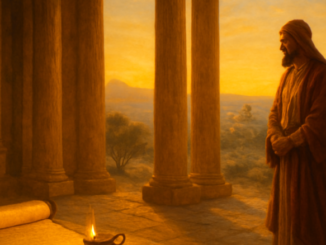
Ancient horn of anointing oil symbolizing inner calling and Masonic transformation
Christianity

First Samuel: Anointing Oil as a Symbol of Inner Calling

A small flask of oil. Ordinary, unremarkable. And yet, when the prophet Samuel pours that oil over the head of a simple shepherd, everything changes. The First Book of Samuel is far more than a chronicle of kings and battles. It reveals a deeper truth about calling, transformation, and the invisible forces that can reshape a person from within. For those who read with symbolic eyes, this ancient text opens a world that resonates profoundly within Freemasonry: the journey from darkness to light, from ignorance to insight. The Horn of Oil: More Than a Ritual Object Picture the horn — a tangible, physical vessel filled with oil pressed from olives. In the daily life of ancient Israel, oil was indispensable: fuel for lamps, nourishment for the body, a balm for healing. But when that same oil is poured over the head of a chosen one, it takes on an entirely different character. The anointing oil becomes a carrier of something that transcends the senses. It marks a transition, a transformation that cannot be seen but is deeply felt. In Freemasonry, we recognize similar moments. When a candidate is initiated, certain actions and objects may appear deceptively simple at first glance […]

Masonic gavel on a workbench symbolizing the cycle of growth and renewal
Christianity

Judges and the Cycle of Falling and Rising: Symbols of Growth

A hammer rests on the workbench. It is motionless, yet it carries within it the potential for both creation and destruction. In much the same way, the Book of Judges lies before us — a collection of stories about leaders who rise and vanish, about a people who fail and recover, fail and recover again. What does this ancient text tell us about the human soul? And how does the symbolism of this seventh book of the Old Testament mirror the path that every Freemason walks? The Cycle as an Archetypal Pattern The Book of Judges does not describe a linear history — it traces a spiral. The people turn away from their path, fall into oppression, cry out for help, and a leader emerges to deliver them. After a period of peace, the cycle begins anew. This pattern repeats itself twelve times, like a mantra carved into the very fabric of the text. For the Freemason, this cycle is deeply familiar. The rough ashlar is not shaped into a perfect cube in a single stroke. It is a process of failure and correction, of straying and returning to center. The cycle in Judges is not a sign of weakness […]

Masonic square and compasses symbolizing the balance of justice and wisdom
Freemasonry & Society

Justice and Retribution: Two Perspectives on Fairness

When news reaches us of a violent crime committed far from home, something ancient stirs within us. A life is taken, a suspect is arrested, and emotions ignite almost instantly. Calls for harsh punishment, outrage over injustice, a deep yearning for retribution. Yet alongside this visceral response, there exist traditions and communities that have looked at such moments differently for centuries — traditions that ask questions before passing judgment. This article explores two perspectives on justice: that of the outraged citizen and that of the searching Freemason. The Perspective of Outrage For most people, the first reaction to a violent crime is entirely understandable and deeply human: horror, anger, and an overwhelming desire for justice. When we hear that a fellow citizen has been killed in a distant land, we feel the pain as if the victim were someone we knew personally. The community closes ranks, the victim is given a face and a story, and the perpetrator becomes a symbol of the evil that must be fought. This perspective is rooted in a fundamental human need for order and safety. Society functions on the basis of shared agreements, and those who violate those agreements in the most horrific manner […]

Open Bible showing the Book of Hosea beside Masonic square and compasses
Christianity

Hosea and the Freemason: Two Perspectives on Faithfulness

The Book of Hosea occupies a remarkable place in the Hebrew Bible. Written by an eighth-century BCE prophet, it speaks of broken promises, unfaithfulness, and the possibility of restoration. But what happens when a biblical scholar and a Freemason each pick up the same text? Both approaches open windows onto deep symbolism — though from very different rooms. The Biblical Scholar Reads: A Covenant History For the biblical scholar, Hosea is first and foremost a historical document. The book emerged during a time of political instability, when the Northern Kingdom of Israel was caught between rival empires. The prophet received an extraordinary commission: he was to marry a woman who would be unfaithful to him. This marriage became a living metaphor for the relationship between the Divine and His people. The scholar analyzes linguistic structures, compares manuscripts, and situates the text within its original context. Unfaithfulness is understood here as idolatry — the straying toward foreign gods and political alliances. The academic approach seeks to uncover what the text meant for its original audience. Which cults were being criticized? Which historical events are reflected in the prophecy? The book closes with a promise of renewal, and the scholar examines how […]

Ancient Roman chariot race arena symbolizing Masonic lessons on status and equality
Freemasonry & Society

Chariot Races as a Mirror: What Circuses Teach About Status

On a sweltering afternoon in Barcelona, drivers battled for the best starting position while thousands of spectators held their breath. The scene was strikingly reminiscent of one that played out two thousand years ago in Rome’s Circus Maximus: charioteers risking their lives under a blazing sun in pursuit of glory and honor. The parallels between ancient chariot racing and modern motorsport are remarkable — but what can these contests truly tell us about our views on status, community, and the society we live in? The Circus Maximus: Arena of Heroes and Symbols In ancient Rome, the Circus Maximus was the beating heart of public life. Up to 250,000 people would gather here to witness chariot races. The four racing stables, known as factiones, were identified by color: blue, green, red, and white. These colors represented far more than sporting rivalry — they symbolized the seasons, the elements, and the cosmic order. The race itself was a ritual, a symbolic battle between the forces of nature fought again and again in the dust of the arena. The charioteers, called aurigae, were often slaves or freedmen who could rise to the status of folk heroes through sheer courage and skill. Their position […]

Masonic level and gavel symbolizing patience and justice in Freemasonry
Freemasonry & Society

Patience as Foundation: What Slow Justice Teaches Freemasons

In an age where everything must happen faster, the slow grinding of the wheels of justice confronts us with an uncomfortable truth: some processes demand a kind of patience that runs directly counter to our expectations. As major court cases drag on for years, we are forced to ask what this means for our trust in societal institutions. Freemasonry, with its centuries-old emphasis on building slowly and deliberately, offers a surprisingly relevant perspective on this tension between haste and thoroughness. The Measure of Time When a court case is delayed for years, frustration is inevitable. Victims wait for acknowledgment, society demands a verdict, and our collective sense of justice feels eroded by endless postponement. Yet within this waiting lies something else entirely — the recognition that truth and justice cannot be forced by the clock. In Freemasonry, we speak of the rough ashlar that must be shaped into a perfect cube. This is not the work of days or weeks, but of years. The apprentice who chips away in haste destroys more than he creates. Seen through this lens, the slow pace of complex legal proceedings may not simply be a failure of efficiency — it may also reflect a […]

Masonic symbols including square and compasses in soft contemplative light
Symbolism & Rituals

Allusive Meaning: Symbols That Whisper in the Silence

The allusive meaning of a symbol does not unfold through explanation — it unfolds through experience. In a world that demands directness and clarity, the allusion offers a refined alternative: it invites reflection without imposing conclusions. For the Freemason, this is not a rhetorical device but a way of life. Today, we explore how the allusive dimension of symbolism bridges the visible and the hidden — the space between what can be spoken and what can only be felt. What Is the Allusive Meaning of a Symbol? When we speak of allusive meaning, we enter the realm of indirect reference. An allusion is never a straightforward statement. It is a nod, a wink toward something greater than the words or images being used. In literature, we recognize this as a reference to a well-known story or figure without naming it explicitly. In symbolism, the concept goes further: the entire medium of communication becomes a whisper. The square and compasses, the rough ashlar, the trowel, the plumb line — all of these objects from the stonemason’s craft carry meanings that extend far beyond their physical form. They point toward something else, something the initiated recognize without it ever needing to be […]

Masonic square and compasses symbolizing allusive meaning in Freemasonry
Symbolism & Rituals

Allusive Meaning: The Art of Veiled Speech in Freemasonry

When we speak of the allusive meaning of words and images, we enter a fascinating realm where nothing is said directly, yet everything is suggested. Allusion is the art of the hint — a reference to something greater without ever naming it outright. In Freemasonry, this way of communicating forms the beating heart of symbolic language. Where others seek direct answers, the Freemason embraces the power of what remains unspoken. What Does “Allusive” Actually Mean? The word “allusive” derives from the Latin alludere, which literally means to play toward something or to refer to it indirectly. An allusive expression never states its meaning outright — instead, it plays with references that the listener or reader must decipher. This demands active engagement, a willingness to look beneath the surface. In everyday language, we use allusions far more often than we realize. When someone speaks of an “Achilles’ heel” or a “stumbling block,” they are referencing stories that resonate far deeper than the words themselves. Allusive meaning distinguishes itself from literal meaning by drawing on shared knowledge, experience, or culture. It creates a bond between speaker and listener — an invisible thread of understanding that exists only for those who recognize the […]

Montaigne essay on misdirected emotions and Masonic self-knowledge
Content & Summary

Montaigne on False Objects: When Our Emotions Go Astray

Why do we slam a door after stubbing our toe? Why do we shout at a frozen computer as though it were deliberately conspiring against us? In the fourth essay of the first book of his Essays, Michel de Montaigne explores this peculiar human behavior: our tendency to direct emotions at objects that have absolutely nothing to do with what actually troubles us. It is a short but penetrating piece that reveals something essential about the human psyche — and offers surprising insights for anyone committed to genuine self-knowledge. The Core Idea: Emotions Cannot Hang in a Void Montaigne opens with a paradox most of us will recognize immediately. The human soul, he argues, cannot let its passions dangle in empty space. Once an emotion has been aroused, it insists on finding an outlet — a target, a destination, an object. But what happens when the real object of our anger, grief, or frustration is out of reach? The soul invents a surrogate. It fabricates a false object onto which it can project its feelings. Crucially, Montaigne does not treat this as a sign of weakness or irrationality. He suggests it is simply how human emotions work. Our passions demand […]

A single tear drop symbolizing grief, vulnerability, and Masonic brotherhood
Freemasonry & Connection

The Tear as Symbol: Montaigne, Grief, and Brotherhood

A tear falls. A single droplet of moisture sliding down a cheek. In everyday life, we might look past it quickly, or avert our gaze out of respect for someone else’s sorrow. But what if we truly considered this tear? What if we paused, as sixteenth-century philosopher Michel de Montaigne did in his essay “Of Sadness,” to reflect on what this small gesture reveals about our humanity and our connection to others? The Tear as a Language Beyond Words In his essay, Montaigne describes how the most intense emotions are sometimes too vast for words. The deepest grief, he observes, exceeds our ability to express it. When sorrow overwhelms us, the body takes over: we weep, we fall silent, we tremble. The tear then becomes more than a physical reaction — it becomes a symbol of everything that language cannot contain. Freemasonry holds a deep understanding of this language beyond words. Rituals, symbols, and gestures carry meanings that the intellect alone cannot fully grasp. Just as the tear speaks where the voice fails, so too do the working tools of the Freemason speak of truths that resist neat definitions. The square does not merely measure angles; it also measures the […]

Ancient potter shaping clay symbolizing Jeremiah and Masonic transformation
Christianity

Jeremiah and Freemasonry: The Prophet as Inner Builder

In 586 BCE, an event unfolded that would shake the Jewish people to their very core: the destruction of the Temple in Jerusalem by the Babylonians. At the center of this historical catastrophe stood a figure who had been sounding warnings for decades. The prophet Jeremiah, whose name has become synonymous with lamentation and prophecy of doom, also carried within him a message of profound hope. For those willing to look beyond the rubble, his vision of rebuilding extended far beyond walls of stone — it reached into the very depths of the human heart. A Prophet in Times of Decline Jeremiah’s prophetic calling began around 627 BCE, during a period when the kingdom of Judah was slowly sliding toward political and moral collapse. What makes the Book of Jeremiah so remarkable is its deeply personal tone. Unlike many other prophetic writings, Jeremiah reveals a man who struggles with his mission, who doubts and suffers. He was called to uproot and tear down, but also to build and to plant. This dual commission forms the very heart of his message. Understanding the historical context is essential to grasping Jeremiah’s significance. The Assyrian Empire had collapsed, Egypt and Babylon were vying […]

A symbolic mirror reflecting multiple faces representing Masonic self-knowledge
Freemasonry & Connection

The Mirror with Many Faces: Montaigne and Freemasonry

Imagine a mirror that doesn’t show one reflection, but a hundred. Every time you look, you see a different face — not because the mirror is broken, but because you yourself are constantly changing. This image captures the essence of what sixteenth-century philosopher Michel de Montaigne described in his reflections on the inconsistency of human action. And it is precisely this insight that reveals a striking kinship with the symbolic journey Freemasons undertake in their quest for self-knowledge. The Unstable Ground Beneath Our Feet Montaigne observed something we all recognize but rarely dare to admit: we are not the consistent beings we believe ourselves to be. Yesterday’s hero is today’s coward. The generous hand closes into a fist by morning. This is not a moral failing — it is a fundamental feature of human existence. We do not move in a straight line from birth to death, but in circles, spirals, and sometimes seemingly random patterns. Freemasonry begins from a remarkably similar starting point. The rough ashlar with which every Freemason symbolically begins their journey is not rough because it is flawed. It is rough because it has not yet been worked — because it has not yet become conscious […]

Vrijmetselarij - New Year's Day: The Masonic Symbolism of a Fresh Beginning
Symbolism & Rituals

New Year’s Day: The Masonic Symbolism of a Fresh Beginning

New Year’s Day represents a clean slate — a chance to start over with renewed purpose and hope. It is a day steeped in reflection, aspiration, and deep symbolism. For Freemasons, this annual turning point carries special significance, offering a meaningful opportunity to reflect on the ongoing construction of one’s personal temple: the lifelong pursuit of self-improvement and harmony with the world around us. The Symbolism of Renewal Renewal lies at the very heart of Freemasonry. New Year’s Day symbolizes the great cycle of life — the ever-present opportunity to begin again with fresh eyes and a clear mind. The turning of the calendar invites deep introspection: How have we built upon ourselves over the past year? Which rough edges have we smoothed, and which building blocks do we wish to add in the year ahead? Just as the sun rises after every night, New Year’s Day reminds us that light follows even the darkest challenges. It is a day of hope and a powerful reminder of the eternal cycle of growth and improvement — a cycle that every Mason recognizes in the work of the lodge and in the journey of the soul. Traditions and the Bond of Brotherhood […]

Candlelit Masonic lodge with checkered floor evoking the Exodus journey
Religion

Exodus: The Journey to Freedom and Inner Growth

Picture a lodge draped in silence, candlelight flickering across the black-and-white checkered floor. A brother reads aloud from the Book of Exodus — the story of a people who cast off their chains in the dead of night and set out into the wilderness, moving toward something they cannot yet name. The words hang in the air, and everyone in the temple feels it: this story is not merely about an ancient people in a distant land. It is about us. What makes the story of Exodus so indelible? Why does this tale of slavery, liberation, and an endless trek through the desert still move us, thousands of years after it was first told? And what does a Freemason gain by returning to this ancient narrative again and again — not as a historical document, but as a mirror for the soul? Egypt as Inner Captivity In the Book of Exodus, everything begins with slavery. The Israelites groan under the yoke of Pharaoh, trapped in a system that reduces them to mere instruments. Within Freemasonry, this image is far more than a historical fact — it is a powerful allegory. Egypt symbolizes every form of inner captivity: the chains of […]

Open Volume of the Sacred Law displaying Genesis in a Masonic lodge setting
Religion

Genesis and Freemasonry: The Deep Symbolism of the Beginning

A candle flickers. A man sits alone in a dimly lit room, a heavy book open on his lap. His eyes trace the very first lines of the Old Testament — words he has read dozens of times before. Yet tonight, they feel as though they are speaking to him for the first time. Not as an ancient story about the origin of the world, but as a mirror posing a single, penetrating question: where does your creation begin? It is a question that has echoed through Masonic lodges for centuries — not as a theological puzzle, but as an invitation to self-examination. The Book of Genesis is one of the most widely read texts in human history, revered across diverse faith traditions. But what makes this creation narrative so particularly meaningful to the Freemason? The answer lies in its imagery. Genesis speaks in symbols that resonate directly with Masonic philosophy: the passage from darkness to light, from chaos to order, from unconscious existence to a life lived with awareness and intention. Becoming: Every Beginning as a Threshold Experience The word Genesis derives from the Greek for “becoming” or “origin.” That alone is telling. In Freemasonry, the concept of a […]

Open Book of Proverbs with Masonic square and compasses symbolizing wisdom
Christianity

Proverbs and Freemasonry: Wisdom as a Building Block of Character

The Book of Proverbs has spoken to seekers of wisdom for millennia. For some, it is a collection of practical rules for living from an ancient world. For others, it is a timeless mirror reflecting moral principles that remain as relevant today as when they were first written. But how does a Freemason approach these ancient texts? And what does someone discovering the symbolic richness of this book for the first time see in its pages? In this exploration, we examine two perspectives on wisdom as raw material for the inner life. The Perspective of the Traditional Reader For many readers, Proverbs is primarily a collection of practical advice attributed to wise kings and teachers of ancient Israel. The book belongs to what scholars call wisdom literature, and it contains short, pithy statements about honesty, diligence, humility, and justice. The tone is direct, sometimes stern, and always oriented toward daily life. A father speaks to his son, a teacher to his student. The wisdom conveyed is concrete: avoid the foolish, seek the righteous, guard your tongue. From this perspective, the book is essentially a manual for right conduct. The reader is encouraged to listen, to learn, and to improve their […]

Open book of Psalms with Masonic square and compasses symbolizing wisdom
Christianity

Psalms and Masonic Symbolism: Practical Wisdom for Daily Life

We all know those moments — a chaotic day spiraling out of control, a difficult decision that refuses to resolve itself, or a stretch of uncertainty that just won’t lift. The Psalms, a collection of 150 songs from the Old Testament, offer surprisingly practical guidance for exactly these situations. In Freemasonry, these ancient texts serve as a rich source of symbolism that can help you take concrete steps in your personal development. This article explores how to translate the imagery of the Psalms into everyday application. The Psalms as a Toolbox for Life Written over the course of centuries, the Psalms contain songs for every human experience: joy, sorrow, fear, gratitude, and wonder. For Freemasons, this is especially relevant because the Volume of the Sacred Law holds a central place in the lodge. The Psalms are often found open upon it as a symbol of wisdom and direction. But how do you translate ancient poetry into something meaningful for your life today? The answer lies in recognizing universal patterns. When a psalmist sings of walking through a dark valley, you may recognize your own season of uncertainty. When the text speaks of building a house upon a rock, you can […]

Open ancient book with Masonic rough ashlar stone symbolizing inner growth
Christianity

The Book of Job: Suffering as a Building Block for Inner Growth

You know the feeling: a season when everything falls apart. Loss, setback after setback, and the people around you don’t seem to understand. In moments like these, a question surfaces — one that humanity has grappled with for thousands of years: why is this happening to me? The Book of Job from the Old Testament confronts us with exactly this question. But it also offers a surprisingly practical framework for anyone willing to look deeper. For Freemasons in particular, this ancient book of wisdom contains symbols that speak directly to the inner journey every Brother or Sister undertakes. The Heart of the Story: A Righteous Man Put to the Test Job is a prosperous, upright man who loses everything — his possessions, his children, his health. His friends insist he must have done something wrong to deserve such misfortune. But Job knows he is innocent. The book isn’t really about whether suffering is a punishment. It’s about how you respond when life hits you with incomprehensible adversity. Job refuses to surrender his integrity, even when everything is stripped away from him. That is the first practical lesson: character stands firm when comfort disappears. The Symbolism of the Rough Ashlar In […]

Rough ashlar stone and chisel symbolizing Masonic self-improvement journey
Personal Development & Leadership

The Broken Journey: Personality Beyond Appearances

A journey begins with a suitcase. We pack clothes, toiletries, perhaps a book. But what we truly carry with us is invisible: our expectations, our fears, our hopes of escaping the routines of daily life. When a journey ends in tragedy — as happened recently with a German family in Istanbul — we are confronted with the fragility of existence. And with a deeper question: who were these people, really, beyond the headlines? This question touches on something essential that Freemasonry continually explores: the mystery of personality itself. The Mask and the Face The word “personality” derives from the Latin persona, which originally referred to the mask worn by actors in Roman theater. The mask concealed the actor’s true face while simultaneously amplifying the voice and making the character recognizable to the audience. There is a striking paradox here that deserves reflection: our masks both hide and reveal at the same time. When a court examines a case involving the loss of human life, it attempts to see through the masks. Judges weigh facts, but also intentions, backgrounds, and the inner state of those involved. They search for the essence behind the actions. This is a task we all perform […]