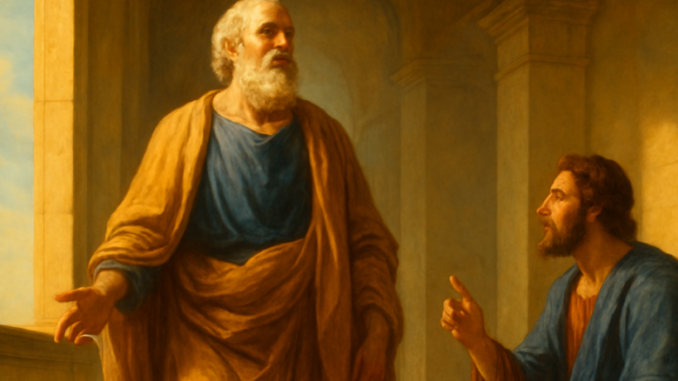
In 369 BC, Plato wrote a dialogue that continues to captivate philosophers and seekers to this day. The Theaetetus poses a deceptively simple question: what is knowledge? Asked more than 2,400 years ago in the streets of Athens, this question still forms the bedrock of every serious inquiry into epistemology. For Freemasons, this dialogue carries particular significance, as the pursuit of truth and understanding lies at the very heart of the Masonic endeavor.
The Intellectual Climate of Plato’s Athens
To fully appreciate the Theaetetus, we need to step into fourth-century BC Athens. Plato composed this dialogue during a period of intense philosophical ferment. His teacher Socrates had been condemned to death several decades earlier, and Plato had since founded his Academy — the first institution of higher learning in the Western world. The intellectual landscape was shaped by several competing schools of thought that Plato engaged with critically.
The Sophists, itinerant teachers of rhetoric and argumentation, had spread relativistic views about truth. Protagoras, whose famous declaration that “man is the measure of all things” still echoes across the centuries, represented the position that knowledge is subjective and ever-changing. Plato vehemently opposed this view. At the same time, the pre-Socratic natural philosophers exerted a powerful influence. Heraclitus’s doctrine of perpetual flux and Parmenides’s emphasis on unchanging Being formed two poles between which the Theaetetus navigates.
The Three Definitions of Knowledge
In the dialogue, Plato has the young mathematician Theaetetus propose three definitions of knowledge, each of which Socrates systematically examines. The first definition equates knowledge with perception. Socrates connects this to the teachings of Protagoras and Heraclitus: if everything is in constant flux and perception is relative, how can we ever arrive at stable knowledge? Plato demonstrates that this position ultimately undermines itself.
The second definition describes knowledge as true belief. This, too, proves untenable — someone may hold a true belief by sheer accident without genuinely understanding why something is true. The third and most influential definition states that knowledge is true belief accompanied by a rational account or justification. This tripartite structure of belief, truth, and justification would later become the foundation of Western epistemology. Yet the dialogue ends in aporia — a philosophical impasse — through which Plato signals that the search for knowledge is never complete.
True knowledge does not arise from passive observation, but from active reflection and the ability to explain why something is true.
The Socratic Method as Midwifery of Ideas
One of the most remarkable elements in the Theaetetus is Socrates’s comparison of his philosophical method to the art of midwifery. His mother Phaenarete was a midwife, and Socrates describes himself as someone who helps others give birth to their thoughts. He possesses no wisdom of his own to impart, but instead assists others in bringing their own insights into the light. This method — known as maieutics, or the art of intellectual midwifery — would remain profoundly influential for centuries.
The Stoics, including Epictetus and Marcus Aurelius, adopted the emphasis on self-reflection. The Skeptics — notably Pyrrho and later the Academic Skeptics — built upon the aporetic elements in Plato’s work. Even the Neoplatonists such as Plotinus, who further developed Plato’s Theory of Forms, recognized the importance of the Theaetetus as preparation for deeper metaphysical inquiry.
Renaissance Humanism and the Rediscovery
The Theaetetus was largely forgotten in Western Europe during the Middle Ages, but it was rediscovered during the Renaissance. In the fifteenth century, Marsilio Ficino translated Plato’s complete works into Latin, giving a new generation of thinkers access to these foundational texts. The humanists saw in Plato an ally in their fight against dogmatism and their advocacy for critical inquiry.
Michel de Montaigne showed himself deeply indebted to the Socratic tradition. His famous motto “Que sais-je?” (What do I know?) echoes the aporetic spirit of the Theaetetus. René Descartes’s methodical doubt and his quest for indubitable foundations of knowledge likewise stand in this lineage. Through the centuries, the dialogue has remained a touchstone for anyone who seriously contemplates the limits and possibilities of human knowledge.
Resonance in Freemasonry
Freemasonry, which assumed its modern form in the eighteenth century, inherited much from these philosophical traditions. The Masonic emphasis on the personal search for truth and light aligns closely with Socratic maieutics. The lodge functions as a space where brethren help one another develop insights — not by imposing dogmas, but by asking questions and encouraging reflection.
The three degrees of Entered Apprentice, Fellowcraft, and Master Mason can be read as stages in the development of knowledge. The Apprentice begins with perception and experience. The Fellowcraft cultivates true belief through study and practice. The Master strives for knowledge with justification — a deeper understanding of the meaning behind the forms. This process is never complete, just as the Theaetetus ends without a definitive answer. The search itself is the path.
From Athens to the Lodge
What Plato explored more than two millennia ago in Athens remains profoundly relevant for anyone who asks what it truly means to know something. The Theaetetus teaches us humility: knowledge is not easily defined, and any claim to absolute certainty always deserves critical scrutiny. At the same time, the dialogue offers hope — through continual reflection and dialogue, we can draw closer to genuine insight, even if we never reach the final destination.
The philosophical legacy of Plato’s Theaetetus extends from the pre-Socratic thinkers through the Stoics and Skeptics, the Renaissance humanists, the Enlightenment philosophers, and into the living tradition of Freemasonry. Each generation takes up the same fundamental question and, in doing so, keeps the flame of inquiry alive. For the Mason who enters the lodge seeking light, this ancient dialogue serves as a powerful reminder: the willingness to question, to examine, and to remain open to new understanding is itself the highest form of wisdom.
Plato’s Theaetetus stands as one of the most enduring meditations on the nature of knowledge ever written. Its refusal to offer easy answers — its insistence that the pursuit of truth requires courage, humility, and relentless self-examination — mirrors the very essence of the Masonic journey. Whether we sit in the Academy of ancient Athens or gather in the lodge, the question remains the same: What do we truly know, and how do we know it? In embracing that question rather than fleeing from it, we honor both the philosopher and the Craft.
Copyright text & image: devrijmetselaar.nl
Texts are based on the ideas and content of the author of devrijmetselaar.nl, reviewed, corrected, and supplemented with the assistance of OpenAI. Images are created based on the ideas of the author of devrijmetselaar.nl using OpenAI/DALL-E.

Be the first to comment