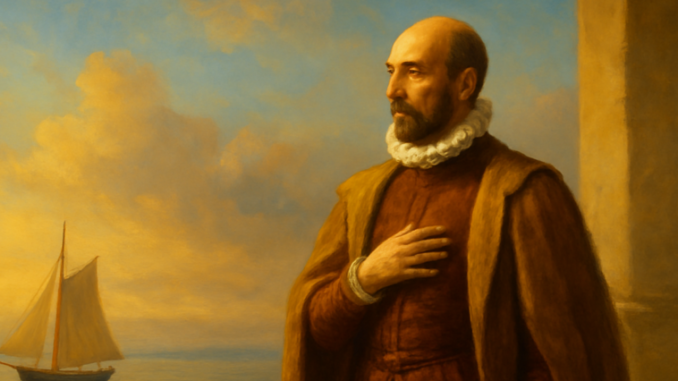
Imagine waking up tomorrow under exactly the same circumstances as yesterday, yet suddenly feeling happier. Nothing in the outside world has changed — only the way you look at it. This simple thought experiment strikes at the heart of what Michel de Montaigne explores in his fourteenth essay. But where did this sixteenth-century thinker draw his ideas from? The philosophical sources he tapped into turn out to be remarkably relevant today, shedding light on how Freemasons, too, think about moral truth and personal perception.
The Stoic Legacy in Montaigne’s Thought
When you read Montaigne’s essay, you immediately taste the influence of Stoic philosophy. Thinkers like Seneca, Epictetus, and Marcus Aurelius shared a central conviction: it is not events themselves that determine our well-being, but our judgments about those events. Montaigne, who frequently quoted and admired Seneca, adopted this starting point and gave it his own distinctive twist. He observed how people experienced the same adversity in completely different ways, depending on their inner disposition.
The Stoics drew a clear line between what lies within our control and what does not. You cannot command the weather, but you can choose how you respond to it. Montaigne applied this principle to the moral domain: what we label as good or evil depends on the perspective we take. This might sound relativistic, but for the Stoics it was precisely a path toward inner freedom. Once you understand that your judgment is malleable, you also gain the power to reshape it.
Skepticism as Liberating Doubt
Alongside the Stoics, Montaigne drew generously from the Skeptical tradition. Philosophers such as Sextus Empiricus and Pyrrho of Elis taught that human knowledge is always provisional. We can never state with absolute certainty how reality is truly structured. Montaigne adopted the famous motto “Que sais-je?” — What do I know? — as his personal device. This was not intellectual laziness but a profound humility about the limits of the human mind.
Our judgment of good and evil is not a mirror of reality, but a window into our own mind.
In the fourteenth essay, you see this Skepticism at work as Montaigne piles up examples of people who hold opposing views about the same situations. Poverty is a curse to one person and a liberation from material concerns to another. Death is feared by some and welcomed by others. Skepticism gave Montaigne the intellectual tools to regard this variation not as chaos, but as evidence that our judgments are constructions — shaped by temperament, experience, and culture rather than by any fixed external standard.
Renaissance Humanism and the Rediscovery of Antiquity
Montaigne wrote in an era of intellectual excitement. Renaissance humanism had rediscovered and made accessible the classical texts of Greece and Rome. Thinkers like Erasmus and Petrarch had paved the way for a renewed appreciation of ancient wisdom. Montaigne benefited enormously: his personal library contained hundreds of classical works, and his essays are laced with quotations from Plutarch, Cicero, Lucretius, and many others.
Plutarch deserves special mention. His Moralia, a collection of philosophical essays, served as a direct source of inspiration for Montaigne’s own essay form. The Greek writer treated moral questions not as abstract theories but as practical matters of daily life. Montaigne followed this example and added his characteristic personal observations — confessional, wandering, and always honest about his own contradictions.
The Connection with Freemasonry and Symbolism
You might wonder what this philosophical background has to do with Freemasonry. The connection runs deeper than you might expect. Freemasons work with symbols, and the power of symbols lies precisely in what Montaigne describes: the same image can carry different meanings for different people. The rough ashlar symbolizes the unworked self, but what that means in practice depends entirely on your own personal reflection.
The Stoic and Skeptical traditions that inspired Montaigne resonate strongly with Masonic values:
- Self-reflection as a path toward wisdom
- Humility about one’s own knowledge and judgment
- The conviction that inner work matters more than outer circumstances
- Respect for different perspectives within a brotherhood
When Freemasons gather in lodge, they bring different backgrounds, beliefs, and life experiences with them. The symbolic language they share creates a common space for reflection, without requiring everyone to arrive at the same conclusions. This is precisely the spirit Montaigne breathes: an appreciation for diversity of insight, combined with a shared quest for self-knowledge.
Historical Context: The Wars of Religion
It is impossible to fully understand Montaigne’s essay without considering the historical context of the French Wars of Religion. While he was writing, Catholics and Protestants were tearing each other apart in the name of their respective versions of the truth. Montaigne, who as mayor of Bordeaux had to navigate between both factions, witnessed daily how absolutist convictions led to violence. His emphasis on the relativity of moral judgment was not merely philosophical — it was also an implicit call for tolerance.
This experience explains why Montaigne scrutinized so critically the certainty with which people defend their beliefs. If our perception of good and evil truly depends on our opinion, then humility is not optional — it is essential. And humility, as Montaigne well understood, is the beginning of peace. This lesson carried forward through the centuries and found fertile ground in the Masonic tradition, where men of different faiths and convictions learn to meet on the level.
The philosophical background of Montaigne’s fourteenth essay reveals a rich intellectual heritage. Stoicism, Skepticism, and Renaissance humanism converge in his insight that our judgment of good and evil does not reflect objective truth, but rather the landscape of our own mind. For Freemasons, this idea holds particular resonance: the lodge is a space where personal perception meets shared symbolism, where the rough stone is shaped not by dogma but by individual reflection. Montaigne’s enduring invitation is simple yet profound — the next time you find yourself certain about what is good or evil, pause, and ask yourself: is this the world speaking, or is it my own mind?
Copyright text & image: devrijmetselaar.nl
Texts are based on the ideas and content of the author of devrijmetselaar.nl, reviewed, corrected, and supplemented with the assistance of OpenAI. Images are created based on the ideas of the author of devrijmetselaar.nl using OpenAI/DALL-E.
Frequently Asked Questions
What is the connection between Montaigne's philosophy and Freemasonry?
Montaigne's exploration of how perspective shapes our understanding of good and evil aligns closely with Masonic teachings about moral development and self-improvement. Both traditions emphasize that inner wisdom and personal reflection are paths to enlightenment, encouraging individuals to examine their judgments and grow beyond rigid thinking. Freemasons, like Montaigne, believe that understanding the malleability of perspective leads to greater compassion and moral clarity.
How do Stoic principles relate to Masonic practice?
The Stoic distinction between what we control and what we don't directly parallels Masonic principles of personal responsibility and virtue. Freemasons use these Stoic insights to cultivate resilience, wisdom, and ethical behavior by focusing on perfecting their character rather than external circumstances. This shared philosophical foundation helps explain why Freemasonry has long valued self-discipline and inner transformation.
Why does Montaigne's skepticism matter to modern Masons?
Montaigne's humble questioning—'What do I know?'—teaches Freemasons to approach moral truth with openness rather than dogmatism. This skeptical attitude encourages Masons to continually examine their beliefs, respect diverse perspectives, and recognize that wisdom comes from acknowledging the limits of our understanding. Such intellectual humility strengthens the fraternal bond by fostering genuine dialogue among members.
How does Renaissance humanism connect to Freemasonry's values?
Renaissance humanism's emphasis on rediscovering ancient wisdom and elevating human potential resonates deeply with Freemasonry's mission to foster education and enlightenment. Both traditions celebrate the dignity of the individual mind and the transformative power of classical knowledge. Freemasons continue this humanistic legacy by promoting self-cultivation and the pursuit of truth through reason and study.


Be the first to comment