Sometimes a news headline stops you in your tracks. A twelve-year-old boy killed under violent circumstances. An adult suspect arrested. You read the words, feel the helplessness, and wonder: how can a human being be capable of such a thing? It is precisely in moments like these that the ancient question of human character forces itself upon us — not as an abstraction, but as an urgent search for understanding.
The Unfathomable Human Being
When confronted with extreme violence, we instinctively reach for explanations. We want to understand what drives a person, what went wrong in the shaping of a personality. The philosopher Aristotle argued that character is not given at birth but formed through repeated actions. You become what you do, again and again. You do not become virtuous by reading about virtue — you become virtuous by acting virtuously.
This insight is as comforting as it is unsettling. It means that every human being has the capacity for growth and improvement. But it also implies that wrong choices, repeated over time, can shape a personality capable of terrible deeds. Freemasonry takes this idea profoundly seriously.
The Rough Stone as Metaphor
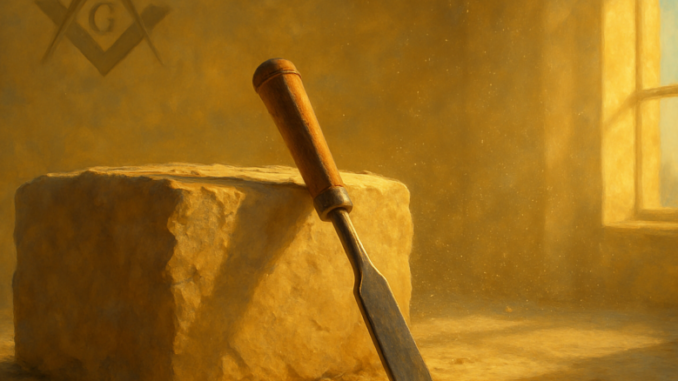
In Freemasonry, the rough ashlar is a central metaphor for the unworked human being. You enter the lodge with all your imperfections, your sharp edges, your hidden flaws. The work you undertake is not the building of temples in the outside world but the shaping of your own personality. The gavel and chisel are tools for inner labor.
Character formation is not a matter of chance but a craft: every day you chip away a piece of rough stone to free the better person within.
This awareness — that you must actively work on who you are — is fundamental. It means you bear responsibility for your own development. It is not circumstances that determine who you become, but the choices you make in response to those circumstances. Marcus Aurelius, the Roman emperor and Stoic philosopher, wrote in his meditations that the soul takes on the color of its thoughts. What you repeatedly think, you become.
Brotherhood as a Mirror
You might wonder what brotherhood has to do with all this. In Freemasonry, the lodge is regarded as a training ground for life. There you meet people from different backgrounds, with different opinions and different temperaments. In that encounter, you are confronted with yourself. The other person serves as a mirror.
The French essayist Michel de Montaigne understood this well. In his essays, he explores how we come to know ourselves through our interactions with others. True self-knowledge does not arise in isolation but in relationship. Brotherhood offers a safe space to face your shortcomings without being condemned. This is not a luxury — it is a necessity for anyone who wishes to shape their character.
When Formation Is Absent
A tragedy like this raises the question of what happens when such formation is absent. When someone has no mirrors, no community to offer correction, no commitment to inner work. Freemasonry does not pretend to have all the answers to such dark questions. But it does offer a framework for thinking about human responsibility and the necessity of conscious development.
Jean-Jacques Rousseau wrote that humanity is naturally good but corrupted by society. Others, like Thomas Hobbes, saw human beings as naturally violent, tamed only by civilization. Freemasonry does not take sides in this debate. Instead, it poses a practical question: what are you doing, here and now, to become a better person?
The Daily Choice
Character formation is not a one-time decision. It is a daily choice, repeated in small moments. How do you respond when someone insults you? What do you do with your anger, your frustration, your fear? The Stoics taught that you have no control over what happens to you, but you do have control over how you respond. That space between stimulus and reaction is where your character is forged.
The Freemason is invited to regularly pause and reflect on his own actions. Not to condemn himself, but to learn. What did I contribute today? Where did I fall short? How can I do better tomorrow? These questions are simple, but answering them honestly requires courage.
Hope Amid Darkness
Amid news of violence and loss, it is tempting to become cynical about human nature. But Freemasonry holds fast to a fundamental optimism: the human being is capable of improvement. Not everyone will choose that path, but the possibility exists. And where that possibility exists, there is also hope.
Johann Wolfgang von Goethe, himself a Freemason, wrote that within every person lies the seed of something higher. It is up to us to cultivate that seed — in ourselves and in others. This does not begin with grand gestures but with the small, daily choices that together form a character.
A twelve-year-old child who loses his life reminds us painfully of the fragility of existence and the devastating consequences when a human personality takes a dark turn. Freemasonry offers no easy answers, but it does extend an invitation: take your own formation seriously. Work on the rough stone. Seek the mirror of brotherhood. And know that every day is a new opportunity to choose the light.
Copyright text & image: devrijmetselaar.nl
Texts are based on the ideas and content of the author of devrijmetselaar.nl, reviewed, corrected, and supplemented with the assistance of OpenAI. Images are created based on the ideas of the author of devrijmetselaar.nl using OpenAI/DALL-E.
Frequently Asked Questions
What is the significance of the rough ashlar in Freemasonry?
In Freemasonry, the rough ashlar is a central metaphor representing the unworked human being who enters the lodge with imperfections and hidden flaws. The work undertaken in the lodge is focused on shaping one's own personality through inner labor, using the gavel and chisel as tools for self-improvement. This metaphor emphasizes that character formation is a craft requiring active effort, not a matter of chance.
How does Freemasonry view the formation of human character?
Freemasonry takes seriously the philosophical idea that character is not given at birth but is formed through repeated actions and choices. Following Aristotle's teachings, the organization recognizes that you become what you repeatedly do, and that every human being has the capacity for growth and improvement. Members bear personal responsibility for their own development through deliberate, ongoing work on themselves.
What role does brotherhood play in personal development within Freemasonry?
The lodge is regarded as a training ground for life where members meet people from different backgrounds, opinions, and temperaments. Through these encounters, members are confronted with themselves, as other people serve as mirrors for self-reflection. This brotherhood creates an environment where individuals can examine themselves and learn from diverse perspectives.

Be the first to comment