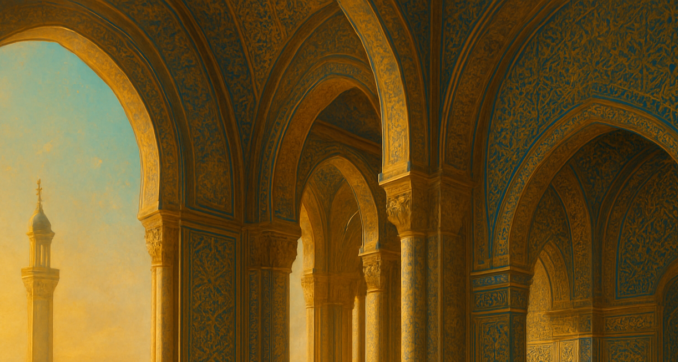
Imagine standing at the edge of a vast desert, where sand dunes stretch endlessly toward the horizon. The landscape appears unchanging, yet every gust of wind reshapes its contours. This image of impermanence and constant transformation lies at the heart of the forty-sixth chapter of the Quran, known as The Dunes. What can this ancient Arabic wisdom text reveal to you as a Freemason — or as any seeker of spiritual depth — about your own inner journey?
The Essence of Surah Al-Ahqaf
Al-Ahqaf, the Arabic name for The Dunes, takes its title from the sand hills that once formed the homeland of the people of Aad. According to Islamic tradition, this ancient civilization thrived in the southern reaches of the Arabian Peninsula, enjoying great prosperity and impressive technological advancement. Yet they were ultimately brought down by their arrogance and their refusal to heed spiritual warnings. The surah describes how their mighty structures were eventually swallowed by the very desert that had once brought them wealth.
There is a universal theme here that sits at the very core of Freemasonry: the tension between building enduring works and recognizing that all material creations are ultimately impermanent. The question that remains is not what you build, but who you become in the process of building.
Impermanence as a Teacher
The image of the dunes is extraordinarily powerful as a spiritual metaphor. Dunes are never static — they move, change shape, and can either bury or reveal entire civilizations. Masonic philosophy contains a strikingly similar wisdom. Consider the progression from Entered Apprentice to Fellow Craft to Master Mason: each stage demands the release of old certainties and the embrace of new insights. Your former self is covered, as it were, by new sand, while deeper layers of your being are simultaneously uncovered.
The true builder recognizes that every stone he lays is part of a greater whole that transcends him, and that his most important work lies not in the stones themselves, but in the transformation of his own character.
The Quran presents the fate of Aad not as cruel punishment, but as a lesson in humility. The people possessed knowledge, skill, and wealth, but lacked the inner orientation that gives those gifts meaning. For any modern seeker, this is an invitation to ask yourself: what inner qualities are you cultivating alongside your outward achievements?
The Prophet as a Messenger of Light
A central element in The Dunes is the figure of the prophet Hud, who warned his people without being heard. This motif of the unheeded wise one appears in virtually every spiritual tradition. In Freemasonry, we encounter the figure of Hiram Abiff, the Master Builder who guarded his secrets to the end and became a symbol of integrity under pressure.
Both narratives pose the same question: are you willing to listen to wisdom you might prefer not to hear? The dunes eventually covered the cities of Aad, but Hud’s message lived on through stories and scripture. This is how spiritual knowledge works — it survives the impermanence of those who carry it.
Brotherhood Beyond Boundaries
What makes this surah particularly relevant to Freemasonry is its emphasis on universal human values. The Quran here addresses not just one people or one era, but everyone willing to listen. Freemasonry shares a similar openness: Brothers from all religious backgrounds meet in the Lodge, not to deny their differences, but to celebrate their shared humanity.
Both traditions emphasize personal responsibility. Both view material works as a means, not an end. Both invite self-reflection and moral growth. And both acknowledge wisdom in diverse sources.
The philosopher Averroës, who bridged Greek philosophy and Islamic theology in twelfth-century Andalusia, understood that truth is not bound to a single tradition. His work later influenced European thinkers like Thomas Aquinas and formed a bridge between civilizations. In that same spirit, you can read The Dunes — not as a text intended to convert you to a particular faith, but as a mirror for your own spiritual development.
The Journey Through the Desert
The desert is a place of trial and purification across many traditions. Moses led his people through the wilderness for forty years. The Christian Desert Fathers sought solitude there to find God. Sufi mystics used the desert as a metaphor for the dark night of the soul. The dunes in this surah are not merely a geographical feature — they represent a spiritual landscape.
You may recognize moments in your own life that feel like a desert crossing: periods of uncertainty, loss, or searching without a clear direction. The Dunes teaches that such moments are never meaningless. The sand that covers old structures makes room for new growth. The wind that opposes you may also be the force that propels you forward.
Building Inwardly in Times of Change
For the Freemason, this imagery offers rich material for reflection. The working tools you handle symbolically in the Lodge are ultimately intended for inner work. The compasses and the square do not help you build physical walls — they help you refine the architecture of your character. And just like the dunes that are perpetually reshaped, your inner temple is never truly finished.
The Dunes invites you to reflect on what is truly lasting. Not the stones you stack, but the love with which you place them. Not the knowledge you accumulate, but the wisdom with which you apply it.
In the meeting of an ancient Quranic surah and the centuries-old Masonic tradition, a shared truth emerges: the most important journey is the one inward, and the most beautiful structures are those that the eye cannot see. Whether you encounter this wisdom through the symbols of the Lodge, the verses of sacred scripture, or the quiet moments of your own contemplation, the lesson of the dunes remains the same — everything changes, yet meaning endures for those willing to seek it.
Copyright text & image: devrijmetselaar.nl
Texts are based on the ideas and content of the author of devrijmetselaar.nl, reviewed, corrected, and supplemented with the assistance of OpenAI. Images are created based on the ideas of the author of devrijmetselaar.nl using OpenAI/DALL-E.

Be the first to comment