Freemasonry is one of the world’s oldest and most widely recognized fraternal organizations, and much of its enduring fascination lies in the rich visual language it employs. From the tools of the stonemason’s trade to ancient philosophical allegories, Masonic symbols serve as vehicles for moral instruction, spiritual reflection, and fraternal identity. Understanding the freemasonry symbols meaning requires a journey through centuries of history, philosophy, and tradition — a journey that reveals not secrets in the sensational sense, but a carefully constructed system of ethical teaching expressed through powerfully resonant imagery.
Historical Background: The Origins of Masonic Symbolism
To understand why Freemasonry uses the symbols it does, one must first appreciate the organization’s origins. The roots of modern speculative Freemasonry are typically traced to the operative stonemason guilds of medieval Europe. These guilds — composed of craftsmen who built the great cathedrals, castles, and civic buildings of the Middle Ages — developed their own customs, signs of recognition, and organizational structures to protect trade knowledge and maintain standards of craft.
As the seventeenth century progressed, these operative lodges began admitting “accepted” or non-operative members — educated gentlemen, philosophers, and intellectuals who were drawn to the fraternal spirit and allegorical potential of the builder’s craft. By 1717, when the first Grand Lodge was formally established in London, Freemasonry had fully transitioned into what is known as speculative Masonry — an organization that uses the tools and vocabulary of architecture as metaphors for the construction of moral character and an enlightened society.
Key intellectual figures of the Enlightenment, including scientists, philosophers, and statesmen, were attracted to the Lodge. Notable Freemasons such as Benjamin Franklin, Voltaire, Wolfgang Amadeus Mozart, and later George Washington embraced the fraternity’s ideals. It was within this atmosphere of Enlightenment thinking that the symbolic vocabulary of Freemasonry was systematized and enriched. The symbols drawn from the builder’s craft were layered with meanings drawn from classical philosophy, Hermeticism, Kabbalah, and Christian mysticism, creating a uniquely multifaceted symbolic language.
The earliest Masonic documents that survive — known as the Old Charges or Gothic Constitutions, with the Regius Manuscript dating to approximately 1390 — speak of the mythological history of geometry and the craft. Later, James Anderson’s Constitutions of the Free-Masons (1723) helped codify much of the organizational philosophy that gave structure to the symbolic teachings used in lodge ritual to this day.
Core Masonic Symbols and Their Meanings
The body of Masonic symbolism is extensive, but certain symbols stand out as foundational — appearing in lodge rooms, Masonic artwork, and ceremonial regalia across cultures and centuries. Each carries layers of meaning that initiates are encouraged to contemplate throughout their Masonic journey.
The Square and Compasses
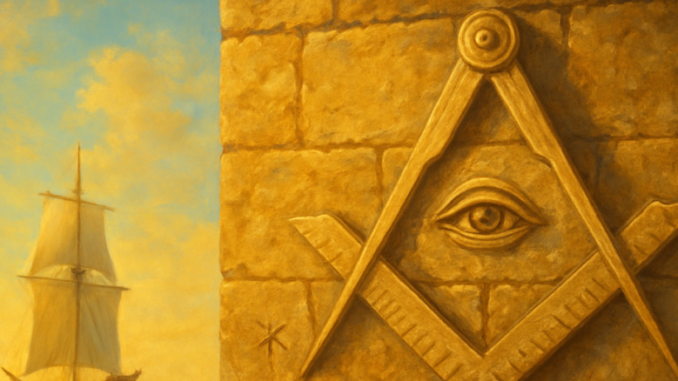
Perhaps the most universally recognized symbol of Freemasonry is the combined image of the square and compasses, often depicted with the letter “G” at the center. This emblem appears on lodge buildings, rings, aprons, and publications around the world, making it the de facto logo of the fraternity.
The square — a right-angle measuring tool used by operative masons to ensure that stonework was perfectly true — symbolizes morality, honesty, and the rectitude of conduct. To “act on the square” means to deal fairly and honestly with one’s fellow human beings. The square is the tool of the Fellow Craft, the second degree of Masonry, and represents the earthly and material realm of human action.
The compasses (or compass) are used to draw circles and to measure proportions. In Masonic allegory, they represent the spiritual and intellectual dimensions of human existence — the ability to circumscribe one’s passions and keep desires within due bounds. Together, the square and compasses suggest the balance between the material and spiritual, the practical and the ideal.
The letter “G” at the center of this emblem is traditionally said to stand for both Geometry — the foundational science of the builder’s craft — and for God (or the “Grand Architect of the Universe,” as Freemasonry refers to the Supreme Being in inclusive, non-denominational terms). This dual meaning reinforces the idea that the study of natural laws and the acknowledgment of a divine creative intelligence are inseparable in the Masonic worldview.
The All-Seeing Eye
The All-Seeing Eye, also known as the Eye of Providence, is one of the most symbolically potent images in Freemasonry. Depicted as a single human eye, often surrounded by rays of light or set within a triangle, it represents the omniscient watchfulness of the Grand Architect of the Universe — the idea that divine intelligence observes all human actions and intentions.
This symbol has ancient antecedents. The Eye of Horus from Egyptian mythology, the Buddhist concept of the “Eye of the World,” and the Christian iconographic tradition of a divine eye within a triangle all contributed to its cultural resonance. In Freemasonry, it serves as a constant reminder to the Mason that virtue must be practiced not merely in public, where social pressures encourage good behavior, but equally in private, where only one’s conscience and a higher power bear witness.
The All-Seeing Eye was incorporated into the reverse of the Great Seal of the United States in 1782 — a design associated with Charles Thomson and William Barton — and later appeared on the American one-dollar bill in 1935. While this has led to considerable popular speculation about Masonic influence on American founding documents, historians note that the symbol’s use predates its Masonic associations and was part of a broad Enlightenment vocabulary of divine providence.
The Rough and Perfect Ashlars
In Masonic lodge rooms, two stones are typically displayed as part of the lodge’s symbolic furniture: the rough ashlar and the perfect ashlar. An ashlar is a block of stone used in construction, and the contrast between these two stones forms one of Freemasonry’s most elegant teaching allegories.
The rough ashlar represents the newly initiated Mason — imperfect, unpolished, still bearing the marks of nature without art. The perfect ashlar — smooth, true, and ready to take its place in an architectural structure — represents the Mason who has worked diligently on their moral and intellectual development, refining their character through education, reflection, and practice. The journey from rough to perfect ashlar is, in essence, the entire Masonic journey: a lifelong process of self-improvement.
The Level and Plumb Rule
Two more working tools of the speculative Mason are the level and the plumb rule (or plumb line). The level — used by operative masons to ensure horizontal surfaces were truly flat — symbolizes equality: the idea that all human beings, regardless of rank, wealth, or social station, stand on equal ground within the lodge. This was a notably democratic principle in an era of rigid social hierarchies.
The plumb rule, used to verify that vertical structures were perfectly upright, symbolizes uprightness of character and conduct — the aspiration to stand morally straight in all one’s dealings. Together with the square, these three tools form what Masons call the “immovable jewels” of the lodge, each carried by one of the lodge’s three principal officers.
The Acacia Branch
The acacia tree holds a particular place in Masonic symbolism, especially in the ritual of the third degree — the Master Mason degree. In Masonic legend, an acacia branch marks the resting place of Hiram Abiff, the legendary architect of Solomon’s Temple, whose story forms the central allegorical narrative of the Master Mason’s initiation.
The acacia, an evergreen shrub that retains its leaves throughout the year, symbolizes the immortality of the soul and the endurance of truth. It is associated with resurrection, renewal, and the triumph of the spirit over death. This makes it one of the most philosophically meaningful symbols in the entire Masonic system, connecting the craft’s teachings directly to questions of mortality, meaning, and what lies beyond.
The Beehive
The beehive is a symbol of industry, cooperation, and collective labor toward a common goal. In Masonic moral philosophy, it reminds members of the virtue of honest work and the importance of contributing to one’s community and fraternity. The ordered social structure of the beehive — where every member has a role and contributes to the whole — serves as an aspirational model for human society.
This symbol became particularly prominent in the ritual and iconography of the eighteenth and nineteenth centuries, reflecting both Enlightenment values of productive citizenship and the fraternal emphasis on mutual support among lodge members.
The Pillars of Jachin and Boaz
Two great pillars, named Jachin and Boaz, feature prominently in Masonic lodge design and ritual. These pillars derive from the biblical description of Solomon’s Temple as recorded in 1 Kings 7:21, where two great bronze columns flanked the entrance to the Temple’s porch. In Masonic symbolism, they represent stability and strength — Jachin is typically interpreted as representing “establishment” or divine confirmation, while Boaz represents “strength.”
Together, the pillars frame the entrance to the lodge and serve as reminders of the Temple of Solomon, which occupies a central place in Masonic allegory as the supreme example of divine architecture — a structure built through skilled labor, cooperative effort, and reverence for higher principles. They also represent the duality inherent in human experience: strength and beauty, wisdom and power, the active and the passive principles.
The Symbolic System: Allegory and Moral Instruction
What distinguishes Masonic symbolism from mere iconography is the way symbols are embedded within a structured system of ritual and degree work. A candidate progressing through the three principal degrees of Craft Masonry — Entered Apprentice, Fellow Craft, and Master Mason — encounters symbols in a deliberate sequence, each building upon the last to create an ever-deepening philosophical education.
The Entered Apprentice, the first degree, introduces the Mason to the fundamental tools: the twenty-four-inch gauge (representing the organization of time), the common gavel (representing the breaking away of bad habits), and the chisel (representing the importance of education). These simple tools initiate a process of self-examination that will continue throughout a Mason’s life.
Masonic scholars such as Albert Pike, whose monumental nineteenth-century work Morals and Dogma (1871) explored the philosophical dimensions of Masonic symbolism in extraordinary depth, and Albert G. Mackey, whose Encyclopedia of Freemasonry remains a standard reference work, have both emphasized that Masonic symbols are intentionally layered. They are not meant to yield a single fixed meaning but to invite ongoing contemplation and personal interpretation. As Pike wrote: “The symbols of the wise always have more than one meaning.”
This open-ended quality distinguishes Masonic symbolism from dogmatic religious iconography. A Mason from a Christian background, a Jewish background, or an Islamic background can each find resonance in the same symbols, because those symbols point toward universal moral and philosophical truths rather than doctrinal specifics. This inclusive quality has been part of Freemasonry’s appeal to men of diverse backgrounds since at least the eighteenth century.
Symbols Across the Degrees and Rites
Beyond the three degrees of Craft Masonry, numerous additional degrees and rites have developed within the broader Masonic family, each introducing further symbolic complexity. The Scottish Rite, for example, extends the degree system to thirty-three degrees (with the thirty-third being honorary), each exploring additional philosophical, historical, and allegorical themes through an ever-expanding vocabulary of symbols.
The York Rite introduces symbols associated with the Royal Arch degree — including the triple tau, a symbol composed of three overlapping letter T shapes — and with the chivalric Orders of the Knights Templar, which bring in Christian symbolism of the cross and sword. The Ancient and Primitive Rite and various Memphis-Misraïm rites incorporate Egyptian symbolism, including the pyramid and the ankh, into their degree work.
Even within the basic Craft degrees, regional variations exist. Scandinavian Freemasonry, for instance, has long incorporated a specifically Christian theological framework into its ritual, while American and British lodges tend to maintain a more broadly theistic approach. Despite these variations, the core symbolic vocabulary — square and compasses, pillars, apron, and working tools — remains remarkably consistent across jurisdictions, reflecting the shared heritage of the fraternity.
The Masonic Apron: Purity and Innocence
One of the most personal and meaningful symbols in Freemasonry is not an emblem on a wall or a piece of furniture in a lodge room, but an item of clothing: the Masonic apron. Made of white lambskin, the apron is presented to every Mason at the moment of initiation and is described in Masonic ritual as “more ancient than the Golden Fleece or Roman Eagle, more honorable than the Star and Garter.”
The white lambskin apron symbolizes purity of conscience and the innocence that a newly initiated Mason brings to the fraternity. The apron’s origin in the practical leather apron worn by operative stonemasons connects the speculative Mason to the long tradition of skilled craftspeople whose labor built civilization. Over the course of a Mason’s progress through the degrees, the apron may be elaborated with additional embroidery and symbols, but the pure white lambskin beneath remains a constant reminder of the foundational virtues: innocence, purity, and the commitment to moral excellence.
Freemasonry Symbols in Culture and Art
The influence of freemasonry symbols meaning extends well beyond the walls of lodge rooms. Masonic imagery has permeated Western art, architecture, music, and literature for centuries. Mozart’s opera The Magic Flute (1791), composed in the year of Mozart’s death and widely interpreted as a Masonic allegory, features three-fold repetition (a Masonic sacred number), themes of initiation, trials of fire and water, and the triumph of enlightenment over ignorance — all rendered through symbolic narrative.
In architecture, Masonic themes influenced the design of public buildings across Europe and America. The Washington Monument, the layout of Washington D.C., and numerous courthouses, libraries, and civic buildings bear design elements traceable to Masonic aesthetic philosophy — the belief that harmonious proportion, sound geometry, and durable materials reflect the virtues of the society that creates them.
In literature, figures from Sir Walter Scott to Arthur Conan Doyle to Rudyard Kipling incorporated Masonic themes into their work. Kipling’s poem The Mother Lodge beautifully captures the fraternal bond that transcends social and cultural difference within the lodge room — a theme that resonates with the egalitarian symbolism of the level.
Frequently Asked Questions About Freemasonry Symbols
What does the “G” in the square and compasses stand for?
The “G” traditionally stands for both Geometry — the foundational science of the ancient builder’s craft — and for God, referred to in Freemasonry as the Grand Architect of the Universe. This dual meaning reflects the Masonic conviction that the study of natural laws and the acknowledgment of a divine creative intelligence are complementary rather than contradictory pursuits. Different Masonic traditions may emphasize one meaning over the other, but most recognize both as valid interpretations.
Is the All-Seeing Eye a Masonic symbol?
The All-Seeing Eye is indeed used in Freemasonry, where it represents the omniscient watchfulness of the Grand Architect of the Universe. However, it is not exclusively Masonic in origin. The symbol has ancient roots in Egyptian, Buddhist, and Christian iconographic traditions and was widely used in Enlightenment-era visual culture before becoming associated with Freemasonry. Its appearance on the Great Seal of the United States reflects this broader cultural use, though the design’s creators were certainly aware of its Masonic resonance.
What is the significance of Solomon’s Temple in Masonic symbolism?
Solomon’s Temple occupies the central position in Masonic allegory as the supreme example of divinely inspired architecture, built through skilled labor, cooperative effort, and moral rectitude. The Temple’s legendary architect, Hiram Abiff, is the protagonist of the Master Mason degree’s foundational allegory. The pillars of Jachin and Boaz, the construction tools, the lodge room’s architectural layout — all derive symbolic meaning from the Temple narrative. The Temple represents the ideal that human society, properly organized and morally grounded, can reflect divine order.
Why does Freemasonry use symbols rather than direct instruction?
Freemasonry employs symbolic and allegorical teaching because its founders and early systematizers believed that symbols engage the imagination and the emotions in ways that direct didactic instruction does not. A symbol, encountered repeatedly and contemplated over years of lodge membership, gradually yields deeper layers of meaning as the Mason’s own life experience and philosophical understanding develop. This approach draws on a long tradition of esoteric and philosophical education, from Platonic allegory to Renaissance emblematic literature, all of which held that symbols could communicate truths beyond the reach of literal language.
Do all Masonic symbols mean the same thing in every country?
The core symbolic vocabulary of Freemasonry — the square and compasses, working tools, pillars, apron, and ashlar — is remarkably consistent across national and jurisdictional boundaries, reflecting the shared heritage of the fraternity. However, the interpretation and emphasis placed on particular symbols can vary. Some rites incorporate additional symbols drawn from local religious, historical, or philosophical traditions. Scandinavian Freemasonry’s explicitly Christian framework, for example, gives certain symbols a specifically Christian meaning, while Anglo-American Craft Masonry maintains a more broadly theistic interpretation. This flexibility is one of Freemasonry’s strengths: the symbolic system is rich enough to accommodate diverse cultural and spiritual perspectives while maintaining a common moral core.
Read more about this topic
- All articles in this category: Symbolism & Rituals
- Symbols in Freemasonry: Meaning and Background
- Violence and Justice: A Historic Look at Human Darkness
- Montaigne on Prophecy and the Masonic Search for Truth
- Acts: Building Community Across Borders in Freemasonry
- Montaigne's Philosophical Sources on Divination and Prophecy
Frequently Asked Questions
Why does Freemasonry use so many symbols instead of just teaching lessons directly?
Masonic symbols serve as powerful vehicles for moral instruction and spiritual reflection, allowing complex ethical teachings to be conveyed through memorable and resonant imagery. This symbolic approach, rooted in the organization's origins with medieval stonemason guilds, engages both the intellect and imagination, making the lessons more profound and personally meaningful to each member. The layering of meanings from philosophy, classical traditions, and spiritual teachings creates a rich educational experience that has proven effective for centuries.
Where do the symbols used in Freemasonry come from?
Masonic symbols originate primarily from the tools and vocabulary of the stonemason's trade, dating back to medieval European builder guilds who constructed great cathedrals and civic buildings. As Freemasonry evolved into a speculative organization in the seventeenth century, these architectural symbols were enriched with meanings drawn from classical philosophy, Hermeticism, Kabbalah, and Christian mysticism. This blending of sources created a uniquely multifaceted symbolic language that reflects the Enlightenment ideals embraced by notable Freemasons such as Benjamin Franklin, Voltaire, and George Washington.
Are Masonic symbols secret, and what do they really mean?
While Freemasonry is known for its private rituals and modes of recognition, the symbols themselves are not secret in a sensational sense—they represent a carefully constructed system of ethical teaching expressed through powerful imagery. The meanings of Masonic symbols are rooted in moral instruction, spiritual reflection, and the metaphorical construction of character and enlightened society. Understanding these symbols requires appreciating their historical context and philosophical foundations rather than seeking hidden or mystical revelations.
When were Masonic symbols standardized and organized as they exist today?
Masonic symbols were systematized during the Enlightenment period, with crucial codification occurring in the early eighteenth century, particularly through James Anderson's Constitutions of the Free-Masons published in 1723. The formal establishment of the first Grand Lodge in London in 1717 marked the transition from operative to speculative Masonry and provided the organizational structure through which the symbolic vocabulary was standardized. These foundational teachings, drawing on earlier documents like the Regius Manuscript from around 1390, continue to form the basis of lodge rituals and symbolic instruction today.


Be the first to comment