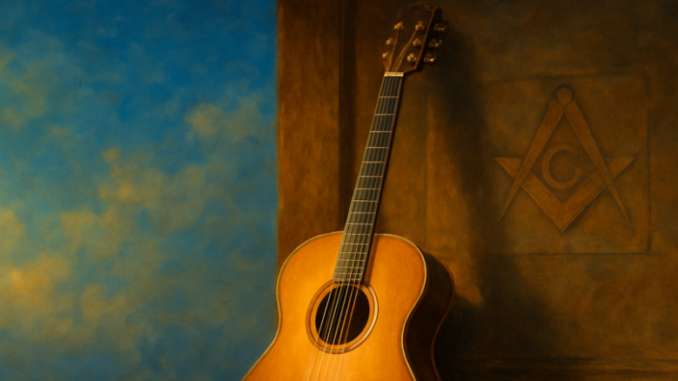
What do the six strings of a guitar have in common with the symbols on a Masonic tracing board? More than you might think. Both the guitar and Freemasonry are deeply rooted in symbolism, introspection, and the pursuit of harmony. They each offer a path toward self-improvement, connection, and creativity — making them a surprisingly powerful combination worth exploring.
The Guitar as a Symbol of Balance
A guitar is far more than a musical instrument — it is a powerful symbol in its own right. Its six strings represent equilibrium and balance: between body and mind, work and rest, reason and emotion. In Freemasonry, this same pursuit of balance is fundamental. The square and compasses, among the most central symbols of the Craft, point to the necessity of measuring our lives both rationally and intuitively, and bringing them into harmony.
The shape of the guitar itself carries deeper meaning. The hollow body, which produces sound through resonance, can be seen as a metaphor for the human soul. Just as a guitar only produces music when it is open to vibrations from the outside, a person can only truly grow by remaining open to the influences and experiences the world has to offer.
The Role of Sound in Masonic Ritual
Sound plays a vital role in both music and Freemasonry. In Masonic rituals, sound is often used to create a specific atmosphere and to guide the brethren into the right state of mind. Think of the profound power of silence during a ceremony, or the striking of a gavel. These moments of sound and silence function much like a musical composition — they carry an emotional message that transcends words.
The guitar adds a unique dimension to this experience. When a guitar is played in a Masonic context, it does more than create a sense of harmony — it deepens the spiritual experience for everyone present. Every chord, every melody has the potential to reach deeper layers of consciousness and bring us closer to ourselves and to one another.
Improvisation and Self-Improvement
Freemasonry encourages every individual to walk their own path and to work continuously on self-improvement. This aligns seamlessly with the concept of improvisation in guitar music. A guitarist discovers new melodies and sounds through experimentation — a creative process that demands both discipline and intuition in equal measure.
Improvisation mirrors the Masonic quest for perfection. A Freemason works on the “rough ashlar” — a metaphor for the unrefined self — through practice, introspection, and lived experience. Just as a guitarist adjusts a chord to find exactly the right tone, a Freemason refines his behavior and beliefs in the ongoing effort to become a better person.
Connecting Through Sound
A guitar has a remarkable power to connect people, both musically and socially. Whether during an informal jam session or in a concert hall, the instrument brings people together. This connective power is also a core value of Freemasonry. The brotherhood invites its members to build a better world together, with each person contributing their own unique talents and perspectives.
Within a lodge setting, the guitar can play a particularly meaningful role as an accompanying instrument. It supports communal singing, accompanies moments of reflection, and creates a tangible sense of unity. Just as the different strings of a guitar come together to form a harmonious chord, the diverse members of a lodge work together to achieve something greater than any one of them could alone.
Symbolism and Harmony in Practice
The symbolic connections between the guitar and Freemasonry go well beyond surface-level similarities. Both invite us to look deeper and to feel more profoundly. The six strings of a guitar, each with its own pitch yet together forming melodies, remind us of the importance of cooperation and balance. Just as Freemasonry uses symbols to explore abstract ideas, a piece of guitar music can open us up to entirely new perspectives.
Consider the Mosaic Pavement of Freemasonry — that checkered floor symbolizing the duality between light and darkness, good and evil. This duality translates beautifully into guitar music. Every chord contains both tension and resolution, and it is precisely this balance that defines the beauty of music. Just as a Freemason strives for inner balance, a guitarist brings his sounds into harmony — creating something that resonates far beyond the notes themselves.
Freemasonry and guitar music are both paths toward harmony, introspection, and human connection. They help us not only to understand ourselves more deeply, but also to touch and inspire others. Whether you are strumming a chord or participating in a Masonic ritual, both experiences offer a profound reflection on what it means to be human. Together, they form an inspiring symphony of sound and symbolism — proof that the quest for meaning can be found in the most unexpected places.
Copyright text & image: devrijmetselaar.nl
Texts are based on the ideas and content of the author of devrijmetselaar.nl, reviewed, corrected, and supplemented with the assistance of OpenAI. Images are created based on the ideas of the author of devrijmetselaar.nl using OpenAI/DALL-E.
Frequently Asked Questions
What is the connection between a guitar's six strings and Freemasonry?
Both the guitar's six strings and Masonic symbolism represent balance and harmony between opposing forces — such as body and mind, work and rest, reason and emotion. Just as a guitar requires all six strings in equilibrium to produce beautiful music, Freemasonry teaches that a balanced life leads to personal growth and spiritual harmony. This shared pursuit of equilibrium makes the guitar a meaningful symbol that complements Masonic principles.
How does music play a role in Masonic rituals?
Sound is a powerful tool in Masonic ceremonies, used to create a specific atmosphere and guide members into a meditative state of mind. The strategic use of both sound and silence — much like a musical composition — carries emotional and spiritual messages that deepen the experience for all present. When a guitar is incorporated into these rituals, it enhances the spiritual journey and fosters a deeper connection among the brethren.
How does guitar improvisation relate to Masonic self-improvement?
Both guitar improvisation and Masonic practice require discipline, intuition, and continuous refinement. A guitarist discovers new melodies through experimentation, while a Freemason works on perfecting himself through practice and lived experience — much like polishing the "rough ashlar" into a finished stone. This parallel process shows how creativity and self-improvement go hand in hand in both pursuits.
Can music bring Freemasons together?
Yes, music is a universal language that connects people on a profound level, and Freemasonry values this connective power as a core principle. The guitar's ability to unite people through sound mirrors Freemasonry's mission to build brotherhood and strengthen bonds among its members. Whether in informal gatherings or formal ceremonies, music enhances the sense of community and shared purpose within the fraternity.

Be the first to comment