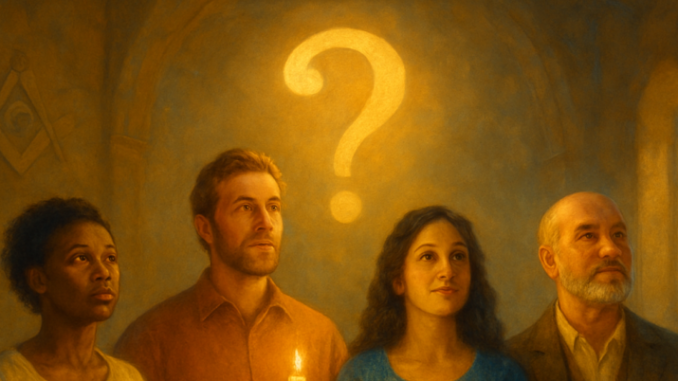
Freemasonry sparks curiosity — and that’s a good thing. Where there’s mystery, questions naturally arise. Whether you’ve been quietly considering reaching out to a lodge or you simply want to understand what Freemasonry is really about, this page offers honest and thoughtful answers to the most frequently asked questions. No evasion, no mystification — just clarity.
Is Freemasonry a Secret Society?
This is probably the most common question of all. The short answer: Freemasonry is not a secret society, but it does contain certain “secrets.” Before your imagination runs wild, those secrets have nothing to do with dark plans or hidden agendas. The “secrets” of Freemasonry refer to personal experiences and symbolism that can only truly be understood by living through them yourself. Think of rituals and ceremonies designed to stir something deep within you. They’re kept private not out of fear of exposure, but out of respect for the experience itself.
Is Freemasonry a Religion or a Cult?
No. Freemasonry is neither a religion nor a cult. There is no dogma, no required belief system, and no leader who must be followed. What is asked of members is an openness to the existence of something greater than themselves. That could be God, the universe, nature, or the idea of universal connectedness. Freemasons come from every religious — and non-religious — background: Christians, Muslims, Buddhists, humanists, agnostics, and everything in between. Diversity of thought is not just tolerated; it’s actively encouraged.
Is Freemasonry Elitist or Only for Certain People?
Absolutely not. Freemasonry is open to anyone who is serious about self-improvement. Whether you’re a baker, a lawyer, an artist, or a plumber — your background, social status, or income don’t matter. What counts is who you are as a person, how you approach life, and whether you’re willing to grow. Inside the lodge, all members stand as equals. We engage with one another based on character, not title.
Are Freemasons Behind Conspiracies or Secret World Plans?
This is one of the most persistent misconceptions, fueled largely by movies and conspiracy theories. In reality, Freemasonry is a space for personal development and moral reflection. Freemasons are ordinary people with an extraordinary motivation to live consciously. There is no political agenda, no shadow government, and no secret power structure. What there is: people trying to do good, quietly and without the spotlight.
What Do Freemasons Do During Their Meetings?
Lodge meetings are formal gatherings centered around ritual, symbolism, and reflection. Typically, one of the members delivers a presentation — often called a “piece of architecture” — on a philosophical or moral topic, followed by group discussion and contemplation. The rituals serve to turn attention inward, to encourage mindful presence and learning through symbolism. It’s a unique blend of depth, structure, and brotherhood.
Is There a Minimum Age or Other Requirements for Joining?
Most jurisdictions require candidates to be at least 21 years of age and willing to work on themselves. There is no maximum age. Whether you’re young and searching for direction or older and seeking deeper meaning, everyone can take the step at their own right moment. The most important thing is that you come to Freemasonry of your own free will and that your curiosity is genuine.
Is Freemasonry Only for Men?
Historically, many grand lodges have been exclusively male. However, the Masonic landscape today is far more diverse. There are male-only lodges, female-only lodges, and mixed-gender organizations such as Le Droit Humain, where men and women work side by side as full members. Freemasonry is available to everyone, regardless of gender — it’s simply a matter of finding the right lodge or order for you.
How Much Time Does Freemasonry Require?
A lodge typically meets once a week on a set evening. Beyond that, there may be occasional extra activities, lectures, or social gatherings. But how much time you invest is ultimately up to you. Freemasonry isn’t about obligations — it’s about dedication to your own development. You get out of it what you put in.
What Does Freemasonry Mean for Everyday Life?
Freemasonry isn’t a hobby you can neatly separate from the rest of your life. The insights you gain, the conversations you have, and the reflections you experience gradually seep into how you think, act, and feel. It won’t change you overnight, but it gives you tools to live more consciously — with greater compassion, inner calm, and a clearer sense of direction.
What Will I Gain from Freemasonry?
That depends entirely on your commitment and your willingness to learn. Many Freemasons report experiencing:
- Greater inner peace and mental clarity
- Deeper understanding of themselves and others
- A profound sense of connection and brotherhood
- More ethical and responsible behavior in daily life
Freemasonry doesn’t hand you ready-made answers. Instead, it teaches you to ask better questions — the kind of questions that lead to real growth.
If you have questions, you’re already on the right track. Freemasonry isn’t a path for people who think they have all the answers — it’s for those who want to discover, explore, and grow. Don’t let misconceptions or doubts hold you back. Ask your questions. Seek your answers. And who knows — it may lead you to a path that profoundly enriches your life. If your question wasn’t covered here, don’t hesitate to reach out to a lodge near you. In the next and final section, you’ll receive a concrete invitation to take your first step — your chance to move from reading to experiencing.
Copyright text & image: devrijmetselaar.nl
Texts are based on the ideas and content of the author of devrijmetselaar.nl, reviewed, corrected, and supplemented with the assistance of OpenAI. Images are created based on the ideas of the author of devrijmetselaar.nl using OpenAI/DALL-E.
Frequently Asked Questions
Is Freemasonry a Secret Society?
Freemasonry is not a secret society, but it does contain certain 'secrets' — personal experiences and symbolic rituals that can only be truly understood by living through them yourself. These are kept private out of respect for the experience itself, not out of fear or hidden agendas.
Is Freemasonry a Religion or a Cult?
No, Freemasonry is neither a religion nor a cult. There is no dogma or required belief system, and members come from every religious and non-religious background — Christians, Muslims, Buddhists, humanists, and more. What's encouraged is an openness to something greater than yourself, however you personally define that.
Is Freemasonry Elitist or Only for Certain People?
Absolutely not. Freemasonry is open to anyone serious about self-improvement, regardless of background, social status, or income. Inside the lodge, all members stand as equals and are valued based on character and integrity, not title or profession.
Are Freemasons Behind Conspiracies or Secret World Plans?
This persistent misconception is largely fueled by movies and conspiracy theories. In reality, Freemasonry is a space for personal development and moral reflection, with no political agenda, shadow government, or secret power structure — just ordinary people motivated to live consciously and do good.
What Do Freemasons Do During Their Meetings?
Lodge meetings are formal gatherings centered around ritual, symbolism, and reflection. Typically, members deliver presentations on philosophical or moral topics followed by group discussion, with rituals designed to encourage mindful presence, inward reflection, and learning through symbol and brotherhood.

Be the first to comment