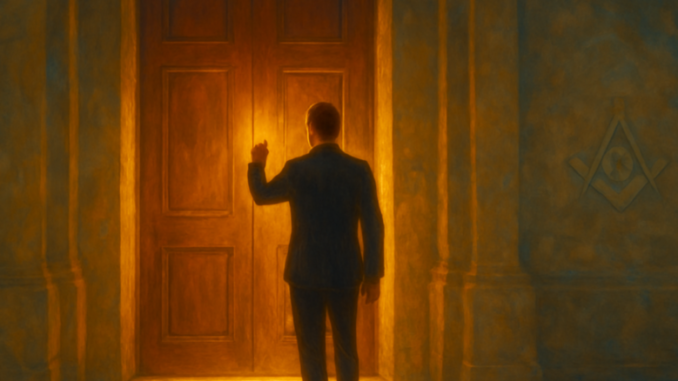
Freemasonry is a centuries-old tradition that unites people in their pursuit of personal growth, ethics, and deeper meaning. Perhaps you’ve been reading about it, exploring Masonic websites, or talking to someone who is already a member — and something about it resonates with you. But how does one actually become a Freemason? What does the process look like, and what should you expect? In this article, we walk you through the journey step by step — clearly, openly, and without unnecessary mystery.
A Conscious Choice — Not a Barrier, but a Door
Becoming a Freemason is not something that simply happens to you. It is a deliberate, personal choice. No one will recruit you, pressure you, or try to convince you. The initiative must come from you. You are the one who knocks on the door.
Freemasonry is open to men aged 18 and over who are committed to self-improvement, want to contribute to society, and are open to the idea that there is more to life than what can be measured. You don’t need to follow a particular religion, but you should be spiritually receptive. You don’t need to be perfect, but you should be eager to learn. You don’t need to think alike, but you do need to treat others as equals.
Step 1: Make Contact
The first step is simple but powerful: let it be known that you’re interested. You can do this by finding a lodge through a Grand Lodge website, sending an email, or approaching a lodge member if you already know one personally.
You don’t need to have everything figured out at this stage. All you need is genuine curiosity.
Step 2: The Introductory Conversation
After you’ve expressed interest, you’ll typically be invited for an introductory conversation. This meeting is informal and open. Its purpose is to answer your questions and to explore together whether Freemasonry might be a good fit for you.
You’ll learn more about what the lodge does, what Freemasonry involves, and what the expectations are. At the same time, the lodge gets to know you a little better as well. Think of it as a two-way conversation, not an interview.
Step 3: Getting to Know the Lodge
If the feeling is right on both sides, you’ll be invited to attend a few evenings at the lodge as a guest — not yet as a member. This gives you a chance to experience the atmosphere, meet the members, and get a sense of the conversations and activities that take place.
Freemasonry is, at its heart, a community. It’s important that you feel at home within it — and equally important that the lodge feels comfortable with you. This period of mutual discovery is a valuable part of the process.
Step 4: Formal Application and Ballot
When you’ve decided that you’d like to become a member, you submit a formal request to the lodge. This request is discussed among the existing members, each of whom has the opportunity to share their perspective. A vote then takes place — a process traditionally known as the ballot.
This procedure isn’t designed to exclude people. Rather, it exists to carefully safeguard the trust, safety, and harmony within the lodge. What matters most is your attitude, your openness, and your willingness to grow.
Step 5: The Initiation — Your Official Beginning
Once accepted, you’ll undergo your initiation. This is an impressive and deeply symbolic ritual that marks your official entry into Freemasonry. It’s not secret theater — it’s a carefully composed experience filled with meaning and purpose.
From that moment on, you become an Entered Apprentice — the first degree in Freemasonry — and your Masonic journey truly begins.
What to Expect After Joining
After your initiation, you gain access to lodge meetings, rituals, lectures, and discussions designed to challenge your thinking and encourage personal development. You’ll be guided by fellow brethren, given space to find your own path, and supported as you build upon your own character, step by step.
You’ll quickly discover that Freemasonry is not something that merely happens to you — it’s something you actively shape. Through quiet reflection, through symbolism, but also through concrete actions in your everyday life.
Is Freemasonry for Everyone?
Freemasonry isn’t a cure-all, and it isn’t for everyone. It’s not a club for quick answers or superficial networking. It is a path for seekers, for thinkers, for doers. It’s for men who have the courage to look honestly at themselves in the mirror and the humility to listen to others.
If you feel ready to live more consciously, to question yourself, and to become part of a community built on trust, brotherhood, and growth — then Freemasonry might just be the next step you’ve been looking for.
Freemasonry is not a destination. It’s a beginning — the start of a journey in which you are central, but in which you are never alone. If something in these words speaks to you, perhaps it’s time to take that first step. The door is there. All you have to do is knock.
Copyright text & image: devrijmetselaar.nl
Texts are based on the ideas and content of the author of devrijmetselaar.nl, reviewed, corrected, and supplemented with the assistance of OpenAI. Images are created based on the ideas of the author of devrijmetselaar.nl using OpenAI/DALL-E.
Frequently Asked Questions
Do I need to be religious to become a Freemason?
No, you don't need to follow a particular religion to join Freemasonry. However, you should be spiritually receptive and open to the idea that there is more to life than what can be measured. Freemasonry welcomes men of all faiths who share a commitment to personal growth and ethical living.
What is the minimum age requirement to become a Freemason?
Freemasonry is open to men aged 18 and over. Beyond age, the key requirement is that you're committed to self-improvement, want to contribute to society, and are willing to treat others as equals.
Will someone recruit me to become a Freemason?
No, Freemasonry doesn't work through recruitment or pressure. The initiative must come entirely from you — you are the one who knocks on the door. This ensures that membership is a conscious, personal choice made by those genuinely interested in the organization's values and mission.
What happens after I express interest in joining?
After expressing interest, you'll be invited for an informal introductory conversation where your questions are answered and you can explore whether Freemasonry is right for you. If both sides feel it's a good fit, you'll be invited to attend lodge meetings as a guest to experience the community and atmosphere before making a final decision.
Do I need to be perfect or have everything figured out to join?
Not at all. Freemasonry welcomes men who may not be perfect but are eager to learn and committed to self-improvement. The organization is built on the principle that all members are on a journey of personal growth and development together.


Be the first to comment