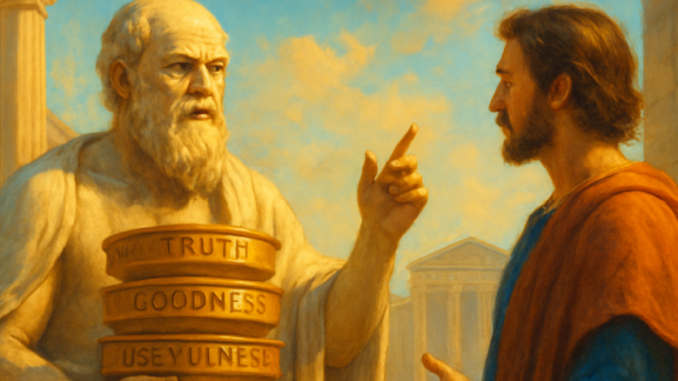
In Freemasonry, our meetings are a blend of serious reflection and warm fellowship. Brothers chat over coffee before the lodge opens, share a drink during the interval, and linger after the closing to enjoy each other’s company. During the formal proceedings — the lodge work itself — the tone is generally more earnest, with lectures and presentations that challenge us to think deeply. Yet even then, there is always room for a well-timed anecdote. Recently, a brother shared the parable of the Three Sieves of Socrates, and it struck a chord with everyone present. It is a short story, but one well worth reflecting upon — because its lesson is as relevant today as it was in ancient Athens.
The Story of the Three Sieves
Socrates, the great Greek philosopher, was walking through the streets of Athens one day when a man rushed toward him in a state of excitement. “Socrates! I must tell you something about your friend who—”
“Hold on a moment,” Socrates interrupted. “Before you go any further, have you passed the story you want to tell me through the Three Sieves?”
“The Three Sieves? What three sieves?” the man asked, bewildered.
“Let us try,” Socrates suggested calmly.
The First Sieve: Truth
“The first sieve is the Sieve of Truth. Have you verified whether what you are about to tell me is actually true?”
“Well, no,” the man admitted. “I heard someone else say it, and—”
“I see,” said Socrates.
The Second Sieve: Goodness
“Then surely it has passed through the second sieve — the Sieve of Goodness? Is what you want to tell me about my friend something good?”
The man hesitated. “Eh, no… not exactly. Quite the opposite, actually.”
“Hm,” said the philosopher thoughtfully.
The Third Sieve: Necessity
“Then let us use the third sieve. Is it necessary for me to hear what has you so excited?”
“No, not strictly necessary,” the man conceded.
Socrates smiled. “Well then — if the story you wish to tell me is not true, not good, and not necessary, forget about it and do not burden me with it.”
Why This Parable Matters in Freemasonry
This simple parable carries a profound lesson that resonates deeply within the Masonic tradition. As Freemasons, we are taught to guard our tongues and to speak with intention. The working tools of our Craft remind us to measure our words just as carefully as a mason measures stone. Gossip, hearsay, and careless speech have no place in the lodge — or, ideally, in any part of our lives.
The Three Sieves align beautifully with the Masonic virtues of Truth, Brotherly Love, and Prudence. Before we speak about another person — whether a brother or anyone else — we would do well to pause and ask ourselves these three questions: Is it true? Is it kind? Is it necessary? If the answer to any of these is no, perhaps silence is the wiser choice.
Applying the Three Sieves in Daily Life
Of course, this parable is not reserved for the lodge room. In a world dominated by social media, instant messaging, and a relentless news cycle, the temptation to share unverified or hurtful information is greater than ever. The Three Sieves of Socrates offer a timeless filter — a moment of reflection before we speak, type, or share. It is a practice that can improve our relationships, protect the reputations of others, and ultimately make us better human beings.
What makes this story so powerful is its simplicity. You do not need to be a philosopher or a Freemason to apply it. You just need to be willing to pause for a moment and reflect before you open your mouth. And that small act of self-discipline can make all the difference.
The Three Sieves of Socrates remind us that wisdom often lies not in what we say, but in what we choose not to say. For Freemasons, this parable reinforces a principle we encounter time and again in our ritual and teachings: that speech is a privilege that comes with responsibility. The next time you feel compelled to share something about someone else, take a moment to pass it through the three sieves of truth, goodness, and necessity. You may find that silence speaks louder — and more honorably — than any words ever could.
Copyright text & image: devrijmetselaar.nl
Texts are based on the ideas and content of the author of devrijmetselaar.nl, reviewed, corrected, and supplemented with the assistance of OpenAI. Images are created based on the ideas of the author of devrijmetselaar.nl using OpenAI/DALL-E.
Frequently Asked Questions
What are the Three Sieves of Socrates and why are they important in Freemasonry?
The Three Sieves of Socrates are Truth, Goodness, and Necessity — three tests we should apply before speaking about others. In Freemasonry, this parable reminds us to guard our tongues and speak with intention, aligning with our core virtues of Truth, Brotherly Love, and Prudence. By asking ourselves whether something is true, kind, and necessary, we cultivate a culture of respect and responsibility both in the lodge and in our daily lives.
How does the Three Sieves lesson relate to Masonic values?
The Three Sieves embody the very principles Freemasons are taught throughout their degrees, particularly the importance of measured and thoughtful speech. Just as a mason carefully measures stone, we are encouraged to measure our words with equal care and intention. This practice strengthens the bonds of brotherhood and creates an environment where trust and integrity flourish.
Can the Three Sieves be applied outside of Freemasonry?
Absolutely — the Three Sieves are a universal wisdom applicable to anyone in today's world of social media and instant communication. Whether you're a Freemason or not, pausing to ask yourself if something is true, good, and necessary before sharing it can help reduce gossip, misinformation, and unnecessary conflict. This simple practice promotes kindness and responsibility in all our personal and professional relationships.
What does Freemasonry teach about guarding one's tongue?
Freemasonry teaches that careful and intentional speech is a hallmark of an honorable person and a true brother. The working tools of the Craft, including lessons on discipline and measure, remind us that our words carry weight and consequence. By practicing the Three Sieves and other Masonic principles, we learn to speak truthfully, kindly, and only when necessary — virtues that strengthen both the fraternity and society.




Be the first to comment