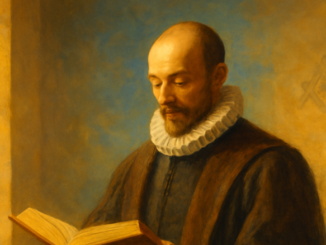
Montaigne on Books: The Philosophical Roots of Essay 2.10
Can anyone speak honestly about themselves without first being honest about their sources? Michel de Montaigne posed that question with striking clarity in the tenth essay of his second book, commonly known as ‘On Books.’ Behind what appears to be a modest self-portrait lies a profound philosophical program. The traditions Montaigne wove together in this essay — from ancient skepticism to Renaissance humanism — form a vision of knowledge that still resonates today in every space where people gather to seek truth together, including the Masonic lodge. Reading as a Philosophical Act Here lies a paradox. In ‘On Books,’ Montaigne insists he is no scholar. He claims his memory is weak and that he reads merely for pleasure. Yet in the very same essay, he demonstrates astonishing erudition and a razor-sharp critical faculty. This apparent contradiction is not carelessness — it is a deliberate philosophical strategy. By foregrounding his own limitations, Montaigne frees himself from the obligation to claim authority. He does not read to prove himself right; he reads to question himself. In doing so, he places the act of reading within a tradition far older than the printing press. Skepticism as Foundation: The Legacy of Sextus Empiricus The […]