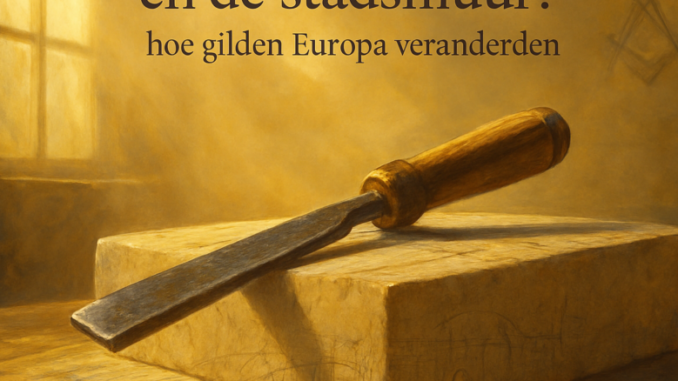
In 1356, the guild movement in the German city of Nuremberg swore an oath that would seal their mutual solidarity for centuries. Among them were stonemasons — the forerunners of what we now know as Freemasons. What bound these craftsmen together was not just their skill with hammer and chisel, but a shared sense of responsibility for the society in which they lived. Their city walls, churches, and bridges were not merely technical constructions; they were expressions of a deeper conviction: those who build in stone also build community.
The Guild as a Social Laboratory for Freemasonry
Medieval guilds were far more than professional associations. They were the first institutions in which craftsmen, independent of nobility or church, developed their own legal systems, mutual care networks, and quality standards. The stonemason guilds — from which the later Masonic lodges would emerge — stood out because of their itinerant nature. While a baker or blacksmith remained tied to one town, the stonemason traveled from cathedral to cathedral, from fortress to city wall. This nomadic existence created a unique culture of knowledge transfer: trade secrets were passed down orally, and symbols served as tokens of recognition between brethren from distant regions.
In the lodges — or building huts — attached to major construction projects, a remarkable hybrid of workshop and school took shape. Young apprentices slept alongside masters, shared meals and rituals. Those who completed their masterpiece were not only called craftsmen but also gained entry into a network that transcended geographic and even linguistic borders. The historian Albert Mackey described how this early form of organization planted the seeds for what would later become operative Freemasonry: a brotherhood founded on mutual trust, professional expertise, and ethical codes of conduct.
From Operative to Speculative: The Freemason as Thinker
Around the beginning of the seventeenth century, a remarkable transformation took place. The great building projects of the Middle Ages were largely complete, and the demand for traveling stonemasons declined. Yet the lodges did not disappear. On the contrary — they opened their doors to men who did not cut stone but shaped ideas. Philosophers, physicians, merchants, and eventually scientists joined the ranks. The tools of the mason became symbols for inner work. The compass no longer stood for setting angles but for maintaining boundaries in one’s own conduct. The square became a measure of just and upright behavior.
The Freemason does not build walls, but the invisible foundations of a just society.
James Anderson codified this transition in 1723 with his Constitutions, marking what we now call speculative Freemasonry. His work, made possible in part by Jean Théophile Desaguliers, established that the brotherhood was open to men of every religious persuasion, provided they acknowledged the existence of a higher order in the universe. This was revolutionary for its time: in a Europe torn apart by religious wars, the lodge offered a neutral space where differences were set aside in favor of shared values.
Social Influence: The Freemason as Bridge Builder
The eighteenth century marked the peak of Freemasonry’s societal influence. Enlightenment thinkers such as Voltaire, Mozart, and Goethe were all initiated members. Their involvement was no coincidence: the lodge provided a platform where radical ideas about tolerance, human rights, and social reform could be discussed without direct censorship from church or state. The brotherhood functioned as a kind of intellectual testing ground, where theories about citizenship and responsibility were measured against the practical realities of communal life.
Across Europe, Freemasons played significant roles in founding societies dedicated to art, science, and charity. In the Netherlands, for example, the Society for Public Welfare (Maatschappij tot Nut van ‘t Algemeen), established in 1784, shared many principles with Freemasonry: public education, moral elevation, and mutual assistance. While not all of its founders were Freemasons, the initiative breathed the same spirit of civic engagement that was cultivated in the lodges.
Lessons from the Past for the Present
What can we learn today from this historical arc? The original stonemason literally built the infrastructure of society. His successor, the speculative Freemason, turned to the moral infrastructure — the unwritten rules of decency, solidarity, and mutual respect that hold a community together. In an age when social division frequently dominates the headlines, this historical example offers an alternative perspective.
Consider what the Masonic tradition still embodies: the lodge as a space where differences are bridged rather than amplified; rituals that do not distract from reality but help us see it more clearly; and a tradition of personal responsibility for the common good. These are not relics of a bygone era — they are principles that remain profoundly relevant.
The medieval guild brother who completed his section of the city wall did not see his work as an individual achievement but as a contribution to something greater. That attitude has not vanished. It lives on in every Freemason who enters the lodge today with the intention of becoming a better person — not for himself alone, but for the world beyond the lodge door.
From stonemason to symbolic thinker, from guild brother to builder of society — the history of Freemasonry is a story of transformation and continuity. The stone walls of old have been replaced by invisible structures of trust and responsibility. Anyone who asks today what a Freemason actually does will find the answer not in secret rituals or hidden signs, but in a centuries-old tradition of building a better society — stone by stone, person by person.
Copyright text & image: devrijmetselaar.nl
Texts are based on the ideas and content of the author of devrijmetselaar.nl, reviewed, corrected, and supplemented with the assistance of OpenAI. Images are created based on the ideas of the author of devrijmetselaar.nl using OpenAI/DALL-E.
Frequently Asked Questions
What was the original connection between medieval stonemason guilds and modern Freemasonry?
Medieval stonemason guilds, particularly those that swore oaths of mutual solidarity in cities like Nuremberg in 1356, were the direct forerunners of modern Freemasonry. These guilds developed their own legal systems, mutual care networks, and quality standards independent of nobility or church. The stonemasons' itinerant nature—traveling between cathedrals and construction projects—created unique knowledge transfer traditions using oral teachings and symbolic recognition. The lodge system, where apprentices trained alongside masters through shared rituals and meals, eventually evolved into the Masonic lodge structure we know today.
How did Freemasonry transform from a craft-based organization to a philosophical one?
Around the seventeenth century, as the great building projects of the Middle Ages were largely completed, the demand for traveling stonemasons declined. However, rather than disappearing, the lodges opened their doors to men who were not stonemasons—including philosophers, physicians, merchants, and scientists. This marked the shift from 'operative' to 'speculative' Freemasonry. The physical tools of masonry became symbols for inner, intellectual work. For example, the compass transformed from a practical instrument for setting angles into a symbol for maintaining ethical boundaries in personal conduct.
What made stonemason guilds unique compared to other medieval craft guilds?
Unlike other medieval craftsmen such as bakers or blacksmiths who remained tied to one town, stonemasons were highly mobile, traveling from cathedral to cathedral and fortress to fortress. This nomadic existence created a distinctive culture of knowledge transfer through oral tradition and symbolic recognition systems that could bridge geographic and linguistic distances. Their itinerant nature and the sophisticated lodge system they developed—where apprentices trained alongside masters in hybrid workshop-schools—made them uniquely positioned to eventually evolve into the networked, knowledge-based organization that Freemasonry became.

Be the first to comment