Symbolic representation of Freemasonry evolving in the 21st century
History

The History of Freemasonry in the 21st Century

The 21st century ushered in an era of globalization, digital transformation, and rapid social change. For Freemasonry — an institution with roots stretching back centuries — this has presented a unique challenge: how to remain relevant in a world that looks vastly different from the one in which it was founded. In this post, we explore how the Craft is blending its time-honored traditions and values with modern technology, greater diversity, and a renewed sense of purpose. Digital Transformation One of the most significant shifts of the 21st century has been the rise of digital communication, and Freemasonry has not been immune to its influence. Lodges around the world now use websites, social media platforms, and email newsletters to share information, promote events, and connect members across geographic boundaries. What once required physical correspondence and word of mouth can now reach thousands with the click of a button. The COVID-19 pandemic accelerated this digital adoption dramatically. When lodges were forced to close their doors, platforms like Zoom and Microsoft Teams became lifelines for fraternal connection. Virtual meetings, educational lectures, and even degree discussions moved online, allowing brothers to stay engaged during an unprecedented period of isolation. Many of these digital […]

Historic Masonic lodge interior representing 20th century Freemasonry
History

The History of Freemasonry in the 20th Century

The 20th century was one of the most turbulent periods in human history — shaped by two devastating world wars, the rise and fall of totalitarian regimes, and sweeping social transformations. Throughout it all, Freemasonry endured as a beacon of stability and idealism. Yet the Craft was far from untouched by these upheavals. It faced persecution, adapted to new realities, and ultimately emerged with its core values intact, ready to carry them into a new millennium. Freemasonry Under Totalitarian Regimes During the interwar years and the Second World War, Masonic lodges across Europe became targets of systematic oppression. Totalitarian regimes — most notably Nazi Germany and Fascist Italy — viewed Freemasonry as a direct threat. The fraternity’s commitment to liberty, equality, and brotherhood stood in stark opposition to authoritarian ideology. Lodges were forcibly closed, their members persecuted, and countless irreplaceable archives were destroyed or confiscated. Despite this relentless campaign of suppression, Freemasonry did not disappear. In several countries, lodges continued to operate underground, preserving their traditions and humanitarian ideals in secret. Their quiet resilience served as a powerful testament to the enduring strength of Masonic principles, offering a spark of hope even in the darkest chapters of the century. Freemasonry […]

Historic Masonic lodge interior representing 19th century Freemasonry
History

The History of Freemasonry in the 19th Century

The 19th century was an era of sweeping transformation. The Industrial Revolution, the rise of nation-states, and the march toward democracy reshaped the world as we know it. Throughout this turbulent period, Freemasonry played a significant role as a community of ideas, social reform, and international cooperation. Freemasonry and the Industrial Revolution As industrialization took hold across Europe and North America, new social classes emerged and the demand for social justice grew louder. Many Masonic lodges found themselves at the forefront of initiatives that championed social reform. Members leveraged their networks to advocate for improved working conditions, expanded access to education, and the establishment of charitable institutions. It was also during this period that women first began to gain a foothold in Freemasonry, albeit often through so-called “adoptive lodges” that operated under the supervision of male Grand Lodges. While inclusivity was slowly increasing, most lodges remained closed to women — a tension that would continue well into the following century. Political Involvement and National Movements The 19th century also witnessed a growing political influence of Freemasonry. In countries like France and Italy, lodges were closely involved in the struggle for national unification and the promotion of republican ideals. Prominent Freemasons […]

18th-century Masonic lodge meeting symbolizing the birth of modern Freemasonry
History

Freemasonry in the 18th Century: From the First Grand Lodge

The 18th century was not only the age of Enlightenment — it was the era in which Freemasonry transformed from a handful of local lodges into a worldwide network with lasting influence on society. This extensively updated article explores how Masonic lodges served as incubators for revolutionary ideas about liberty, equality, and fraternity, and how the Craft shaped some of the most consequential events in modern history. The 1700s were a time of revolution, intellectual awakening, and the rapid spread of ideas about freedom and equality. It was also a pivotal century in the history of Freemasonry. From the founding of the first Grand Lodge to the Craft’s involvement in world-changing political movements, the 18th century established Freemasonry as a powerful force for social and philosophical change. The First Grand Lodge of London (1717) The century opened with a landmark moment for the Craft: the founding of the first Grand Lodge in London in 1717. Four London lodges came together to form a central governing body — an event widely regarded as the official birth of modern Freemasonry. The establishment of the Grand Lodge did far more than create an organizational framework. It introduced a standardized structure of degrees, rituals, […]

Ancient Masonic symbols and mysterious imagery representing alternative Freemasonry history
History

Alternative History of Freemasonry: Myths, Legends & Theories

Freemasonry continues to captivate the imagination with stories of secret origins, hidden symbols, and mysterious connections. From the Knights Templar to the ancient mystery schools of Egypt and Greece, alternative histories of the Craft abound — some grounded in fragments of truth, others rooted firmly in fantasy. In this article, we dive into the most intriguing alternative narratives surrounding the brotherhood, examining the legends, the theories, and what they reveal about our enduring fascination with Freemasonry. For centuries, Freemasonry has inspired both admiration and suspicion. Beyond the well-documented history of operative stonemasons evolving into speculative lodges, there exists a rich tapestry of alternative narratives, conspiracy theories, and legends that offer a very different view of the Craft’s origins and influence. These stories may not always stand up to scholarly scrutiny, but they remain remarkably compelling. A Mysterious Origin Story According to alternative historians, the roots of Freemasonry extend far beyond the medieval stonemason guilds of England and Scotland. One of the most persistent theories draws a direct line between the Craft and the Knights Templar — the powerful medieval military order that was dissolved in the early 14th century. The theory suggests that surviving Templars fled to Scotland and other […]

Historic Masonic lodge interior symbolizing the history of Freemasonry
History

The Official History of Freemasonry: Origins to Today

Freemasonry is an ancient organization steeped in mystery, ritual, and symbolism. What began as a brotherhood of stonemasons in the Middle Ages has evolved into a worldwide community with deep spiritual and philosophical dimensions. This article traces the official history of Freemasonry, from its earliest origins to its present-day form. The Origins of Freemasonry The roots of Freemasonry reach back to the Middle Ages, when stonemasons and master builders organized themselves into guilds. These skilled craftsmen didn’t just construct cathedrals and churches — they also worked according to strict codes of ethics and craftsmanship. The guilds protected their trade secrets through passwords and symbols, which later became core elements of Masonic ritual. During the 17th century, the nature of these organizations began to shift. The guilds started admitting members who had no direct connection to the building trades. This marked the crucial transition from “operative” to “speculative” Freemasonry. The focus moved away from physical construction toward a symbolic quest for wisdom and self-improvement. The Rise of Modern Freemasonry The year 1717 is widely regarded as a turning point in the history of Freemasonry. In London, four lodges came together to form the first Grand Lodge of England. This moment is […]

Historical image representing Freemasonry during the Second World War
History

Freemasonry During the Second World War

The Second World War marked one of the darkest chapters in the long history of Freemasonry. Across Nazi Germany and the occupied territories, Freemasons were systematically targeted, persecuted, and silenced. Yet even in the face of totalitarian oppression, the Craft’s core ideals of liberty, equality, and brotherhood endured — sometimes at extraordinary personal cost. Why the Nazis Targeted Freemasonry Nazi ideology was built on antisemitism, extreme nationalism, and elaborate conspiracy theories. Freemasonry, with its emphasis on universal brotherhood and its tradition of private meetings, became an easy target. The regime falsely portrayed the fraternity as a shadowy network conspiring against the state, lumping it together with Jewish communities and other perceived enemies. In reality, Freemasonry stood for exactly the kind of values — tolerance, free thought, and human dignity — that totalitarian regimes cannot tolerate. The Ban on Freemasonry in Germany and Occupied Territories When Adolf Hitler rose to power in 1933, Freemasonry was swiftly banned throughout Germany. Lodges were forced to close their doors, their assets seized, and their records confiscated. Well-known Masonic symbols such as the Square and Compasses were deliberately distorted in propaganda materials to fuel conspiracy theories and public distrust. As German forces swept across Europe, […]

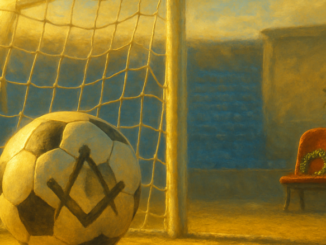
Football hitting the net symbolizing a decisive Masonic moment of meaning
History

The Decisive Moment: Symbolism of the Winning Goal

A ball rolls into the net. A stadium erupts. A name is etched into club history. Then, years later, that same name surfaces again — this time surrounded by silence. The story of a young footballer who scored a decisive goal against a powerhouse and then passed away at the age of twenty-eight raises questions that reach far beyond sport. What remains of a person after they are gone? What is the true value of that single, seemingly fleeting moment when everything comes together? Freemasonry, with its centuries-old contemplation of mortality and meaning, offers a surprisingly illuminating perspective on these questions. The Ball as a Symbol of Fate On the surface, a football is nothing more than an object of leather and air. Yet it carries within it the potential for triumph and defeat, for heroes and forgotten names. In Freemasonry, we are familiar with the concept of working tools that transcend their material form. The gavel, the compasses, the square — they represent inner qualities and life lessons. In much the same way, the ball can be seen as a symbol of fate itself: round, without beginning or end, unpredictable in its movements, yet ultimately subject to the laws […]