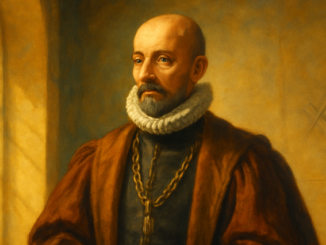
Montaigne on Bias: Philosophical Roots of Masonic Self-Criticism
In his brief but remarkably powerful essay “On a Defective Partiality,” Michel de Montaigne holds up a mirror to one of humanity’s most persistent flaws: the tendency to judge others more harshly than we judge ourselves. This theme did not emerge in a vacuum. It is rooted deep in the classical philosophy that Montaigne studied so voraciously — from the Greek Skeptics to the Roman Stoics, from Plutarch to Seneca. The thinkers who populated his library whispered to him that true wisdom begins with examining one’s own prejudices. For the Freemason who regards himself as a rough ashlar, Montaigne’s essay opens a fascinating window onto a question that lies at the heart of the Craft: how honestly do we really look at ourselves? The World of a Sixteenth-Century Thinker When Montaigne began writing his Essays around 1572, France was torn apart by devastating Wars of Religion. The intellectual world was fractured between the dogmatic certainties of Catholics and Protestants alike. In this climate of violent conviction, Montaigne made a deliberate choice: he embraced doubt as a method. He retreated to his tower study in Bordeaux, surrounded by thousands of quotations from classical authors that he had inscribed on the ceiling […]