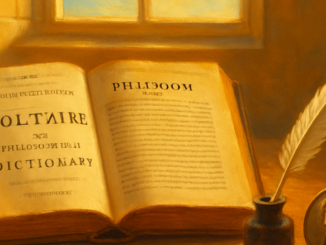
Vrijmetselarij - Voltaire on Freedom: Philosophical Roots of an Enlightened Mind
Symbolism & Rituals

Voltaire on Freedom: Philosophical Roots of an Enlightened Mind

In 1764, François-Marie Arouet — better known as Voltaire — published his Philosophical Dictionary. The entry on freedom quickly became one of the most debated passages in the entire work. But which thinkers and intellectual currents laid the groundwork for Voltaire’s ideas? A journey through the philosophical sources of the Enlightenment reveals surprising connections to the values that Freemasonry continues to cherish to this day. The Legacy of John Locke No philosopher exerted a greater influence on Voltaire’s concept of freedom than John Locke. During his exile in England from 1726 to 1729, Voltaire immersed himself in Locke’s Essay Concerning Human Understanding. Locke’s central thesis — that the human mind is a blank slate at birth — struck Voltaire profoundly. If our ideas are not innate but arise from experience, then our education and environment shape who we become. This insight carried revolutionary implications for the question of freedom. Locke drew a careful distinction between freedom of action and freedom of will. We are free when we can do what we want, but the question of whether we are free to want what we want is fundamentally different. Voltaire wrestled with this paradox and adopted Locke’s nuance. In the Philosophical […]

Vrijmetselarij - De kunst van het luisteren: persoonlijkheid in gepolariseerd debat
Personal Development & Leadership

The Art of Listening: Character in a Polarized World

The lodge rests in half-light. A brother has just shared a viewpoint that stands in direct opposition to what another deeply believes. For a moment, silence hangs heavy, charged with unspoken emotion. Then a calm voice breaks through: “Tell me more about how you arrived at that thought.” In that single sentence lies a world of wisdom that reaches far beyond the walls of the temple — into a society where conversations increasingly fall silent before they have truly begun. When Debate Suffocates A troubling wind is blowing through public discourse. More and more often, disagreements don’t lead to deeper understanding — they lead to silence. The reflex to dismiss an opponent as someone who simply “hates” or “doesn’t get it” has become pervasive. It’s a mechanism that smothers debate before it can even take root. Instead of engaging with arguments, we question motives. Instead of listening, we wait for an opening to interrupt. This phenomenon is hardly new, but it seems to carry particular urgency in our time. When we reduce another person to a caricature of their opinions, we don’t just lose the chance at understanding — we lose a part of ourselves. Because whoever refuses to listen […]