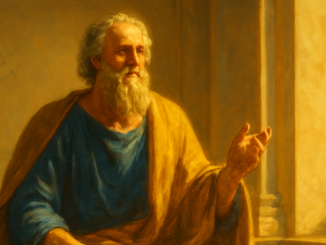
Plato’s Symposium: Philosophical Sources of the Desire for Love
You may have wondered where that deep human urge for connection truly comes from — that pull toward something greater than yourself, toward beauty, toward truth. Plato asked the same question more than two thousand years ago, and his answer in the Symposium has shaped generations of thinkers. But Plato didn’t write in a vacuum. His ideas about love were nourished by a rich philosophical tradition reaching back to the earliest Greek thinkers. Let’s explore the intellectual sources that gave shape to this masterwork — and discover why it resonates so profoundly with the Masonic tradition. The Legacy of the Presocratic Philosophers Before Plato ever put pen to paper, thinkers like Parmenides and Heraclitus had already posed fundamental questions about the nature of reality. Parmenides taught that behind the ever-changing world lies an unchanging truth. This idea echoes powerfully in Plato’s vision of love as a ladder leading upward to the eternal and immutable Beautiful. Heraclitus, by contrast, emphasized the constant flux of existence — the perpetual state of becoming. In the Symposium, both influences are clearly at work: love as a dynamic force that sets us in motion, yet directed toward something that transcends all change. Empedocles, another early […]