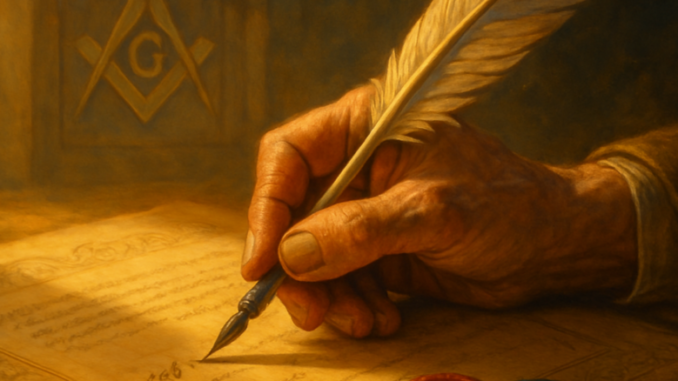
In 1215, an English king pressed his seal onto a document that would curtail his own power. The Magna Carta was not signed out of conviction but under the weight of circumstances that left no alternative. More than eight centuries later, a Hungarian president signed a document sealing his own departure from office. The signature — as a symbol of power, surrender, and transformation — carries a rich history that reaches deep into the traditions of Freemasonry.
The Historic Power of Ink on Parchment
Looking back at medieval traditions, we see that the signature was far more than a formality. Kings and nobles used signet rings to authenticate documents, and the seal itself carried profound symbolic weight. Breaking a seal was an act of dishonor; affixing one was a sacred promise. In the craft guilds from which Freemasonry evolved, the same principle held true: a master who placed his mark upon a finished work bound his honor to its quality.
In this context, the signature represents no simple act of identification. It is a visible trace of an inner state — a moment in which the invisible is made visible. When someone signs, they simultaneously reveal their willingness to bear responsibility for what follows.
The Seal as a Mirror of Character
In Freemasonry, symbolism plays a central role in understanding human action. The square and compasses are not merely tools; they serve as reminders of righteousness and proper boundaries. In a comparable way, the signature functions as a symbol of conscience. To sign is to acknowledge that one’s words and deeds carry consequences reaching far beyond the present moment.
The true test of character lies not in what one promises, but in what one signs when the world is watching.
History offers examples of rulers who refused to sign, even as their downfall approached. Others signed with their heads held high, accepting that their time had come. In the eighteenth century, when Freemasonry flourished across Europe, the ideals of honor and integrity became closely linked to the willingness to be publicly accountable. A signature was not weakness — it was an act of moral courage.
From Medieval Ritual to Modern Meaning
Recent events in Hungary breathe new life into this ancient symbolism. When a high-ranking official signs a document that seals their own resignation, we witness an echo of centuries-old rituals. In the medieval tradition, there existed the carta dimissoria — a letter through which a cleric or nobleman formally relinquished his position. Signing such a document was considered a rite of passage, comparable to the initiation rituals practiced within brotherhoods and fraternal orders.
Freemasonry likewise contains moments of symbolic transition. Upon entering the lodge, the candidate is asked to set aside certain objects representing his former state. This ritual act of divesting creates space for a new phase of existence. In much the same way, signing a resignation can be understood as a threshold moment — not an ending, but a transformation.
The Lesson of the Empty Desk
What can we learn today from these historical parallels? In an era when signatures are often applied digitally and their symbolic weight seems to fade, events like these remind us of the deeper meaning embedded in the act of signing. Every signature we affix — whether on an employment contract, a marriage certificate, or a letter of farewell — carries something of our essence within it.
Consider what the signature represents at its deepest level: a confirmation of personal integrity, a ritual moment of transition, a visible manifestation of the invisible conscience, and — in the case of a cleared desk — a symbol of new possibilities waiting to unfold.
The Freemason is taught to seek a deeper layer in everyday actions. Signing a document is never merely administrative. It is a moment in which past, present, and future converge in a single movement of the hand.
When an Ending Becomes a Beginning
In the history of European monarchies, some sovereigns laid down their crowns with dignity, while others clung to power until the bitter end. The former are generally remembered with far greater respect than the latter. The willingness to sign for one’s own departure demonstrates, paradoxically, a strength that the mere holding of power can never provide.
The rough ashlar that the Freemason works upon is not meant to retain the same form forever. The goal is transformation, growth, and ultimately the willingness to make room for what comes next. In this sense, every signature beneath a document of departure carries within it the promise of renewal — not only for the one who leaves, but for all who remain.
The symbolism of the signature connects us to a long tradition of honor, responsibility, and transition. When we read about a president signing the document of their own departure, we would do well to look beyond the political headlines of the day. What we are witnessing is an ancient ritual of human dignity — the moment when someone acknowledges that their role has been fulfilled and makes space for the next chapter. In that simple movement of pen across paper lies a wisdom that transcends the centuries.
Copyright text & image: devrijmetselaar.nl
Texts are based on the ideas and content of the author of devrijmetselaar.nl, reviewed, corrected, and supplemented with the assistance of OpenAI. Images are created based on the ideas of the author of devrijmetselaar.nl using OpenAI/DALL-E.
Frequently Asked Questions
What is the connection between Freemasonry and the symbolism of signatures?
In Freemasonry, a signature represents far more than identification—it symbolizes conscience, accountability, and moral courage. Just as the square and compasses remind Masons of righteousness and proper boundaries, a signature is a visible trace of an inner commitment to bear responsibility for one's words and deeds. This tradition evolved from medieval craft guilds where masters bound their honor to the quality of their work through their mark or seal.
How do Masonic rituals relate to moments of transition and resignation?
Freemasonry teaches that significant life transitions are sacred moments deserving of ritual and reflection. When a candidate enters the lodge, they divest themselves of objects representing their former state, creating space for transformation. Similarly, signing a resignation document can be understood as a threshold moment—a formal acknowledgment of change that echoes the carta dimissoria of medieval times, when relinquishing a position was considered a rite of passage.
Why did medieval Freemasonry emphasize honor and accountability?
In the eighteenth century, when Freemasonry flourished across Europe, the fraternal order placed great emphasis on integrity and public accountability as cornerstones of character. Masonic teachings held that true moral courage is demonstrated not through avoiding difficult decisions, but through being willing to accept responsibility publicly when the world is watching. This commitment to honor transformed the signature into a sacred act rather than a simple formality.
What does Freemasonry teach about the true test of character?
Freemasonry teaches that the true test of character lies not in what one promises, but in what one is willing to sign when accountability matters most. The craft emphasizes that signatures and seals carry profound symbolic weight—they represent moments where the invisible becomes visible, revealing one's willingness to bear the consequences of one's actions.
How does the seal connect to Masonic principles of integrity?
In Masonic tradition, the seal represents a binding commitment to truth and quality, drawing from the medieval craft guilds where masters authenticated their work through their personal mark. Breaking a seal was considered an act of dishonor, while affixing one was a sacred promise—principles that Freemasonry continues to honor today as symbols of a craftsman's dedication to excellence and moral responsibility.


Be the first to comment