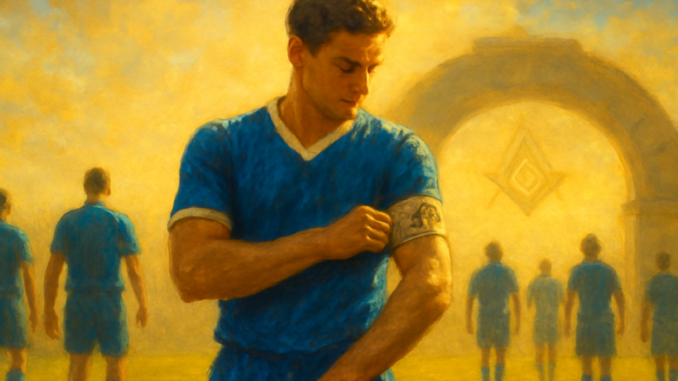
A green pitch, twenty-two players, and somewhere among them a figure who sets the direction. When a nation achieves a historic victory, all eyes turn to the captain — the armband, the gesture toward teammates, the calm gaze amid the chaos. In those moments, an ancient pattern unfolds, one that Freemasons recognize instinctively: the captain as Master Builder, someone who does not merely play but builds something far greater than any individual could alone.
The Armband: A Symbol of Responsibility
Anyone who has watched a football match knows the image of the captain’s armband. A simple strip of fabric, usually in the colors of the nation or the club, worn around the upper arm. At first glance, it seems unremarkable. But look deeper. That band distinguishes one player from the other ten. It is not a decoration — it is a commission. The one who wears it takes responsibility for the whole.
In Freemasonry, we have comparable symbols of responsibility. The apron, worn by every Brother, serves as a reminder of labor and dedication. But the officers of a Lodge wear additional insignia: jewels, collars, specific regalia. These are not status symbols in the worldly sense. They are reminders of the duty to serve, to safeguard the greater whole. Like the armband on the captain’s arm, they are silent promises.
The Rough Stone and the Playing Field
In Masonic symbolism, the rough ashlar occupies a central place. It represents the human being in an unworked state — full of potential but not yet shaped. The Freemason’s task is to work this stone, to chip away at it, to polish it, until it fits into the greater structure. Here the Master Builder emerges as one who not only works on himself but also guides others in their own formation.
On the football pitch, we see the same principle at work. Every team consists of individuals with their own talents and shortcomings. The captain is the one who must forge these different elements into a functioning whole. He must know when a teammate needs encouragement and when correction is called for. He must channel the raw power of some and protect the fine technique of others. In essence, he is a Master Builder of the moment.
Historic Moments and the Timeless Lesson
When a nation achieves a historic sporting victory, history is written. But what makes a moment truly historic? Is it the scoreline alone, or something deeper? In Freemasonry, we learn that history is not simply a sequence of events but a pattern of meanings. Every historic event carries a lesson within it — a symbol that speaks across time.
The true leader does not build his own monument but lays the foundation upon which others can stand.
The ancient Egyptian civilization, one of the cradles of human culture, understood this principle profoundly. The pyramids were not built by pharaohs alone but by the coordinated labor of thousands. Yet every pyramid required a Master Builder — someone who oversaw the whole. This figure worked not only with stones but with people, with dreams, with the invisible threads that bind a community together.
The Gesture Toward a Teammate: Brotherhood in Action
One of the most beautiful moments in sport is the goal scorer’s gesture toward the player who provided the assist. The pointing finger, the embrace, the look of recognition. In those seconds, we witness brotherhood in its purest form. The individual is not the center — the connection is. The goal does not belong to one person; it belongs to the interplay.
In the Lodge, Brethren work together on the symbolic temple. Nobody builds alone. The Entered Apprentice is guided by the Fellowcraft, the Fellowcraft by the Master Mason, and even Master Masons continue to learn from one another. These chains of connection form the backbone of Freemasonry. They remind us that true greatness does not arise in isolation but in community.
The Silence Before the Match: Contemplation and Focus
There is a moment before every great match — a moment of silence. The players stand in formation, the national anthems ring out, and for a brief instant there is nothing but breath and expectation. This moment is remarkably similar to the opening of a Lodge meeting. The world outside is temporarily left behind. The mind turns to what lies ahead. In that stillness, the captain gathers his thoughts, just as the Worshipful Master centers himself before the ritual begins.
These moments of reflection are essential. They remind us of the gravity of what we undertake. Whether it is a match or a ritual, the outcome depends on the intention with which we begin. The captain who consciously inhabits this silence is already building before the first whistle sounds.
From the Pitch to the World: Leadership as a Way of Life
The lessons of the playing field reach far beyond sport. Leadership, as Freemasonry understands it, is not a position but a practice. It is the daily choice to take responsibility, to uplift others, to serve the greater whole above self-interest. The captain who leads his team to a historic victory demonstrates what Master Buildership means in action.
Consider the qualities this demands:
- The courage to stand at the front when things get difficult
- The wisdom to know when to step back
- The humility to share success with everyone
- The strength to rise again after defeat
In these qualities, we recognize the core of what it means to work on oneself in the Masonic tradition. It is not glory that counts but growth. Not only the final result but the path that leads there.
When we witness a historic sporting achievement, we see more than athletic prowess. We see a living symbol of what human cooperation can accomplish when guided by someone who understands the art of building. The captain on the field and the Master Builder in the Lodge share the same ancient calling: to unite individual stones into a temple that transcends them all. It is a reminder that true leadership — whether on grass or on the checkered floor — is ultimately an act of service, of brotherhood, and of quiet, purposeful construction.
Copyright text & image: devrijmetselaar.nl
Texts are based on the ideas and content of the author of devrijmetselaar.nl, reviewed, corrected, and supplemented with the assistance of OpenAI. Images are created based on the ideas of the author of devrijmetselaar.nl using OpenAI/DALL-E.
Frequently Asked Questions
What does the captain's armband have to do with Freemasonry?
In Freemasonry, symbols like the captain's armband represent responsibility and duty to serve the greater whole. Just as the armband distinguishes a captain and reminds them of their obligation to their team, Masonic regalia and insignia serve as silent promises of service and dedication to the Lodge and its members. Both represent not status, but the solemn duty to guide and build something greater than oneself.
How does Freemasonry view leadership?
Freemasonry views leadership through the metaphor of the Master Builder—someone who guides others in their personal development while working on themselves. A true leader does not seek to build his own monument but lays foundations upon which others can stand, recognizing that meaningful achievement comes through coordinating the talents and efforts of many people working toward a common purpose.
What is the meaning of the rough ashlar in Freemasonry?
The rough ashlar represents a human being in their unworked state—full of potential but not yet refined. Freemasons believe in the continuous work of self-improvement and shaping oneself into a valuable member of society, much like a rough stone is chiseled and polished to fit perfectly into a greater structure.
Does Freemasonry teach lessons from history?
Yes, Freemasonry views history not merely as a sequence of events but as a pattern of meaningful lessons and symbols that speak across time. From ancient civilizations like Egypt to modern achievements, Freemasonry teaches that truly historic moments reflect deeper principles about cooperation, duty, and the importance of wise leadership guiding collective effort.

Be the first to comment