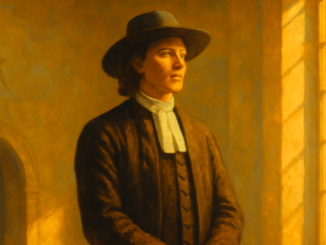
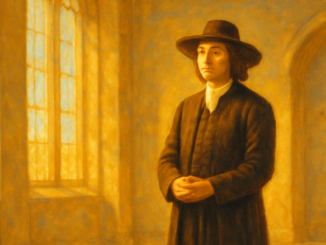
A quiet Quaker meeting house interior symbolizing silence and spiritual reflection
Quakers

The Quakers: Origins and Spiritual Roots for Freemasons

Imagine sitting in a bare room with no priest, no liturgy, no outward display of any kind. You wait in silence until someone is moved to speak — or no one speaks at all, and the silence itself becomes the message. This experience, which has transformed millions of lives across the centuries, began in seventeenth-century England with a shoemaker’s apprentice who refused to remove his hat for any earthly authority. The Society of Friends, known internationally as the Quakers, offers a surprisingly practical approach to spirituality that resonates deeply with Freemasons. A Revolutionary Beginning in Turbulent Times George Fox, born in 1624 in Leicestershire, grew up in an England torn apart by religious disputes and civil war. As a young man, he wandered for years in search of spiritual answers, but no preacher or theologian could satisfy his deepest questions. In 1647, he experienced what he would later describe as a moment of revelation: there existed an inner light in every human being that granted direct access to divine truth — without the mediation of priests or sacraments. This insight was explosive in an era when religious authority was literally a matter of life and death. Fox began to preach […]
Rough ashlar and sculpting tools symbolizing Platonic and Masonic education
Plato – Content & Summary

Plato’s Republic Book III and Freemasonry: Education & Virtue

How do you shape a human being into a virtuous one? This question has occupied philosophers for millennia, and few have explored it as thoroughly as Plato in the third book of The Republic. In this remarkable text, the Athenian thinker presents his vision of education as the key to a just society — a vision that resonates strikingly with the way Freemasonry forms its members. In this article, we bring two worlds into conversation: the classical Athens of Plato and the symbolic workshop of the Masonic lodge. What do they share, and what can we learn from the comparison? The Heart of Book III: Music, Gymnastics, and the Soul In the third book of The Republic, Plato continues his dialogue through Socrates about the ideal state. The central question is how the Guardians — the protectors of the city — should be educated. Plato identifies two pillars: musical training for the soul and gymnastic training for the body. This division is far from arbitrary. The philosopher believes that harmony in the soul must precede harmony in the state. Musical education, in Plato’s framework, encompasses far more than music in the modern sense. It includes poetry, storytelling, and myth. Plato […]

Open copy of Marcus Aurelius Meditations with Masonic square and compasses
Marcus Aurelius – Freemasonry & Connection

Marcus Aurelius on Evil: Book VII Wisdom for Freemasons

A candle flickers as a Freemason sits in silence after the evening’s labor. In his hands rests a worn copy of the Meditations. He reads a passage from Book VII — about people who do harm without realizing it — and recognizes something familiar, something discussed in lodge: how do you respond to injustice without losing your own inner balance? Marcus Aurelius, the Roman emperor-philosopher who lived nearly nineteen centuries ago, turns out to be remarkably relevant for anyone seeking moral clarity. The Heart of Book VII: Justice in the Face of Evil In the seventh book of his Meditations, Marcus Aurelius wrestles with a question that occupies every thoughtful person: how should you respond to those who do wrong? The emperor, who dealt daily with intrigue, betrayal, and human weakness, chose an unexpected path. Rather than anger or retaliation, he advocated understanding. Not because wrongdoing should be condoned, but because anger damages one’s own soul. Marcus Aurelius writes that those who do evil act out of ignorance about what is truly good. This idea, which traces back to Socrates and Plato, forms the backbone of his approach. Evil is not a deliberate choice of wrong over right, but a […]

Marcus Aurelius statue symbolizing Stoic justice and Masonic inner temple
Marcus Aurelius – Content & Summary

Marcus Aurelius Book VII: On Evil and Justice

There may have been a moment in your life when someone wronged you and you felt anger rising like a tide. Or perhaps you recognize those times when your own thoughts tormented you more than the situation itself. Marcus Aurelius, the Roman emperor-philosopher, wrestled with exactly these questions. In Book VII of his Meditations, he examines what evil truly is, how justice guides our actions, and why inner peace never depends on the behavior of others. The Heart of Book VII: What Is True Evil? Marcus Aurelius opens Book VII with a radical proposition: the evil others inflict upon you does not damage your soul. What truly harms you is your own reaction to it. This is a foundational Stoic insight that he returns to again and again. When someone insults you, lies to you, or deceives you, the real danger lies not in the act itself but in how you choose to respond. If you allow yourself to be swept away by anger and resentment, you surrender your power. If you remain aligned with your inner compass, you preserve your freedom. The emperor wrote these reflections as private notes, never intended for publication. That is precisely what makes them […]

The Lost Symbol book with Masonic square and compasses symbolism
Symbolism & Rituals

The Lost Symbol: Dan Brown’s Claims About Masonic Rituals

When Dan Brown’s The Lost Symbol hit bookshelves in 2009, it instantly became a global bestseller — and placed Freemasonry squarely at the center of public conversation. Set against the monumental backdrop of Washington D.C., the thriller painted Masonic rituals as keys to an ancient mystery. But what exactly does Brown claim about these rituals? And how do his assertions hold up against the actual history and practice of Freemasonry? The Central Premise: Freemasonry as Guardian of Ancient Secrets The Lost Symbol presents Freemasonry as the custodian of an ancient mystery — a secret reaching back to the earliest human civilizations. Dan Brown portrays Masonic rituals not as quaint traditions or fraternal ceremonies, but as carriers of hidden knowledge. According to the novel, these symbolic acts contain a deeper truth about the human mind and its untapped potential. Freemasonry doesn’t serve as mere background scenery in the story; it is the engine that drives the entire plot. The rituals function as literal keys to deciphering a great secret concealed within the architecture and geography of the American capital. Brown suggests that Masonic rituals are symbolic echoes of a lost wisdom — one that originated in the ancient mystery schools of […]

Ancient Roman bust of Marcus Aurelius symbolizing Masonic brotherhood and Stoic wisdom
Marcus Aurelius – Freemasonry & Connection

Marcus Aurelius Book VI: Brotherhood as the Art of Living

Have you ever wondered why certain ancient wisdom still strikes such a powerful chord? Nearly two thousand years ago, Marcus Aurelius wrote about the art of living among others, and his words feel as though they could have been penned yesterday. In Book VI of his Meditations, the Roman emperor-philosopher reveals what it truly means to live as a human being among human beings. For Freemasons, these reflections sound remarkably familiar — because the values Marcus Aurelius describes also form the very foundation of the Craft. Humanity as One Body Throughout Book VI, Marcus Aurelius returns again and again to the theme of human interconnectedness. He does not see humanity as a collection of isolated individuals, but as parts of a single great organism. Just as a hand or a foot only finds its purpose as part of the body, so too does a person discover meaning through relationship with others. This is not idle philosophical musing — it is a call to action. When you wake in the morning and feel annoyed at the people you will encounter that day, Marcus Aurelius reminds you that they are your kindred. Not because you share the same blood, but because you […]

Ancient manuscript and magnifying glass symbolizing the Priory of Sion mystery
Symbolism & Rituals

The Priory of Sion in The Da Vinci Code: Fact or Fiction?

You may have read the book or watched the movie: Dan Brown’s The Da Vinci Code spins a breathtaking tale about a secret organization that has supposedly guarded an explosive secret for centuries. The Priory of Sion sits at the very heart of the story. But what exactly does the book claim? And more importantly, how can you, as a critical reader, evaluate such claims for yourself? In this article, we unravel the central assertions of this bestselling novel and give you practical tools to separate fact from fiction. What Does The Da Vinci Code Claim About the Priory of Sion? In The Da Vinci Code, Dan Brown portrays the Priory of Sion as an ancient secret brotherhood dating back to the era of the Crusades. According to the story, this organization was founded to protect an explosive secret: the alleged bloodline of Jesus Christ and Mary Magdalene. The book suggests that famous historical figures such as Leonardo da Vinci, Isaac Newton, and Sandro Botticelli served as Grand Masters of the Priory. Brown presents a fascinating theory within his novel: through secret documents and symbols, the Priory supposedly passed this secret down through the centuries. Artworks, architecture, and hidden codes […]

Ambigram design illustrating the relationship between fiction and Masonic symbolism
Angels & Demons

Ambigrams in Angels & Demons: Fiction vs. Real Symbolism

Imagine a word that reads exactly the same when you flip it upside down — symmetrical, mysterious, and seemingly impossible. In Dan Brown’s bestselling thriller Angels & Demons, these typographic designs called ambigrams play a starring role as alleged secret symbols of an ancient brotherhood. But what does the novel actually claim? And how do those claims hold up against what we genuinely know about symbols, secret societies, and Freemasonry? What Exactly Are Ambigrams? Let’s start at the beginning. The word “ambigram” derives from the Latin ambi (both sides) and gramma (letter). An ambigram is a typographic design that can be read in more than one way — most commonly by rotating it 180 degrees. It is an art form that truly came into its own during the twentieth century, developed by graphic designers and calligraphers experimenting with symmetry and legibility. Here’s the critical question: if ambigrams are a modern invention, how could they possibly be the secret signs of an eighteenth-century secret society? That contradiction takes us straight to the heart of what the novel claims. What Does the Novel Actually Claim? In Angels & Demons, ambigrams are presented as authentic, historical symbols of the Illuminati — the Bavarian […]

Historical illustration representing the founding of the Bavarian Illuminati in 1776
Illuminati

The Bavarian Illuminati: Origins and Spiritual Roots in 1776

On May 1, 1776 — while the American Declaration of Independence was taking shape across the Atlantic — a young professor in the Bavarian city of Ingolstadt founded a society that would captivate the imagination of historians and conspiracy theorists alike for centuries to come. Adam Weishaupt, a professor of canon law and former pupil of the Jesuits, established the Order of the Perfectibilists, later known as the Illuminati. This article examines the historical facts behind this eighteenth-century society and explores the spiritual ideals that connected Weishaupt’s vision to the Freemasonry of his era. The Intellectual Climate of the Late Eighteenth Century To understand the birth of the Bavarian Illuminati, we need to step into the Bavaria of the 1770s. The electorate was governed by a deeply conservative Catholic regime, even as the Enlightenment flourished elsewhere in Europe. Philosophers like Voltaire and Jean-Jacques Rousseau were spreading ideas about reason, natural rights, and religious tolerance. These ideas inevitably reached the university town of Ingolstadt, where the young Weishaupt immersed himself in ancient philosophy and contemporary Enlightenment thinkers. Weishaupt, born in 1748, had been orphaned at the age of five and entrusted by his godfather to the Jesuit order for his education. […]

A closed bridge shrouded in mist symbolizing Masonic self-reflection
Spiritual Traditions

The Closed Bridge as a Mirror for the Soul: A Masonic View

Imagine you’re driving down the highway, heading to a meeting, an appointment, or someone you love. Then a sign appears: the bridge ahead is closed. At least 48 hours. As a precaution. Your plans crumble, frustration rises. But what if this forced stop is more than an inconvenience? What if every blocked road in life is an invitation to turn inward? The Paradox of Precaution as Wisdom The word “precaution” carries a curious duality. On one hand, it implies fear of what lies ahead. On the other, it speaks of prudence — the ability to see beyond immediate utility. The decision to close a bridge is not a sign of weakness but of deeper insight: some structures deserve inspection before they collapse. This principle already echoed through the writings of Marcus Aurelius, who wrote in his Meditations about the importance of self-examination before the soul develops cracks. The Stoic emperors understood that prevention is not cowardice — it is wisdom. The same wisdom runs through Freemasonry, where ritual silence precedes every piece of work. Before the gavel falls, there is reflection. Stillness as a Spiritual Necessity Modern culture has an uneasy relationship with standing still. We are perpetually on the […]

A peaceful Quaker meeting house interior representing silent worship and reflection
Quakers

The Quakers: Origins and History of a Silent Movement

In the middle of the seventeenth century, amid religious turmoil and civil war in England, a movement emerged that was radically different from anything the Christian world had seen before. The Quakers — officially the Religious Society of Friends — rejected church hierarchy, ordained clergy, and even the sacraments. They believed that every human being has direct access to the divine, without the mediation of priests or rituals. This conviction that an inner light serves as the source of spiritual truth raises compelling parallels with other traditions that seek direct experience of the higher self, including Freemasonry. George Fox and the Birth of a Radical Movement The Quaker movement began with George Fox, a shoemaker’s son from Leicestershire who underwent a profound spiritual crisis during the 1640s. He visited countless preachers and churches but found no answers to his existential questions. In 1647, Fox experienced what he later described as a direct revelation: there was one who could speak to his condition — Christ himself — without the mediation of human institutions. This experience became the cornerstone of what would develop into Quaker theology. Fox began travelling across England, proclaiming his message wherever he went. He attracted followers who recognized […]

Mountain glacier reflecting sunlight as a symbol of Masonic self-reflection
Personal Development & Leadership

The Melting Glacier and Your Character: A Masonic Lesson

Picture yourself standing on the flanks of the world’s highest mountain, surrounded by ancient ice and silence. You are not alone. Thousands of climbers have come before you, and each one left something behind — not just footprints, but something far more human: their body heat, their waste, their urine. Recent research has revealed that even these seemingly insignificant acts contribute to the accelerated melting of the glacier. It is a confronting insight that raises a deeper question: what are you leaving behind? Small Actions, Great Consequences Recent studies have shown that the warm urine of climbers on Mount Everest measurably contributes to the melting of the Khumbu Glacier. It sounds almost absurd — how can something as trivial as relieving yourself in the snow affect something as vast as a glacier? Yet this is precisely what happens when thousands of people visit the same place year after year. The sum of all those small actions creates an unintended chain reaction. Freemasons will recognize this principle immediately. In lodge, we constantly speak of building the inner temple, stone by stone. But the same logic works in reverse: every rough stone you leave unworked, every small negligence you ignore, contributes to […]

Rough ashlar stone with gavel and chisel symbolizing Masonic character formation
Personal Development & Leadership

Tragedy and Reflection: On the Forming of Character

Sometimes a news headline stops you in your tracks. A twelve-year-old boy killed under violent circumstances. An adult suspect arrested. You read the words, feel the helplessness, and wonder: how can a human being be capable of such a thing? It is precisely in moments like these that the ancient question of human character forces itself upon us — not as an abstraction, but as an urgent search for understanding. The Unfathomable Human Being When confronted with extreme violence, we instinctively reach for explanations. We want to understand what drives a person, what went wrong in the shaping of a personality. The philosopher Aristotle argued that character is not given at birth but formed through repeated actions. You become what you do, again and again. You do not become virtuous by reading about virtue — you become virtuous by acting virtuously. This insight is as comforting as it is unsettling. It means that every human being has the capacity for growth and improvement. But it also implies that wrong choices, repeated over time, can shape a personality capable of terrible deeds. Freemasonry takes this idea profoundly seriously. The Rough Stone as Metaphor In Freemasonry, the rough ashlar is a central […]

Rough ashlar stone with gavel symbolizing Stoic obstacles in Freemasonry
Marcus Aurelius – Freemasonry & Connection

Marcus Aurelius on Obstacles: Stoic Wisdom for Freemasons

In 172 AD, Emperor Marcus Aurelius sat along the Danube frontier, surrounded by war and personal loss, and wrote some of the most penetrating observations ever recorded about the human capacity to transform adversity. His fifth book of the Meditations contains a core insight that still resonates in Masonic lodges around the world nearly two thousand years later: the obstacle becomes the way. This philosophical legacy connects the ancient Stoic tradition with the ongoing pursuit of moral perfection that lies at the heart of Freemasonry. The Historical Context of Book V Marcus Aurelius never intended his Meditations for publication. They were private notes — a journal of self-examination written during one of the most turbulent periods of his reign. Book V emerged during the Marcomannic Wars, a grueling campaign against Germanic tribes that kept the emperor far from Rome, surrounded by death and hardship. And yet, amid all of it, he turned his gaze inward. He asked himself a deceptively simple question: how do I remain a good man when the world around me descends into chaos? This was no rhetorical exercise. Marcus Aurelius buried children, lost trusted advisors, and watched soldiers fall around him. His own health was failing. […]

Ancient Roman statue of Marcus Aurelius representing Stoic philosophy and wisdom
Marcus Aurelius – Meditations

Marcus Aurelius Book V: The Philosophy of Overcoming Obstacles

When Marcus Aurelius wrote about overcoming obstacles in the fifth book of his Meditations, he drew on a rich philosophical tradition stretching back to the earliest Stoics in ancient Greece. To the modern reader, his words can feel strikingly relevant. To the Freemason, they carry a particular resonance — echoing the ideal of the rough ashlar that must be shaped and polished through sustained inner effort. But how does the outsider’s reading of these texts differ from that of someone steeped in initiatory traditions? This article compares both perspectives and reveals what they share in the search for meaning. The Stoic Roots of Book V Marcus Aurelius never intended his Meditations for publication. They were personal exercises in the art of living — spiritual journal entries composed, most likely, during gruelling military campaigns along the Danube frontier. Book V breathes the spirit of Stoicism as it was founded by Zeno of Citium around 300 BCE. The core idea is straightforward: we cannot control the external world, but we can control how we respond to it. Obstacles are not enemies — they are teachers. This philosophy reached Marcus Aurelius through a chain of thinkers. Cleanthes and Chrysippus refined Zeno’s teachings, but […]

A mirror reflecting a rough ashlar stone symbolizing Masonic self-examination
Spiritual Traditions

Drug Violence and the Weekend Pill: A Spiritual Mirror

A middle-aged man sits at his kitchen table, shaking his head at yet another news report about a drug-related killing. ‘Terrible,’ he mutters over his morning coffee. That same evening, at a party, he accepts a pill from a friend without a second thought. The moment of moral reflection has vanished like mist in the sun. This everyday scene touches on a profound question that philosophers and spiritual traditions have posed for centuries: how can we truly know ourselves — and what do we do with that knowledge? The Modern Moral Contradiction Many Western societies find themselves in a peculiar moral split. On one hand, there is genuine horror at the violence fueled by the drug trade — assassinations, threats against journalists, lawyers murdered in broad daylight. These events shake our collective conscience. On the other hand, recreational drug use is deeply woven into weekend culture. This contradiction raises a fundamental question: how do we relate to our own role in the larger picture? It is easy to point the finger at criminal organizations, at failed policy, at someone else. It is far more difficult to turn the mirror toward ourselves. And it is precisely in that movement — the […]

Compass and square symbolizing philosophy and Freemasonry guidance
Lucius Annaeus Seneca – Freemasonry & Connection

Seneca’s Letter XVI: Philosophy as a Compass for Connection

Imagine waking up in the morning with the day stretching out before you like an unfamiliar road. You have decisions to make, people to meet, perhaps conflicts to resolve. What helps you choose the right direction? For Lucius Annaeus Seneca, the answer was clear: philosophy. In his sixteenth letter to Lucilius, he describes how philosophy is not merely an intellectual pursuit but a practical guide for daily life. This idea resonates deeply with Freemasonry, where brethren likewise seek an inner compass that connects them to themselves and to others. Philosophy as a Daily Companion Seneca writes to his friend Lucilius that philosophy is not a luxury reserved for quiet moments — it is a necessity for every single day. He compares it to a helmsman guiding his ship through rough waters. Without knowledge of the stars and currents, you are at the mercy of the waves. The same holds true for life: without philosophical reflection, you are swept along by impulses, emotions, and external pressures. This idea can be applied directly to your own life. Instead of reaching for your phone first thing in the morning, begin with a moment of silence. Ask yourself: what do I truly want to […]

Rough ashlar stone and chisel symbolizing Masonic self-improvement journey
Personal Development & Leadership

Reckless Actions and the Courage to Admit Your Mistakes

You probably recognize the moment: you say or do something without thinking, and only afterward does it dawn on you how hurtful or inappropriate it was. That painful flash of recognition, followed by the inevitable question — what now? A recent news story about a well-known actor who publicly apologized for mocking a sign language interpreter touches on this deeply universal human theme. The celebrity himself isn’t what matters here. What matters is the question his behavior raises: what does it truly mean to acknowledge your mistakes, and how does doing so shape you into a better person? The Rough Ashlar We All Are In Freemasonry, the rough ashlar plays a central role as a symbol for the individual at the beginning of their inner journey. You enter the lodge as unworked material — full of irregularities, sharp edges, and hidden flaws. The goal is never to deny or conceal these imperfections, but to recognize them and patiently work on them. Every mistake, every thoughtless action, every moment of weakness is like an imperfection in that stone. When someone publicly mocks another person — especially someone performing an essential service for deaf and hard-of-hearing members of the community — it […]

Ancient Stoic philosophy scroll with Masonic square and compasses symbol
Lucius Annaeus Seneca – Content & Summary

Seneca Letter XVI: Philosophy as a Guide for Living

What does it truly mean to practice philosophy? Is it enough to read books and collect wise quotations, or does the love of wisdom demand something far more fundamental? In his sixteenth letter to Lucilius, Lucius Annaeus Seneca explores these questions with the directness and warmth that define his celebrated correspondence. This letter reveals why philosophy cannot remain an intellectual hobby — it must become a compass for daily action. What Is the Central Question of This Letter? Seneca opens with an observation that still resonates nearly two thousand years later: many people claim to be philosophers, yet their lives tell a different story. They can quote Plato and recite the doctrines of the Stoics, but the moment fate tests them, they fall prey to the same fears and desires as everyone else. The central question Seneca poses is therefore not “what do you know?” but “how do you live?” This distinction between knowledge and practice forms the heart of Letter XVI. Seneca argues that philosophy only acquires real value when it shapes character and directs action. A philosopher who fails to embody his own principles is like a physician who cannot heal himself. Philosophy, as Seneca puts it, must […]

Freemason lodge interior symbolizing spiritual homecoming and commitment
Spiritual Traditions

Coming Home as a Spiritual Choice: Lessons from Racing

In a world that glorifies mobility — where success is measured by the next step, the bigger opportunity, or the better offer — the declaration “this is my home” sounds almost rebellious. When a world champion in motorsport chooses to stay where he was shaped, it touches something far deeper than sporting sentiment. It touches an ancient spiritual principle that Freemasons have understood for centuries: the power of conscious commitment. The Historical Roots of Loyalty to a Community The history of Western spirituality is filled with examples of individuals who deliberately chose commitment over unlimited freedom. In the medieval building lodges — the direct predecessors of modern Freemasonry — loyalty to one’s workshop was not a limitation but a prerequisite for growth. A journeyman who drifted from lodge to lodge without ever settling lacked the depth that only sustained commitment can provide. The great cathedrals of Europe were not built by roaming adventurers but by generations of craftsmen who dedicated their entire lives to a single structure. Johann Wolfgang von Goethe, himself a Freemason and author of the celebrated novel about Wilhelm Meister’s formative years, described this principle with eloquence. For Goethe, true freedom was not the ability to go […]