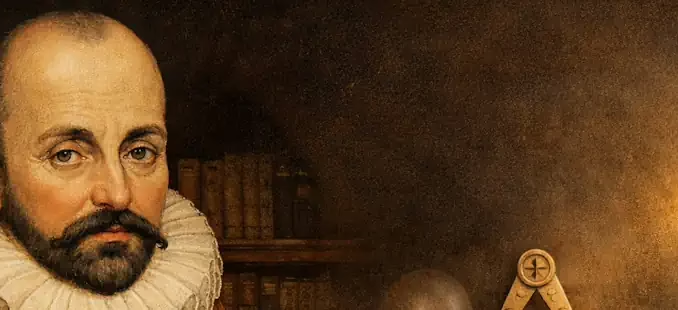
In the opening chapter of his Essays, Michel de Montaigne immediately shows what kind of thinker he is. He offers no rules, no instructions, and no moral conclusions. He observes. He compares. And he invites the reader to think for themselves.
His central idea is simple, yet unsettling: completely different attitudes can sometimes lead to the same outcome. Humility may work. Fearless courage may also work. But just as often, neither does.
With that, Montaigne sets the tone. Anyone looking for fixed answers will not find them here.
No fixed formula for right action
Montaigne describes situations in which people seek mercy from a victor. Sometimes by pleading and submitting. Sometimes by standing firm and refusing to show weakness. At times this evokes compassion. At other times, respect. And sometimes it provokes even greater cruelty.
His point is clear: human behavior cannot be reduced to rules. What moves one person may irritate another. What inspires admiration today may provoke jealousy tomorrow.
For those interested in Freemasonry, this feels familiar. Freemasonry does not promise ready-made answers but teaches how to deal with complexity. Not by judging, but by understanding.
Compassion and admiration
One of the most striking moments is Montaigne’s honesty about himself. He admits that he is personally more easily moved by compassion than by admiration for courage. He presents this neither as a virtue nor as a flaw. It is simply an observation.
In doing so, he reveals something essential: self-knowledge comes before moral conviction.
He contrasts this with the Stoics, who rejected compassion and believed one should help without emotional involvement. Montaigne chooses no side. He observes how differently people respond and how poorly universal moral theories survive contact with reality.
Dignity independent of outcome
In many of Montaigne’s examples, people preserve their dignity even when they lose, suffer, or die. Sometimes this is rewarded. Often it is not.
This is where Montaigne becomes sharpest. The value of courage or dignity does not lie in the result, but in the attitude itself. It is not a strategy to succeed, but a way of being.
This resonates with how many people experience Freemasonry. The work is not about success, recognition, or being right, but about inner consistency. About remaining faithful to oneself, even when it yields nothing.
The unpredictability of human beings
A recurring theme in this chapter is the unpredictability of human nature. The same action can provoke admiration or rage, depending on who is watching, when, and from which emotional state.
Montaigne warns against moral certainty. Good behavior does not guarantee a good outcome. Bad behavior is not always punished. The world does not follow a clean moral logic.
This is not cynicism. It is realism. And it makes his thinking strikingly modern.
Alexander the Great as a turning point
The story of Alexander the Great forms a sharp contrast. Where others are moved by courage, Alexander responds with cruelty. He cannot tolerate an equal. Admiration turns into jealousy and rage.
Montaigne does not explain this. He asks questions. About anger. About power. About the inability to accept limits.
The implicit message is clear: qualities that appear admirable can become dangerous without self-control and self-awareness. Courage without reflection can turn destructive.
What Montaigne ultimately shows
At the end of the chapter, Montaigne remains true to his method. He offers no conclusion. No moral summary.
What he leaves the reader with is attention. To nuance. To contradiction. To the uncertainty of human action.
For those interested in Freemasonry, this is a familiar attitude. Not the pursuit of absolute truths, but of sharper perception. Not the urge to resolve everything, but the ability to live with complexity.
There is no single path that always works.
But every conscious attitude reveals something about who you are.
Copyright text & image: devrijmetselaar.nl
Texts are based on the ideas and content of the author of devrijmetselaar.nl, reviewed, corrected, and supplemented with the assistance of OpenAI. Images are created based on the ideas of the author of devrijmetselaar.nl using OpenAI/DALL-E.

Be the first to comment