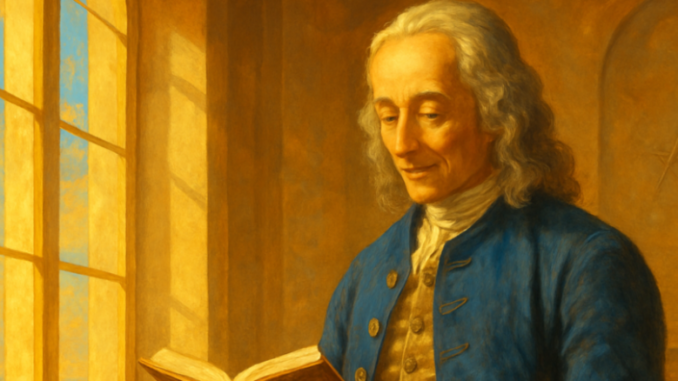
What happens when a philosopher encounters a scientist who changes the world forever? Voltaire posed this question to himself when he wrote about Isaac Newton in his Letters on the English. But why should this matter to a Freemason in 2026? Perhaps because Voltaire’s admiration for Newton illuminates the very values that are cherished in the lodge: the pursuit of light, reverence for truth, and the understanding that knowledge only gains meaning when it is shared.
Why Was Voltaire So Fascinated by Newton?
In the early eighteenth century, Voltaire spent several years in England, where he encountered an intellectual climate radically different from what he had known in France. While the continent was still deeply immersed in the ideas of René Descartes, Newton had already sparked a revolution across the Channel. His laws of gravity and his groundbreaking work on light left a profound impression on Voltaire. Here was a thinker who did not merely speculate — he measured, proved, and demonstrated.
What captivated Voltaire above all was Newton’s method. Newton did not begin with grand theories and then force the facts to fit. He observed, experimented, and let nature speak for itself. For Voltaire, this was a masterclass in intellectual humility: truth cannot be coerced — it must be discovered with patience and honesty.
How Does This Resonate with the Masonic Search for Light?
In Freemasonry, the concept of “light” holds a central place. The initiate is symbolically led from darkness into light — light representing knowledge, insight, and moral illumination. When Voltaire writes about Newton’s unraveling of sunlight into its color spectrum, he touches — perhaps unwittingly — on this very same symbolism. Newton demonstrated that white light is not simple, but a composite whole made up of many colors. Knowledge, the metaphor seems to suggest, consists of many facets that together form something greater.
The search for truth demands the same attitude as Newton’s work: patience, honesty, and the willingness to revise your own assumptions.
For any Freemason, this is deeply familiar. The work on the rough stone is not a single act but an ongoing process of self-examination and refinement. Just as Newton continually tested his theories against reality, the Freemason tests his own conduct and convictions against the moral standards the brotherhood offers him.
Was Newton Himself a Freemason?
This is a question that surfaces regularly, and it deserves careful nuance. There is no conclusive historical evidence that Isaac Newton was a member of a Masonic lodge. What we do know is that he devoted considerable energy to alchemy, biblical chronology, and subjects we might now call “esoteric.” His interests ranged far beyond pure natural science. He searched for hidden patterns, for an underlying order in the universe.
This quest for hidden harmony aligns seamlessly with the Masonic ideal. Whether or not Newton was formally a member, his intellectual disposition bears striking parallels with the Masonic approach: combining reason and intuition, seeking coherence behind appearances, and acknowledging that the greatest mysteries cannot be solved in a single lifetime.
What Does Voltaire’s Admiration Teach Us About Brotherhood?
There is something remarkable in the way Voltaire writes about Newton. He does not place Newton on an unreachable pedestal but presents him as a human being whose work is accessible and worth emulating. Voltaire wanted to spread Newton’s ideas to a broader audience. He saw knowledge not as the property of an elite, but as a gift meant to be shared.
Here we touch on a core value of Freemasonry: brotherhood. Knowledge that remains unshared stays sterile. The lodge is a place where insights are exchanged, where one brother helps another along his path. Voltaire’s effort to make Newton understandable to the layperson reflects the same impulse. Wisdom grows when it circulates.
How Can We Apply This Today?
The world of 2026 is far more complex than that of Voltaire and Newton. Yet the fundamental questions remain the same. How do we distinguish truth from illusion? How do we stay open to new insights without losing our critical faculties? And how do we connect with others in a shared search for meaning?
Cultivate intellectual humility — recognize that your current understanding is incomplete. Share what you learn — knowledge locked away loses its value. Seek connection — truth often unfolds in conversation with others. Stay curious — the light you seek is frequently found where you least expect it.
Voltaire’s Letters on the English and their passages on Newton are more than a historical document. They are an invitation to combine the attitude of the scientist with the inner quest of the Freemason. Both paths require dedication, honesty, and the courage to keep searching for light in the darkness.
In Voltaire’s words about Newton, we recognize a timeless truth that still echoes in every lodge. The pursuit of knowledge is not a solitary endeavor but a path we walk together. Whether we are exploring the laws of nature or the principles of a virtuous life, the light we seek grows brighter when we share it with others. In this way, the spirit of Newton and Voltaire remains alive — not as a museum piece, but as an inspiration for anyone who still asks today: what is truth, and how can I serve it?
Copyright text & image: devrijmetselaar.nl
Texts are based on the ideas and content of the author of devrijmetselaar.nl, reviewed, corrected, and supplemented with the assistance of OpenAI. Images are created based on the ideas of the author of devrijmetselaar.nl using OpenAI/DALL-E.
Frequently Asked Questions
Why was Voltaire so fascinated by Isaac Newton?
Voltaire was captivated by Newton's scientific method during his time in England. What impressed him most was that Newton did not begin with grand theories and force facts to fit them. Instead, Newton observed, experimented, and let nature speak for itself. This approach represented intellectual humility and demonstrated that truth cannot be coerced—it must be discovered with patience and honesty.
How does Newton's work on light relate to Masonic symbolism?
In Freemasonry, 'light' symbolizes knowledge, insight, and moral illumination. Newton's discovery that white light is composed of many colors mirrors the Masonic concept that knowledge has many facets that together form something greater. Both Newton's scientific work and the Masonic journey emphasize the same values: patience, honesty, and the willingness to revise assumptions in pursuit of truth.
Was Isaac Newton himself a Freemason?
This question surfaces regularly and deserves careful nuance. The article indicates there is no definitive evidence presented to confirm Newton's membership in Freemasonry, though the question remains intriguing given the alignment between his scientific method and Masonic principles.

Be the first to comment