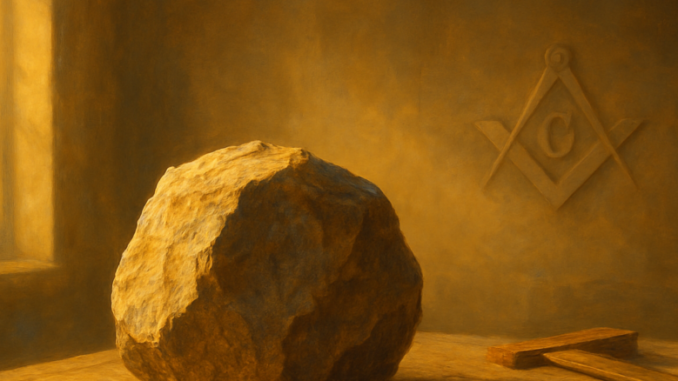
When political negotiations grind to a halt and progress seems like a distant mirage, the instinctive reaction is frustration. We want movement, results, forward momentum. But for those who have learned to look beneath the surface, an apparent impasse can reveal an ancient secret that builders and philosophers have cherished for centuries: stillness as a gateway to genuine transformation.
The Stone That Does Not Move
Picture a rough ashlar. It sits there, unworked, seemingly useless. Days pass, perhaps weeks, and nothing appears to happen. The untrained eye sees only stagnation — an obstacle, raw material that stubbornly refuses to become what it should be. Yet every stonemason knows that this period of rest is far from empty. The stone is being studied, measured, and carefully considered. The craftsman contemplates where the chisel must fall, which forms lie hidden within the rough material.
The same dynamic plays out on the political stage whenever negotiations seem to stall. Commentators see no grand gestures, no breakthroughs, and declare the process broken. But is the absence of visible action truly the same as the absence of meaning? Freemasonry teaches us that the answer is far more complex than it first appears.
Patience as a Spiritual Discipline
In the writings of Meister Eckhart, the medieval mystic whose influence stretched well into the Enlightenment, we find a radical idea: true receptivity only arises when we stop grasping. He called it Gelassenheit — a kind of active letting-go that, paradoxically, is the very precondition for real progress. Spinoza, whose philosophy inspired countless Enlightenment thinkers, similarly emphasized that impulsive action often springs from misunderstood passions, while genuine freedom emerges through insight and reflection.
Spiritual growth does not demand constant motion. It demands the ability to discern when stillness is more fruitful than haste. This discernment lies at the heart of what Freemasons call their inner work. Not every day is spent building. Sometimes the most important task is studying the tracing board, calibrating the tools, and waiting until the light falls just right.
The Temple That Grows in Silence
The construction of King Solomon’s Temple — one of the most central symbols in Freemasonry — took seven years. Seven years in which spectacular progress was not visible every single day. Seven years in which, at times, only the foundations were being strengthened: invisible to the eye but essential to the stability of the whole structure. The legendary master builder Hiram Abiff represents not only supreme craftsmanship in Masonic tradition but also the patience required to complete a masterwork.
Compare this with the modern expectation that political negotiations should move quickly and efficiently. Media outlets record every day without a breakthrough as a failure. But what if that apparent standstill is a necessary phase? What if the negotiators — consciously or not — are applying a wisdom far older than our hurried age? The most enduring structures in human history were never built in haste. They were built with deliberation, with pauses for reflection, and with the understanding that invisible labor often matters most.
Inner Work During the Impasse
For the individual, any kind of external standstill offers a mirror. When the outer world stalls, space opens for inner movement. The Stoic philosopher Epictetus, whose teachings were revived during the Enlightenment, drew a sharp distinction between what lies within our power and what lies beyond it. Budget negotiations and political maneuvering are beyond most citizens’ sphere of influence. But personal spiritual development — the work of refining character and deepening insight — remains always within reach.
The stillness outside invites movement within. Patience is not passivity but an active state of mind. The invisible labor often bears the richest fruit.
In Masonic ritual practice, this principle is constantly embodied. The Entered Apprentice does not learn by endlessly receiving new information. He learns by contemplating the same symbols again and again, each time from a slightly shifted perspective. What first appeared to be a simple square gradually unfolds into an entire universe of meaning. The repetition is not redundancy — it is deepening.
The Distant Goal That Draws Us Forward
When people say a resolution is far away, it is worth reflecting on the curious nature of distance. The stars seem unreachable, yet sailors have navigated by them for millennia. The ideal of a perfect society may be unattainable, yet it has inspired generation after generation to keep building. Johann Wolfgang von Goethe, himself a Freemason, wrote about striving as a life’s purpose in itself — not for the destination, but for the journey.
The spiritual lesson is clear: the distance to a goal says nothing about the value of the pursuit. In fact, it is precisely the distance that shapes the traveler. Every day that a resolution remains out of reach is a day when negotiators can revise their positions, deepen their understanding, and practice the art of listening. Whether they actually do so lies beyond our view. But the possibility is there — like a door that stands always open for those willing to walk through it.
Any impasse — political, personal, or professional — is more than a problem to be solved. It is an invitation to contemplation, a reminder of the ancient wisdom that not all growth is visible, not all movement is progress, and not all stillness is wasted time. The rough ashlar that appears untouched waits patiently for the hand that will shape it. And sometimes, the waiting itself is already the beginning of transformation.
Copyright text & image: devrijmetselaar.nl
Texts are based on the ideas and content of the author of devrijmetselaar.nl, reviewed, corrected, and supplemented with the assistance of OpenAI. Images are created based on the ideas of the author of devrijmetselaar.nl using OpenAI/DALL-E.
Frequently Asked Questions
What does Freemasonry teach about stillness during times of impasse?
Freemasonry teaches that stillness and apparent lack of progress are not signs of failure, but rather gateways to genuine transformation. Using the metaphor of a rough ashlar stone, the craft demonstrates that periods of rest and contemplation are essential for careful consideration and planning before action is taken. This parallels political negotiations where the absence of visible movement does not mean the absence of meaningful progress.
What is Gelassenheit and how does it relate to spiritual progress?
Gelassenheit is a concept from medieval mystic Meister Eckhart meaning 'active letting-go.' It represents a paradoxical spiritual discipline where true receptivity and progress arise only when we stop grasping for immediate results. This idea, which influenced Enlightenment thinkers like Spinoza, teaches that genuine freedom and spiritual growth emerge through insight and reflection rather than impulsive action.
How does the construction of King Solomon's Temple illustrate the value of patience in Masonic practice?
The construction of King Solomon's Temple took seven years, during which spectacular visible progress was not evident every day. Much of the work involved strengthening foundations—invisible to the eye but essential to the structure's integrity. This symbolizes how important inner work and foundational development often occur invisibly, yet are critical to eventual achievement and spiritual growth.


Be the first to comment