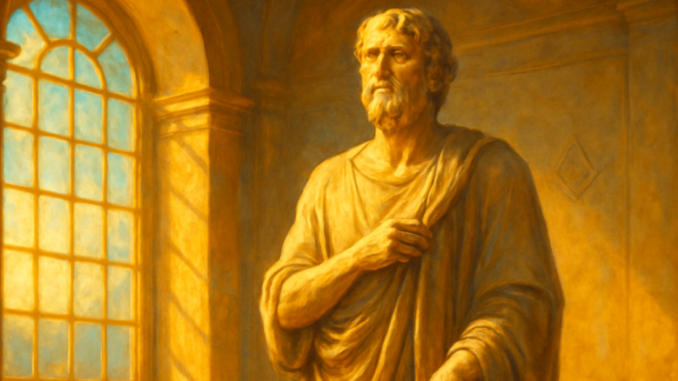
A candle flickers in the early morning light. A Freemason stands before his mirror — not out of vanity, but out of habit. He studies his face, feels the weariness of a short night, and wonders: how much attention does this body actually deserve? Nearly two thousand years ago, Lucius Annaeus Seneca posed precisely this question to his friend Lucilius. The answer he gave touches, with surprising directness, on something brothers in the lodge have always sought: the right balance between the material and the spiritual.
The Paradox of Bodily Care
In his fourteenth letter, Seneca confronts us with an apparent contradiction. On the one hand, we must not neglect the body, for it carries the spirit. On the other, we must not become enslaved to it, for then the servant becomes the master. Seneca writes with his characteristic sobriety: we should treat the body as an instrument, not as an idol. It deserves maintenance, not worship.
This idea was far less self-evident in the Roman world than it might seem today. Gladiatorial games, bathhouse culture, and culinary excess defined the streetscape. Seneca did not oppose bodily pleasure in itself, but rather its tyranny. When the body dictates what the mind must think, the natural order has been reversed. For the Stoic, the principle was clear: the mind governs, the body serves.
The Temple and Its Upkeep
Freemasons are familiar with the image of a person as a rough stone that must be shaped into a perfect ashlar. But there is another symbol that resonates powerfully here: the temple. In Freemasonry, the temple represents the inner sanctuary — the place where light and truth converge. Seneca’s view of the body as an instrument fits seamlessly into this image. The temple must be maintained, not because the building itself is the purpose, but because work is carried out within it.
A neglected temple cannot host meaningful gatherings. A deteriorating body cannot sustain clear thought. Yet a temple valued solely for its facade loses its function as a place of assembly and reflection. This is precisely the balance the Freemason seeks: caring for the material without losing sight of the spiritual.
The body is not a destination — it is a workshop. He who neglects his tools cannot build. He who only polishes his tools builds nothing either.
Brotherhood and Mutual Care
Seneca addressed his letters to one person, but intended them for many. In that spirit of shared wisdom lies a deeper lesson about connection. Care for the body is not merely a private matter. In Freemasonry, brotherhood is not only experienced through ritual, but also through everyday attentiveness to each other’s well-being.
When a brother visibly struggles with his health — whether physical or mental — it is the duty of the lodge to take notice. Not out of intrusion, but from the recognition that no one shapes his stone alone. The chain of brothers is only as strong as its weakest link, and that weakness often manifests first in the body. Fatigue, stress, and self-neglect are signals that deserve to be heard.
Temperance as a Masonic Virtue
In Letter XIV, Seneca argues emphatically for moderation. Not the asceticism of the hermit, not the gluttony of the despot, but the middle path. This principle of temperantia is found in the classical tradition of virtue that Freemasons have long cherished. Alongside prudence, justice, and fortitude, temperance stands as a pillar of a virtuous life.
In the lodge, this temperance is symbolized by the level — the instrument that reveals whether something is in balance. Just as the operative mason checks whether his work is true, the speculative Freemason examines whether his way of life is in equilibrium. Seneca would have recognized this image immediately. The level measures not only stones, but characters.
The Body as a Mirror of Inner Growth
There is a subtler lesson embedded in Seneca’s letter. The way someone treats his body reveals something about his inner life. Excessive attention to appearance may signal inner insecurity. Gross neglect may point to despair or indifference. The Freemason who truly knows himself understands that body and spirit are in constant dialogue.
This does not mean that every pound weighs on the scales of virtue. It does mean that awareness of one’s own body is part of the self-reflection that lies at the heart of Freemasonry. The question Seneca asks is ultimately the same question posed in the silence of the temple: who am I, and how do I relate to that which is greater than myself?
From Seneca to the Present Day
The fourteenth letter remains strikingly relevant in an era of fitness obsession and epidemic burnout. Seneca might have been astonished by LED-lit gyms, but he would not have been surprised by the underlying hunger for balance. His advice remains unchanged: treat the body with respect, but do not make a religion of it. Use it as a tool for higher purposes.
For the Freemason, this translates into something concrete: take good care of yourself so that you can take good care of others. Maintain your temple so that there remains room for light. And when a brother is struggling, be the hand that helps him find his balance again. This is the connection Seneca envisioned — and the one that is still lived out in the lodge today.
Seneca’s fourteenth letter reminds us that the body is neither enemy nor master, but ally. In Freemasonry, this wisdom finds a lasting echo: the temple must be maintained, not out of vanity, but in service of the greater work. Bodily care becomes an act of connection — with yourself, with your brothers, and with the light you seek. The level in hand, Seneca’s letter in mind: this is how the Freemason continues to build his inner temple.
Copyright text & image: devrijmetselaar.nl
Texts are based on the ideas and content of the author of devrijmetselaar.nl, reviewed, corrected, and supplemented with the assistance of OpenAI. Images are created based on the ideas of the author of devrijmetselaar.nl using OpenAI/DALL-E.
Frequently Asked Questions
What is Seneca's main teaching about the relationship between the body and spirit?
Seneca teaches that the body should be treated as an instrument that carries the spirit, not as an idol to be worshipped. The mind should govern while the body serves. We must maintain the body without becoming enslaved to it, avoiding both neglect and excess. This balance between caring for the material and remaining focused on the spiritual is central to his philosophy.
How does the Freemason symbol of the temple relate to Seneca's view of the body?
In Freemasonry, the temple represents the inner sanctuary where light and truth converge. Similarly, Seneca views the body as a workshop or temple that must be maintained to sustain the work happening within it. The body is not valued for its own sake, but as a functional space for meaningful reflection and spiritual work. A neglected temple cannot host meaningful gatherings, just as a deteriorating body cannot sustain clear thought.
Why did Seneca's teaching about bodily care matter in the Roman world?
Seneca's message was particularly radical in Roman society, which was characterized by gladiatorial games, bathhouse excess, and culinary indulgence. Seneca did not oppose bodily pleasure itself, but rather its tyranny—when the body's demands dictate what the mind must think. His teaching offered a corrective to a culture of excess by establishing that the natural order requires the mind to govern and the body to serve.

Be the first to comment