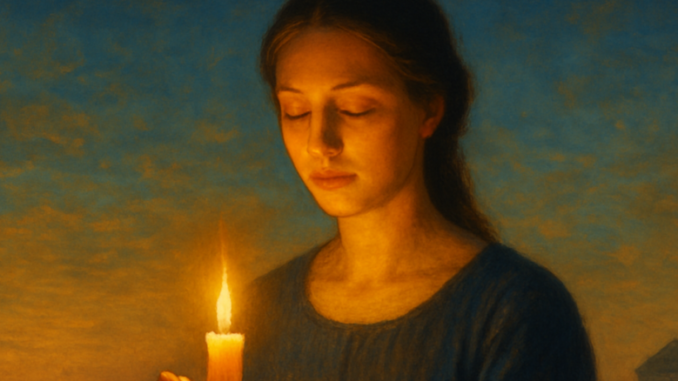
Somewhere in a small town in Georgia, a man stands at his window. The streetlights have gone dark, the refrigerator has fallen silent, and even the distant hum of the highway has ceased. In the sudden stillness, he hears his own breathing, his own thoughts. The entire country is plunged into darkness by a massive power outage. And in that darkness, a question arises — one far older than electricity itself: who am I, really, when no one is watching?
The Mask Falls in the Dark
When the lights go out, masks fall with them. In everyday life, we constantly present curated versions of ourselves. We are the friendly colleague, the patient parent, the competent professional. But what happens when those spotlights are extinguished? The recent nationwide power outage in Georgia offers an unexpected laboratory for a question that Freemasons have explored for centuries: what lies at the core of our character?
In Freemasonry, we speak of working the rough ashlar into a perfect cube. This is not a decorative metaphor — it is a lifelong assignment. The question it poses is not who we appear to be in the company of others, but who we truly are when we stand alone, in the dark, without applause or witnesses. A power outage, in this sense, becomes an unexpected mirror.
Chaos or Calm: The Test of the Unexpected
News reports from the Georgian blackout reveal two distinct types of responses. Some people panic, hoard food, or become aggressive while waiting in line for water. Others light candles, share what they have with neighbors, or remain remarkably calm amid the chaos. This difference is not random. It reveals something essential about a person’s inner architecture.
Freemasonry uses the concept of the inner temple — a metaphor for the mind and spirit we build and maintain throughout our lives. Some have laid solid foundations through self-reflection, discipline, and the cultivation of virtues. Others may have erected only a facade: beautiful on the outside, but hollow within. A crisis like a blackout tests which construction truly stands.
The Dark Chamber as Ritual Space
In many Masonic rituals, darkness plays a crucial role. The candidate entering a lodge for the first time does so blindfolded. This is no theatrical gimmick — it is a deliberate confrontation with the unknown, with one’s own fears and assumptions. Only when the light returns can the candidate see what is truly there, both outside and within themselves.
In darkness, we learn that light does not only come from without — it must also shine from within.
The power outage in Georgia forced millions of people into a comparable experience, albeit involuntarily. For some, it was merely an inconvenience. For others, it may have become a moment of insight: what do I carry within me that does not depend on external circumstances? What inner light can I kindle when every other source has been extinguished?
Character as a Building Project
Freemasonry does not view character as something you simply have or lack. It is a structure that requires active maintenance. Just as a cathedral does not rise in a single day, a strong character develops through years of conscious self-improvement. This includes recognizing your own weaknesses, cultivating courage, compassion, and honesty, and practicing these virtues especially when it is difficult.
The qualities that matter most when the lights go out are precisely those the Masonic tradition seeks to develop:
Self-knowledge — knowing who you are without external validation.
Resilience — standing firm when circumstances turn against you.
Service — helping others even when no one sees it.
Inner peace — finding calm without external distraction.
A blackout reveals how far this inner construction has progressed. Those who panic may discover that certain foundations are still missing. Those who remain calm — and can even support others — experience the fruits of labor previously invested in themselves.
Brotherhood in the Darkness
Among the most striking reports from Georgia are the stories of spontaneous solidarity. Neighbors meeting for the first time by candlelight. Strangers sharing food. Impromptu communities forming around generators or campfires. This echoes a core Masonic principle: brotherhood is not an abstract ideal but a practice that flourishes most powerfully in difficult times.
The true test of character is not how we behave when everything is going well, but how we respond under pressure. Do we become smaller and more selfish, or larger and more generous? The Freemason strives to be the best version of himself in every circumstance — especially the difficult ones. Not for the eyes of others, but as an expression of inner integrity.
Making Light Where There Is None
The power outage in Georgia will pass. Technicians will find the cause, make repairs, and the lights will return. But the question that the darkness poses remains relevant: who are you when everything that normally defines you falls away? Your job, your possessions, your social role, even your digital identity — what remains?
For the Freemason, the answer is not a riddle but an invitation. It is an invitation to begin today — right now — building a character that does not depend on circumstances. A character that creates light where there is none, offers warmth where cold prevails, and radiates stability amid chaos. Not because someone is watching, but because that is who you truly are.
The nationwide power outage in Georgia is more than a technical incident. It is an unexpected invitation to self-reflection — a confrontation with the question of who we are in our most stripped-down state. Freemasonry offers no ready-made answers, but it does provide tools: the discipline of self-examination, the courage to acknowledge weaknesses, and the dedication to build ourselves day by day. So that when the darkness comes — and it always does — we are not left searching for a light switch, but carry the light within us.
Copyright text & image: devrijmetselaar.nl
Texts are based on the ideas and content of the author of devrijmetselaar.nl, reviewed, corrected, and supplemented with the assistance of OpenAI. Images are created based on the ideas of the author of devrijmetselaar.nl using OpenAI/DALL-E.
Frequently Asked Questions
What does Freemasonry mean by 'working the rough ashlar into a perfect cube'?
This is a central metaphor in Freemasonry representing the lifelong journey of self-improvement and character development. It symbolizes the process of refining ourselves—removing rough edges and imperfections—to become our best selves. The work is never truly finished, as it encourages continuous personal growth throughout life.
Why is darkness used in Masonic rituals and initiation ceremonies?
Darkness in Masonic rituals serves as a powerful tool for self-reflection and confrontation with the unknown, helping candidates face their fears and assumptions. When candidates experience blindness during initiation, they learn that true light must come from within themselves, not just from external sources. This practice teaches that understanding and wisdom are internal qualities to be cultivated.
How does Freemasonry define true character?
Freemasonry teaches that true character is revealed not by how we behave when others are watching, but by who we are when no one is observing. It emphasizes building a strong 'inner temple'—a foundation of integrity, discipline, and virtue—that stands firm regardless of external circumstances or crises. This inner strength is what defines authentic character.
What is the 'inner temple' concept in Freemasonry?
The inner temple is a metaphor for the mind and spirit that Masons build and maintain throughout their lives through self-reflection, discipline, and the cultivation of virtues. It represents the difference between appearing good on the surface and actually possessing a solid, authentic foundation of character. This concept teaches that true strength comes from developing our inner spiritual and mental architecture.


Be the first to comment