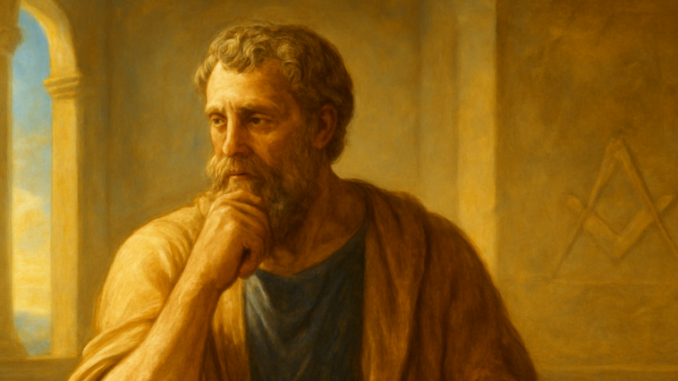
What if the most important virtue lies not in our actions, but in knowing the limits of our own knowledge? In Plato’s early dialogue Charmides, Socrates investigates the concept of sophrosyne — a term usually translated as temperance or moderation, but one that carried far richer meaning in its original Greek context. This exploration of self-knowledge as the foundation of virtue speaks directly to what Freemasons pursue in their labor upon the rough ashlar.
The Athenian Context of Sophrosyne
Plato likely wrote the Charmides around 380 BCE, though the dialogue itself is set in 432 BCE — just before the catastrophic Peloponnesian War. This gap in time is significant. Plato was looking back at an Athens still brimming with confidence, while writing from a city that had suffered the devastating consequences of hybris — of overreach and the failure to recognize limits. The question of sophrosyne was therefore far from academic; it was existential.
Sophrosyne was one of the four cardinal virtues that Greek philosophy would eventually systematize, alongside wisdom, justice, and courage. But while those other virtues seemed relatively straightforward to define, sophrosyne remained elusive. Was it moderation in pleasure? Modesty? Self-discipline? Or something more fundamental altogether?
Socrates and the Method of Not-Knowing
The dialogue follows Socrates’ characteristic method of elenchus — the systematic questioning through which he unravels definitions. Charmides, an attractive young Athenian, is challenged to explain what temperance actually means. He offers several attempts in succession: calmness, modesty, minding one’s own business. Each answer is methodically dismantled by Socrates — not out of cynicism, but to demonstrate how surface-level definitions conceal deeper truths.
What takes place here is not destructive skepticism but rather what later philosophers would recognize as the foundation of epistemic humility. Socrates demonstrates that true wisdom begins with acknowledging the boundaries of one’s own understanding. This resonates powerfully with the Delphic inscription “Know Thyself,” which adorned the Temple of Apollo and which Socrates regarded as his philosophical guiding principle.
Critias and the Paradox of Self-Knowledge
Midway through the dialogue, Critias — Charmides’ uncle, and later one of the infamous Thirty Tyrants of Athens — takes over the conversation. He offers a more sophisticated definition: sophrosyne is knowing yourself, knowing what you know and what you do not know. Socrates seizes upon this to expose a deeper paradox. Can there be a form of knowledge that takes itself as its own object? Can the mind fully comprehend itself?
Temperance, the dialogue suggests, is not about possessing all the answers. It is about recognizing that some questions are larger than the human mind can contain on its own.
This question would continue to occupy Western philosophy for millennia. Aristotle would later connect sophrosyne in his Nicomachean Ethics to the golden mean between extremes. The Stoics — notably Marcus Aurelius and Seneca — would make self-knowledge the cornerstone of their philosophy of life. But it was Plato who laid the groundwork here: the acknowledgment that self-reflection is necessary yet inherently problematic.
Renaissance Humanism and the Rediscovery
When Marsilio Ficino translated Plato’s complete works into Latin in the fifteenth century, the Charmides received fresh attention. The Renaissance humanists recognized in the dialogue an argument for what they considered humanity’s highest calling: the cultivation of the self through study, reflection, and moral discipline. Michel de Montaigne, whose essays are steeped in Socratic self-interrogation, would carry this tradition forward.
The question Plato raises — whether complete self-knowledge is even attainable — remained profoundly relevant. The Renaissance thinkers answered it not with definitive propositions but with an attitude toward life: a perpetual willingness to examine one’s own thinking. In later centuries, this attitude would resonate with Enlightenment ideals and with the emerging tradition of Freemasonry.
Temperance as Masonic Labor
Freemasonry, with its emphasis on working the rough ashlar, places the insights of the Charmides within a ritual context. The Entered Apprentice who steps into the lodge is not expected to possess all the answers — he is expected to learn how to ask the right questions. The square and compasses function as symbols of measure and limitation, as physical translations of what the Greeks understood as sophrosyne.
The dialogue ends without a definitive conclusion — a hallmark of Plato’s early works that some readers find frustrating. But perhaps that is precisely the lesson. Temperance is not a state one achieves and then maintains. It is an ongoing exercise, a daily labor upon the self that is never truly completed. The rough ashlar is never made perfectly smooth, but the work itself shapes the worker.
Influences and Legacy
The intellectual lineage flowing from the Charmides is remarkably rich. Pythagoras and the mystery schools emphasized inner purification as a prerequisite for wisdom. Heraclitus championed self-examination as a path to deeper truth. Xenophon provided parallel accounts of Socratic conversations about virtue. Stoicism became the direct heir of the Socratic self-knowledge tradition. And Neoplatonism, through Plotinus, interpreted self-knowledge as a return to the One.
What the Charmides ultimately presents is a question that every generation must answer anew. Can we truly know ourselves? And if that knowledge remains incomplete, what does that mean for our claims to wisdom, to virtue, to living a good life? The dialogue offers no definitive answer, but it opens a door that can never be closed again.
Plato’s Charmides stands at the beginning of a long tradition of philosophical self-examination that runs through the Stoics, the Renaissance humanists, and the Enlightenment, reaching into the heart of Freemasonry itself. The central paradox — that true temperance requires recognizing the limits of one’s own knowledge — remains a challenge for anyone who seeks to work the rough ashlar. Perhaps the deepest wisdom lies not in finally arriving at an answer, but in the unwavering commitment to keep asking the question.
Copyright text & image: devrijmetselaar.nl
Texts are based on the ideas and content of the author of devrijmetselaar.nl, reviewed, corrected, and supplemented with the assistance of OpenAI. Images are created based on the ideas of the author of devrijmetselaar.nl using OpenAI/DALL-E.
Frequently Asked Questions
What is sophrosyne and why is it important in Plato's Charmides?
Sophrosyne is a Greek term usually translated as temperance or moderation, but it carries richer meaning in its original context. In Plato's dialogue Charmides, Socrates investigates sophrosyne as one of the four cardinal virtues alongside wisdom, justice, and courage. The concept is central to understanding self-knowledge as the foundation of virtue, which Freemasons pursue in their work on the rough ashlar.
Why did Plato write about sophrosyne during the time period he did?
Although Plato likely wrote the Charmides around 380 BCE, the dialogue is set in 432 BCE, just before the Peloponnesian War. Plato was writing from a city that had suffered devastating consequences of hybris—overreach and failure to recognize limits. The question of sophrosyne was therefore existential rather than merely academic, as Athens needed to understand the importance of knowing and respecting boundaries.
What is the Socratic elenchus method and how does it relate to temperance?
The elenchus is Socrates' characteristic method of systematic questioning that unravels definitions. In the Charmides dialogue, Socrates questions Charmides about temperance, dismantling each surface-level definition (calmness, modesty, minding one's own business) to reveal deeper truths. This method demonstrates that true wisdom begins with acknowledging the boundaries of one's own understanding, embodying epistemic humility and the Delphic principle 'Know Thyself.'


Be the first to comment