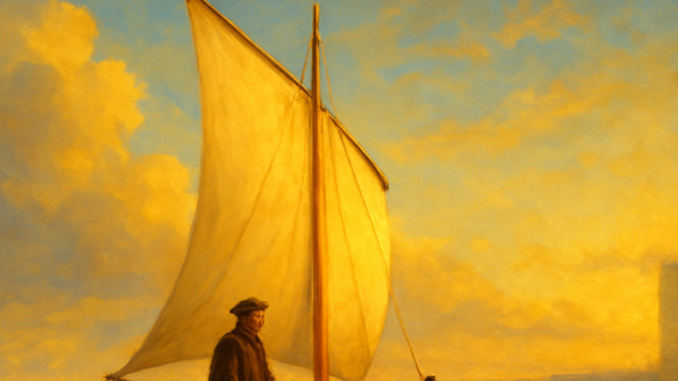
In a dimly lit study, a man bends over a manuscript. Outside the wind howls, and somewhere in the distance an astrologer makes his calculations. The man at the desk smiles, sets his quill to paper, and writes: what can we truly know about tomorrow? Michel de Montaigne — the sixteenth-century philosopher who made himself the subject of his own study — turned his attention in his eleventh essay to a question that has haunted humanity for centuries: the value of predictions.
The Heart of the Essay
In this brief but provocative essay, Montaigne examines the deeply human desire to know the future. He poses a fundamental question: why are we so inclined to place our faith in predictions when the evidence for their reliability is so scarce? At its core, the essay explores the tension between our profound longing for certainty and the inescapable uncertainty of human existence.
Montaigne opens with a characteristically sober observation: throughout the ages, people have devised all manner of methods to peer into the future. From studying the flight of birds to interpreting dreams, from reading entrails to casting astrological charts — every era has had its preferred forms of divination. But what, he wonders, does this actually tell us about our ability to truly know what lies ahead?
Lessons from Antiquity
As was his custom, Montaigne draws liberally from classical sources. He references the Roman practice of consulting oracles and the way military commanders would let critical decisions hinge on the interpretation of omens. A bird flying from left to right could determine the fate of an entire army. An unfavorable sign could delay or even cancel a battle altogether.
Particularly striking is his reference to Cicero, who in De Divinatione had already mounted a sharp critique of the art of divination. Montaigne approvingly quotes the famous question: why can two soothsayers not look at each other without laughing? It is a question that strikes at the very heart of his argument — if the practitioners themselves doubt their own craft, why should we take them seriously?
The Psychology Behind Our Belief
What sets Montaigne apart from simple scoffers is his genuine interest in why people believe in predictions. He acknowledges that the need to know the future is profoundly human. The uncertainty of existence is difficult to bear. A prediction, however dubious, offers an illusion of control in a world that is fundamentally unpredictable.
The future is not something we can seize. It unfolds at its own pace, indifferent to our predictions.
Montaigne also points to the selectivity of human memory. We remember the times a prediction came true but forget the countless occasions when it failed. This confirmation bias explains why the reputations of fortune-tellers remain intact despite their inconsistent track records. It is an observation far ahead of its time — one that modern psychologists still recognize and study today.
The Symbolic Value of Uncertainty in Freemasonry
For those familiar with Freemasonry, Montaigne’s argument resonates in a particularly meaningful way. The Masonic tradition contains a rich symbol that connects directly to this theme: the Mosaic Pavement, the checkered pattern of black and white tiles found on the lodge floor. This symbol represents the eternal alternation of light and darkness, knowledge and ignorance, certainty and doubt.
Like Montaigne, this symbol reminds us that life is made up of opposites we must learn to accept. The white tiles represent what we know; the black tiles represent what remains hidden from us. The pattern teaches us that the two are inseparably linked. There is no light without shadow, no certainty without mystery. The wise Mason, like the wise reader of Montaigne, does not flee from the dark squares but walks across the whole floor with equanimity.
A Lesson for Everyday Life
What can this centuries-old essay teach us in our own time? Montaigne does not advocate cynicism or despair. On the contrary, he invites us to embrace the uncertainty of existence as a given. Rather than squandering our energy on attempts to divine the future, we can direct our attention to the present — to what we can actually influence.
His practical wisdom can be distilled into a few guiding principles: accept that complete knowledge of the future is impossible; examine your own tendency to seek certainty where none exists; cultivate healthy skepticism without falling into cynicism; and focus your attention on the present moment and your own actions.
This attitude is not passivity — it is an active choice for inner freedom. Those who are no longer dependent on predictions, who can bear uncertainty with grace, find a deeper peace. It is the peace of someone who understands that life is not a puzzle to be solved, but a mystery to be lived.
Montaigne’s Enduring Relevance
Although this essay was written over four centuries ago, it has lost none of its power. The astrologers of Montaigne’s day have been replaced by algorithms that claim to predict our behavior, by economists who try to read the markets, and by all manner of experts who speak with certainty about what is to come. The human need for certainty has remained unchanged.
Montaigne’s skepticism is not nihilism. He does not deny that patterns exist or that some predictions come true. But he reminds us that the future is fundamentally open, and that wisdom begins with recognizing the limits of our knowledge. Paradoxically, it is in that recognition that a profound freedom can be found.
Michel de Montaigne holds up a mirror to us in this essay. Who are we, he asks, to think we can seize the future? The question is not meant to discourage us but to invite humility. In accepting the uncertain lies a remarkable form of wisdom — a wisdom that frees us from fear and teaches us to live in the only moment that is truly ours: the present. For Freemasons and seekers of truth alike, this remains one of the most liberating insights philosophy has to offer.
Copyright text & image: devrijmetselaar.nl
Texts are based on the ideas and content of the author of devrijmetselaar.nl, reviewed, corrected, and supplemented with the assistance of OpenAI. Images are created based on the ideas of the author of devrijmetselaar.nl using OpenAI/DALL-E.
Frequently Asked Questions
What is the connection between Montaigne's philosophy and Freemasonry?
Montaigne's emphasis on questioning, self-examination, and intellectual humility aligns closely with Masonic principles of seeking truth and knowledge. Freemasonry values the pursuit of wisdom through careful contemplation and the acknowledgment of human limitations, much like Montaigne's philosophical approach. Many Masonic teachings encourage members to embrace uncertainty as part of their journey toward enlightenment and self-improvement.
How does Freemasonry teach members to deal with uncertainty?
Freemasonry teaches that uncertainty is a natural part of human existence and encourages members to seek wisdom through study, reflection, and brotherhood rather than through false certainties. The fraternity's emphasis on personal growth and moral development helps members find meaning and purpose even in an unpredictable world. By focusing on what they can control—their character and actions—Masons learn to navigate life's uncertainties with integrity and confidence.
Why do Freemasons value critical thinking and skepticism?
Freemasonry encourages members to think critically and question assumptions, much like Montaigne did, rather than blindly accepting claims without evidence. This intellectual approach helps Masons distinguish between superstition and genuine knowledge, strengthening their ability to make sound decisions. The fraternity believes that true wisdom comes from careful reasoning and examination, not from blind faith or unfounded predictions.
How does understanding limitations of knowledge benefit Masonic practice?
By acknowledging the limits of human knowledge, Masons cultivate humility and open-mindedness—core Masonic virtues. This understanding helps members focus on meaningful self-improvement and ethical conduct rather than seeking impossible certainties about the future. Freemasonry teaches that the true path to wisdom lies in honest self-examination and continuous learning, not in pretensions of absolute knowledge.

Be the first to comment