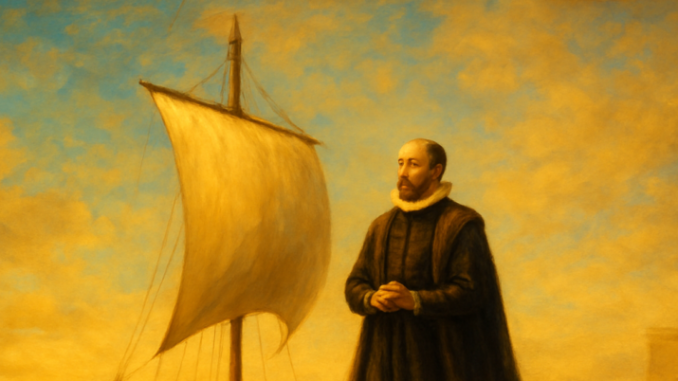
In 1580, Michel de Montaigne published his Essays, a collection of personal reflections that would permanently reshape Western literature. Among them, one essay stands apart for its emotional depth: the twenty-eighth chapter of Book One, devoted entirely to friendship. Far from being an abstract philosophical treatise, this essay is a passionate tribute to Étienne de La Boétie — the friend with whom Montaigne shared a bond he would never again equal. For Freemasons, who regard brotherhood and sincere human connection as cornerstones of their craft, this centuries-old text offers surprisingly relevant wisdom.
The Historical Context of the Essay
Montaigne likely composed this essay around 1572, several years after the death of Étienne de La Boétie in 1563. The two men had met in 1558 at the Parliament of Bordeaux, where both served as councillors. Their friendship lasted only five years, yet its intensity would mark Montaigne for the rest of his life. The essay emerged during one of the most turbulent chapters of French history: the Wars of Religion raged across the country, the St. Bartholomew’s Day Massacre had claimed thousands of lives, and trust between people had been deeply shattered. It was precisely in this context of division and violence that Montaigne chose to write about the healing power of true friendship.
The Central Thesis: Friendship Above All Other Bonds
In his essay, Montaigne draws a sharp distinction between various kinds of human connection. He examines kinship, business relationships, marital love, and erotic attachment, but ultimately places true friendship above them all. While other bonds arise from duty, calculation, or desire, genuine friendship — in Montaigne’s view — springs from a complete merging of two souls. He invokes Aristotle, who declared that friends are one soul inhabiting two bodies. This idea would resonate centuries later within Freemasonry, where brethren aspire to a bond that transcends social distinctions and worldly rank.
True friendship knows no self-interest: it is the meeting of two souls that recognize each other without conditions.
The Famous Quote and the Mystery of Connection
The most celebrated passage in the essay is Montaigne’s answer to the question of why he loved La Boétie so deeply: “Parce que c’était lui, parce que c’était moi” — because it was he, because it was I. With these words, Montaigne expresses that the deepest form of friendship defies rational explanation. No list of virtues or shared interests can justify why two people come to experience each other as indispensable. This mysterious dimension of human connection has fascinated readers for centuries, and it touches upon what Freemasons sometimes call the invisible bond that unites brethren in the lodge — a connection felt rather than explained, recognized rather than constructed.
Classical Examples That Illuminate the Ideal
Montaigne draws liberally from classical sources to support his argument. He references the friendship between Laelius and Scipio Africanus, famously described by Cicero in his dialogue De Amicitia. He also cites the Greek biographer Diogenes Laërtius, along with the legendary pairs Pylades and Orestes, and Damon and Pythias. These classical examples serve not merely as scholarly ornamentation but illustrate a rich historical tradition in which friendship was considered the highest of all human bonds. Montaigne places himself and La Boétie in this illustrious company — not out of vanity, but from a sincere conviction that their bond deserved the comparison.
A Sharp Critique of Superficial Friendships
The essay also contains a pointed analysis of what friendship is not. Montaigne takes aim at the everyday social courtesies that people casually call friendship: polite exchanges, business alliances, social conventions. He labels these connections “communities of mutual advantage” that dissolve the moment the benefit disappears. Against these calculating relationships, he sets the friendship that asks nothing and gives everything. This distinction carries not only philosophical weight but practical relevance: Montaigne warns his readers against using the word friendship carelessly, because doing so drains it of meaning.
Several key principles emerge from his argument:
- True friendship is rare and cannot be forced into existence.
- It demands complete openness and the surrender of self-interest.
- The bond runs deeper than shared activities or common hobbies.
- Authentic friendship transforms both individuals for the better.
The Emptiness After Loss
One of the most moving aspects of the essay is Montaigne’s description of his life after La Boétie’s death. He writes that since losing his friend, everything seems only half of what it once was — that he moves through life as someone who has lost an essential part of himself. These passages display a vulnerability that is rare in sixteenth-century literature. Montaigne feels no shame about his grief; on the contrary, he presents it as proof of the authenticity of their bond. For later generations of Freemasons, this open expression of brotherly love would become a source of inspiration — a reminder that true fraternal feeling is not a sign of weakness, but of depth.
What This Essay Teaches Us Today
More than four hundred and fifty years after its publication, Montaigne’s essay on friendship remains astonishingly current. In an age where social networks promise us hundreds of “friends” and superficial connections have become the norm, Montaigne reminds us of the rarity and value of genuine human connection. His essay is not a how-to guide for making friends; it is a meditation on what it means to be truly known by another person. For Freemasons, who strive in their lodges for a brotherhood that reaches beyond the profane world, this historical document serves as both a mirror and an ideal — a benchmark against which we can measure the depth of our own bonds.
Michel de Montaigne’s essay on friendship is more than a literary monument — it is an invitation to examine our own relationships with honesty and courage. The question Montaigne poses echoes across the centuries and speaks directly to any Freemason who takes brotherhood seriously: Do we truly know someone with whom we share our soul, or do we fill our lives with pleasant but fleeting acquaintances? The answer, as Montaigne would remind us, cannot be manufactured. It can only be recognized — because it was he, because it was I.
Copyright text & image: devrijmetselaar.nl
Texts are based on the ideas and content of the author of devrijmetselaar.nl, reviewed, corrected, and supplemented with the assistance of OpenAI. Images are created based on the ideas of the author of devrijmetselaar.nl using OpenAI/DALL-E.


Be the first to comment