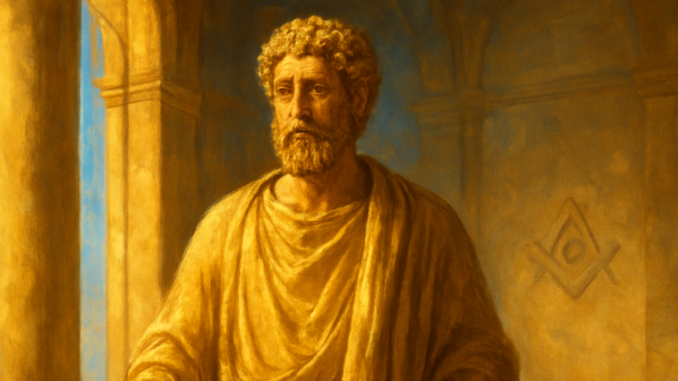
When a Roman emperor sat down by candlelight in the second century AD to record his private thoughts, he produced one of the most influential philosophical texts in Western history. Book VII of Marcus Aurelius’ Meditations tackles a theme that touches every human life: the unpredictability of existence. This essay explores the philosophical traditions that nourished these reflections and reveals a striking parallel with how Freemasonry approaches change, impermanence, and the shaping of character.
The Stoic Legacy: From Zeno to the Imperial Age
Stoicism was born around 300 BC in Athens, where Zeno of Citium taught his students in the Stoa Poikile — the painted colonnade that would give the school its name. The central idea was deceptively simple: while we cannot control external events, we can master our own responses to them. This philosophy was refined by thinkers such as Cleanthes and Chrysippus before reaching its Roman zenith in the works of Seneca, Epictetus, and ultimately Marcus Aurelius himself.
In Book VII of the Meditations, we see Marcus Aurelius wrestling with the very questions that preoccupied his predecessors. The fickleness of fortune — what the Greeks called tyche — is not treated as an enemy but as a teacher. Seneca had already written that adversity reveals a person’s true nature, and Marcus Aurelius built on this insight by arguing that every event, however unwelcome, provides raw material for inner growth.
Heraclitus and the River of Change
One thinker who exerted an especially deep influence on Marcus Aurelius was Heraclitus of Ephesus, the pre-Socratic philosopher best known for his observation that one can never step into the same river twice. This metaphor of perpetual change saturates Book VII. Marcus Aurelius does not merely quote Heraclitus — he transforms those insights into the very foundation of his meditative practice.
Where Heraclitus described the eternal flux of the universe, the Stoic tradition added an ethical dimension. Change is not something to fear or mourn but to accept as part of the cosmic logos — the rational order underlying all things. For Marcus Aurelius, this meant that even the death of loved ones, the loss of power, or the failure of ambition were not causes for despair but invitations to deeper understanding.
Two Perspectives: The Philosopher and the Freemason
How would a Freemason look at these same themes? On the surface, the worlds of imperial Rome and the eighteenth-century lodge room seem far apart. Yet they share a fundamental conviction: that through conscious reflection, a person can shape his own character regardless of fortune’s whims.
The true Mason does not build walls of stone but an inner edifice that stands firm when all outer structures crumble.
In Freemasonry, the rough ashlar that is worked into a perfect cube plays a central symbolic role. This image expresses in visual language exactly what Marcus Aurelius articulated in philosophical terms: the human being as imperfect material that can be transformed through personal effort and wisdom. The mallet and chisel represent the moral labour required to shape one’s own character — independent of external circumstances.
Epictetus: The Slave Who Taught Freedom
Marcus Aurelius was profoundly shaped by the teachings of Epictetus, the former slave whose Enchiridion remains one of the most widely read Stoic texts. Epictetus drew a sharp line between what lies within our power and what does not. Our judgments, impulses, and desires we can govern; health, wealth, and reputation we cannot. This distinction echoes throughout Book VII of the Meditations.
The paradox that a slave taught inner freedom to an emperor who wielded supreme outward power illustrates the very heart of the Stoic message. True sovereignty lies not in ruling others or controlling circumstances but in mastering one’s own mind. This insight resonates powerfully within Freemasonry, where the Master Mason does not rule over others but over himself.
The Roman Context: War and Uncertainty
It is essential to understand the conditions under which Marcus Aurelius wrote. Large portions of the Meditations were composed during military campaigns along the empire’s northern frontiers, amid war, disease, and death. The fickleness of fate was no abstract philosophical concept for him — it was daily reality. Soldiers perished, battles were won and lost, and the Antonine Plague decimated both the army and the civilian population.
In this context, the reflections on fate acquire an urgency that can easily be lost when read in peacetime comfort. Marcus Aurelius did not write for publication; he wrote to survive — to train his mind the way an athlete trains his body. Philosophy was not an intellectual luxury but a spiritual necessity.
What Both Traditions Share
Both Stoic philosophy and Freemasonry acknowledge that outward circumstances are impermanent. Solomon’s Temple was destroyed, empires fell, and even the mightiest emperors turned to dust. Yet this is no cause for nihilism. On the contrary: precisely because everything passes, the present moment gains its value. Precisely because fate is fickle, inner steadfastness becomes precious.
The Stoic practises accepting what comes. The Freemason works his rough stone into something enduring. Both seek a wisdom that holds firm when everything around them changes. Though separated by centuries and expressed through different languages — one philosophical, the other symbolic — these traditions converge on a single, powerful truth: the only fortress that cannot be besieged by fortune is the one built within.
The intellectual legacy of Marcus Aurelius extends far beyond the boundaries of Stoicism. Renaissance humanists such as Erasmus and Montaigne read the Meditations, and their own essays bear unmistakable traces of that reading. The emphasis on self-reflection, on honesty toward oneself, and on the acceptance of human limitation — these are threads that run through Western thought and find a living expression in the Masonic tradition to this day.
Book VII of the Meditations is more than an ancient philosophical text — it is a living conversation with ideas that continue to shape how thoughtful people, Freemasons among them, navigate uncertainty and change. Marcus Aurelius, writing in a military tent two thousand years ago, articulated a vision of inner sovereignty that remains as vital now as it was then. Whether one reaches for the language of the Stoa or the symbols of the lodge, the work is the same: to build within ourselves something that endures when the world around us shifts and crumbles.
Copyright text & image: devrijmetselaar.nl
Texts are based on the ideas and content of the author of devrijmetselaar.nl, reviewed, corrected, and supplemented with the assistance of OpenAI. Images are created based on the ideas of the author of devrijmetselaar.nl using OpenAI/DALL-E.

Be the first to comment