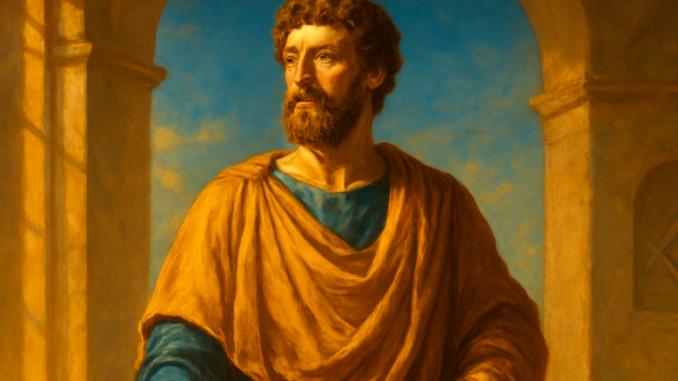
When Marcus Aurelius writes about the acceptance of fate in the tenth book of his Meditations, he draws upon an ancient philosophical tradition that stretches back centuries before his reign. His words are far more than personal reflections — they stand at the crossroads of Greek philosophy, Roman duty ethics, and a cosmic worldview that still resonates today. How does a philosopher approach these texts, and how does a Freemason read them? Both perspectives reveal different layers of the same enduring truth.
The Philosopher’s Perspective: Stoic Foundations
For the academic philosopher, Book X of the Meditations is inseparable from the Stoic school. This philosophical movement, founded by Zeno of Citium at the beginning of the third century BCE, laid the groundwork for everything Marcus Aurelius would write. The Stoics taught that the cosmos is a rationally ordered whole, governed by a divine logos. Within this system, every event has its place and purpose.
Marcus Aurelius built upon the work of his predecessors. Epictetus, the freed slave whose lectures he encountered through his teacher Junius Rusticus, emphasized the crucial distinction between what lies within our power and what does not. Seneca, the Roman statesman and philosopher, had written decades earlier about the art of dying and the value of adversity. Chrysippus, the great systematizer of the early Stoa, had established the logical foundations for the doctrine that fate is not something to be feared, but something to be embraced.
The Freemason’s Perspective: Symbolic Resonance
The Freemason reads the same text with different eyes. Where the philosopher traces systematic influences, the Brother searches for symbolic echoes. The love of fate — the central theme of Book X — finds its equivalent in the ritual acceptance of the trials that the candidate undergoes in the lodge. The rough ashlar that must be shaped into a perfect cube carries the same underlying lesson: it is not our circumstances that determine our worth, but how we respond to them.
The love of fate is not resignation — it is an active embrace of reality as the raw material for inner growth.
The symbolism of the lodge carries traces of the same cosmic order the Stoics described. The Great Architect of the Universe represents, for many Brethren, the same rational ordering that Marcus Aurelius called the logos. The square and compasses serve as reminders of the measurable harmony of the universe — a harmony to which we must align ourselves without surrendering our own responsibility.
Heraclitus and the River of Change
Both perspectives — the philosopher’s and the Freemason’s — find common ground in an even older source: Heraclitus of Ephesus. This pre-Socratic thinker, who lived around 500 BCE, introduced the idea of eternal flux. Everything flows; nothing remains. Marcus Aurelius refers repeatedly in Book X to this ceaseless change, asking how a person can find peace in a world that never stands still.
The answer lies in recognizing that change itself is the constant. The philosopher sees in this a metaphysical principle. The Freemason recognizes the cycle of birth, death, and rebirth symbolized in the rituals. Both readings lead to the same conclusion: resistance to the inevitable is not only futile but harmful to the soul.
The Roman Context: Duty and Cosmopolitanism
Marcus Aurelius was not only a philosopher — he was also an emperor. This fact colors Book X in fundamental ways. The Stoic doctrine of the cosmopolis, the world-city in which all people are citizens, took on a practical dimension in his hands. His love of fate was not an escape from the world but a way of bearing the immense burdens of imperial rule.
Each of his philosophical forerunners contributed essential tools. Epictetus provided the psychological instruments: focus on what you can control. Seneca offered consolation in times of loss and hardship. Heraclitus supplied the cosmic framework of eternal change. And Plato’s theory of Forms resonated in the Stoic conception of a rational world order. Together, these influences formed the intellectual bedrock upon which Marcus Aurelius constructed his deeply personal philosophy.
Where Philosophy and Freemasonry Meet
The philosopher and the Freemason approach the text of Marcus Aurelius from different traditions, yet they meet in the essence. Both acknowledge that the love of fate does not mean passivity. It is not about uncritically accepting injustice or suffering, but about discerning what truly lies within our sphere of influence. The Freemason calls this working on one’s own stone; the philosopher speaks of cultivating virtue.
Plutarch, the Greek biographer and philosopher, wrote about the lives of great men and asked what shaped them. He would surely have seen in Marcus Aurelius an embodiment of the synthesis between thinking and acting. The Meditations are not abstract treatises — they are personal exercises, written in a tent during military campaigns, by candlelight after exhausting days of governance.
A Legacy That Endures
The philosophical background of Book X reveals a richness that extends far beyond historical curiosity. The questions Marcus Aurelius posed are the same questions that still echo in the silence of the lodge and in the lecture hall alike. How do we find inner peace in a world of uncertainty? How do we remain true to our principles when fate puts us to the test?
The answers the Stoics formulated — and that Marcus Aurelius distilled in his tenth book — remain relevant because they do not depend on specific circumstances. They speak to the human condition itself. Whether one reads these words as a philosopher, as a Freemason, or simply as a seeker of wisdom, the invitation remains the same: embrace fate not in spite of its unpredictability, but because of it. Therein lies true freedom.
The love of fate, as Marcus Aurelius understood it, is neither blind submission nor stoic indifference. It is a deliberate, courageous act — a conscious choice to meet life’s challenges as opportunities for growth. For the philosopher, this is the pinnacle of Stoic virtue. For the Freemason, it is the heart of the Craft: the ongoing, never-finished work of shaping the self. Both paths lead, ultimately, to the same light.
Copyright text & image: devrijmetselaar.nl
Texts are based on the ideas and content of the author of devrijmetselaar.nl, reviewed, corrected, and supplemented with the assistance of OpenAI. Images are created based on the ideas of the author of devrijmetselaar.nl using OpenAI/DALL-E.

Be the first to comment